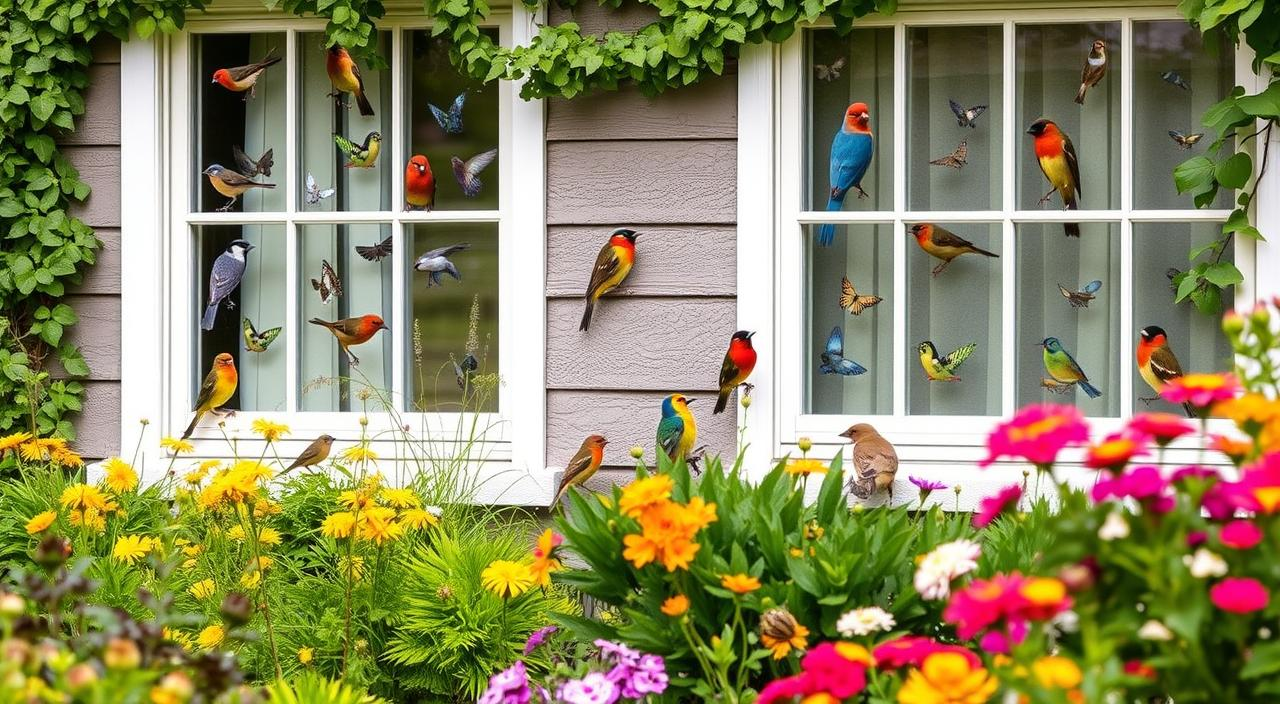
Clear glass can look like open sky, a leafy reflection, or a “fly-through” route to a bird.
The good news: you can reduce collisions dramatically with a few practical changes—many of them cheap, fast, and renter-friendly.
Add screens where possible, adjust feeder placement, and reduce night lighting during migration. [1]
Quick-start checklist (do this first)
If you want the biggest reduction in the shortest time, start here:
- Mark the outside of the glass with a consistent pattern (not a single sticker) using the 2×4 spacing rule. [1]
- Use screens where you can: exterior insect screens or solar screens reduce reflections and add a buffer. [1]
- Move feeders/baths to safer distances: either very close (to reduce impact speed) or farther away from high-risk glass. [1]
- Reduce night lighting during peak migration and on foggy/overcast nights when disorientation risk is higher. [1]
Tip: Fix the windows that reflect trees/sky first. Those panes are often the highest-collision panels.
Why birds hit windows
Birds don’t “see” glass the way we do. In many situations, a window reads as real habitat (reflection) or an open passage (see-through).
Collisions are common at homes and low-rise buildings—especially where vegetation is reflected or visible through glass. [1]
1) Reflection confusion
If your window reflects trees, shrubs, or open sky, a bird may aim straight at that reflection because it looks like real habitat.
2) The “see-through” effect
Corner windows, glass railings, and opposite-facing windows can create the illusion of a clear flight path through your home, porch, or sunroom.
3) Night lighting and disorientation
Artificial lights at night can draw birds into built areas or disrupt orientation, increasing the chance they encounter glass. [1]
How to identify high-risk windows at home
Do this 10-minute risk audit to identify which windows deserve your first fixes.
Step A: The reflection test
- Stand outside at different times of day.
- Look for strong reflections of vegetation or sky.
- If you see “a perfect tree” in the glass, treat that pane as high risk.
Step B: The fly-through test
- Check if habitat is visible through glass (e.g., a garden seen through a glass door + opposite window).
- Corner windows and aligned glass doors are common fly-through traps.
Step C: The bird-traffic test
- Any pane near a feeder, bird bath, or favorite perch deserves extra attention.
- If you ever find feather marks or hear repeated “thumps,” prioritize that window immediately.
Best fixes ranked by effectiveness
The core principle is simple: make glass readable as a solid barrier.
In general, exterior solutions outperform interior ones because they directly reduce reflections. [1]
| Fix | Best for | DIY? | Impact on view | Notes |
|---|---|---|---|---|
| Exterior screens / solar screens | Large reflective windows, sliding doors | Sometimes | Low–Medium | Reduces reflection and adds a small “buffer.” [1] |
| Exterior pattern (film/markers/tape/paint) | Most home windows | Yes | Low–Medium | Works best when applied outside and spaced correctly. [1] |
| Hanging cords (“curtain” lines) | Picture windows, rentals | Yes | Low | Creates a visible barrier in front of the glass (must keep spacing consistent). |
| Feeder/bath placement changes | Windows near bird activity | Yes | None | Use the “very close or far away” guideline. [1] |
| Interior decals only | When you can’t treat the outside | Yes | Low | Can help, but may be weaker if outside reflections remain strong. [1] |
The 2×4 spacing rule (simple and critical)
A few decals usually fail because birds try to fly around them. What works is a consistent pattern.
A widely used guideline is the 2×4 rule: keep gaps no more than
2 inches apart vertically (between horizontal elements) or 4 inches apart horizontally (between vertical elements). [1]
- Horizontal stripes: place them 2 inches apart (vertical spacing).
- Vertical strips/cords: place them 4 inches apart (horizontal spacing).
DIY window collision prevention (step-by-step)
These methods are popular because they’re cheap, quick, and proven in real homes—especially when applied on the outside of the glass. [1]
Option 1: Painter’s tape pattern (fast + removable)
- Clean the outside of the glass so tape adheres.
- Apply vertical strips spaced 4 inches apart, or horizontal strips spaced 2 inches apart.
- Press edges firmly to reduce peeling in rain.
- Replace any loose sections so gaps don’t widen.
Option 2: Tempera paint or soap pattern (cheap + highly visible)
- Use white tempera paint (or bar soap for a temporary pattern).
- Create dots/lines across the whole pane following the 2×4 rule.
- Don’t leave big unmarked “runways” in the center.
Option 3: Hanging cord “curtain” (renter-friendly)
- Mount a thin rod or outdoor hooks above the window frame.
- Hang cords in front of the glass, spaced about 4 inches apart.
- Keep cords taut so wind doesn’t bunch them into wider gaps.
Option 4: Exterior netting or screens (high protection)
Netting/screens installed a short distance in front of the window can reduce reflection and provide a safer “bounce-back” surface.
Standard insect screens can help when kept in place. [1]
Night lighting and migration: reduce “lights-out” risk
Reduce unnecessary outdoor lighting at night—especially during spring and fall migration, and on foggy/overcast nights. [1]
- Turn off decorative exterior lights overnight.
- Use motion sensors or timers where you need safety lighting.
- Close blinds on brightly lit rooms facing large glass panels.
Feeder placement and landscaping to reduce strikes
Feeders and baths increase bird traffic, so placement matters. A common guideline is to place them either
very close to the window (reducing impact speed) or farther away from the danger zone. [1]
- Very close: within about 3 feet of the window. [1]
- Far away: beyond about 30 feet when possible. [1]
- If a window is highly reflective, treat the glass even if you move feeders.
Landscaping tweaks (supporting steps)
- Add shrubs or trellises to “soften” large glass surfaces (but don’t rely on landscaping alone).
- Avoid positioning indoor plants where they look like outdoor habitat through glass.
- If a window reflects a favorite perch, treat the glass directly.
What to do if a bird hits your window
(Avoid giving food or water—handling can worsen stress or injury.) [1]
If the bird is stunned but alive
- Keep pets and people away.
- Gently place the bird in a small ventilated box lined with a towel (darkness helps calm it).
- Place the box somewhere quiet, warm, and dark.
- After a short rest, if the bird is alert and flies strongly, release it outdoors. [1]
Get help immediately if you see
- Bleeding, drooping wing, obvious fractures, labored breathing
- Inability to stand/perch, or no improvement after rest
- Repeated collisions at the same window (treat glass urgently)
If you’re unsure, it’s safer to call a wildlife rehabilitator for advice rather than attempting extended care yourself. [1]
Maintenance and seasonal plan
Weekly (5 minutes)
- Check that tape/cord spacing hasn’t shifted into large gaps.
- Clean treated surfaces so patterns remain visible.
During spring and fall migration
- Add temporary markings to any untreated high-reflection panes.
- Be stricter about night lighting (especially in fog/low cloud).
Common mistakes that reduce effectiveness
- Using one decal (birds fly around it).
- Putting deterrents inside while reflections remain strong outside.
- Leaving a large untreated “runway” in the center of the pane.
FAQ
What is the best window collision prevention method?
Usually an exterior fix: screens or a consistent outside pattern that breaks up reflections across the entire pane.
Exterior solutions generally outperform interior-only options. [1]
Do bird silhouette stickers work?
One silhouette is often not enough. Birds tend to fly around isolated decals.
A consistent pattern using the 2×4 rule across the whole window works better. [1]
Should I put deterrents inside or outside the window?
Outside is usually more effective because it directly reduces reflections.
Inside options can help when outside isn’t possible, but they can be weaker if reflections remain. [1]
Where should I place bird feeders to prevent window strikes?
A common guideline is either within about 3 feet of a treated window (reducing impact speed) or beyond about 30 feet.
If a window is highly reflective, treat the glass regardless. [1]
Why do collisions get worse in spring and fall?
Migration increases bird movement through unfamiliar areas, and night lighting can increase risky approaches to buildings.
Temporary seasonal markings can help during peak weeks. [1]