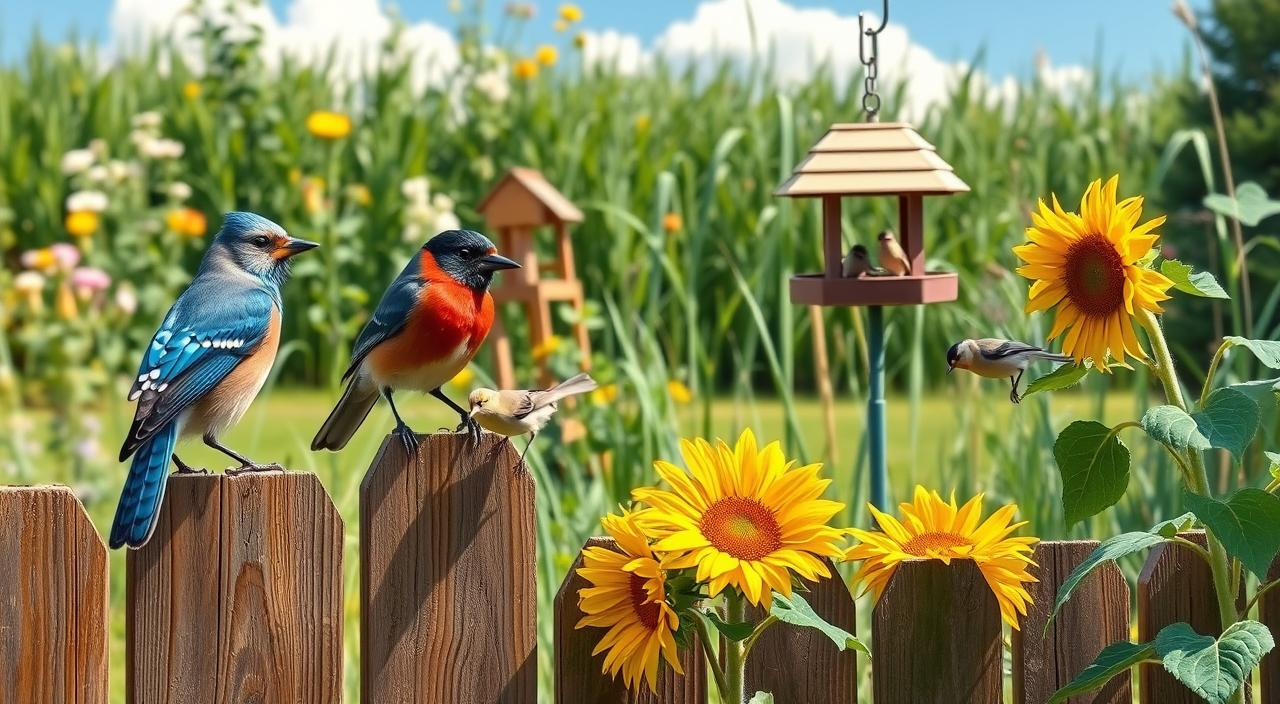
The first bird I ever really watched — not glanced at, actually watched — was a Black-capped Chickadee on a cold February morning. I had terrible department-store binoculars, the kind that make everything look like you’re peering through a kaleidoscope. I tracked it anyway for about four minutes. I saw it pick a single sunflower seed from the feeder, fly exactly eight feet to a branch, pin the seed under one foot, and hammer it open. It ate, returned, picked another seed, went back to the same branch. Same routine, over and over.
I’ve never forgotten that bird. Not because chickadees are rare or remarkable — they’re one of the most common birds in North America — but because four uninterrupted minutes of watching produced something that a hundred quick glances never had: the feeling of actually understanding what I was seeing. That moment is what this guide is trying to get you to.
Everything here is built around your backyard. The birds at your feeder, your fence line, your birdbath — those are not a consolation prize until you can get somewhere “real.” Most of the perceptual skills that make someone a genuinely confident birder were built exactly there: at a feeder, on a porch, watching the same birds show up reliably, day after day, in all weathers, until the patterns became automatic. Your yard is the classroom. You just need to know what questions to ask while the bird is still in front of you.
⚡ Before you reach for the app — ask these four questions while the bird is still there:
- How big is it? Sparrow-sized, robin-sized, or crow-sized?
- Where exactly is it? Ground, feeder tube, tree trunk, or perched somewhere scanning the grass below?
- What’s the one thing that stands out? A crest, a mask, wing bars, a bright chest — one feature that’s obviously different from everything else you’ve been seeing.
- What is it actually doing? How a bird moves often identifies it faster than any marking.
This sequence is adapted from Cornell Lab’s four keys to bird identification: Size & Shape, Color Pattern, Behavior, and Habitat. Learn the method. The species names follow naturally.
The Beginner Bird ID Method — Step by Step
Here’s the thing that slows down almost every beginner: the app opens first. You see something, your instinct is to identify it immediately, and by the time Merlin has loaded, the bird is gone. You’re left trying to match a blurry memory to a thumbnail. This is nearly universal in the early stages, and there’s an easy fix — but it requires a mental shift that feels slightly counterintuitive until it becomes automatic.
Observe first. Identify second. Keep your eyes on the bird — or your binoculars up — while you work through this sequence. Five seconds of real observation beats thirty seconds of searching a field guide from memory.
Step 1: Size and Silhouette — Before You Notice Anything Else
The first question isn’t “what color is it?” It’s “how big is it, and what shape?” Three mental anchors cover the vast majority of backyard birds:
- Sparrow-sized: small, quick, compact — fits comfortably in a cupped hand
- Robin-sized: medium, longer body — roughly the size of a mango
- Crow-sized: large, heavy-looking, slow wingbeats, broad profile
Then look at the silhouette before you process color. Long tail or short? Chunky body or slim? Large head or small? Thick bill or thin? A bird with a heavy, conical bill is almost certainly a seed-eater. A bird with a slim, slightly drooped bill is probably hunting insects. The silhouette tells you what the bird eats and how it lives — information you can read in about two seconds before the bird moves.
Step 2: Where Is It? The Yard Zones Method
Birds aren’t scattered randomly across your yard. Each species uses a specific zone, and knowing which zone you’re watching immediately narrows your options — sometimes down to two or three candidates before you’ve looked at a single marking.
- Ground scratchers — moving through leaf litter or bare lawn: sparrows, juncos, towhees, doves. If it’s kicking up debris with both feet simultaneously in a backward hop, it’s almost certainly a towhee or a White-throated Sparrow.
- Feeder clingers — hanging sideways or upside-down on a tube feeder: chickadees, finches, nuthatches. The ones that hang upside-down without apparent effort are usually chickadees or titmice.
- Trunk climbers — moving up or down tree bark: woodpeckers and nuthatches. A bird moving headfirst down the trunk is specifically a nuthatch — almost nothing else does this. That single behavior gets you to a genus before you’ve seen a color.
- Perch-and-pounce hunters — sitting motionless on a wire or post, then dropping straight down: robins, bluebirds, flycatchers. The long stillness before the drop is the tell.
- Canopy foragers — working through treetops and outer branches: jays, orioles, warblers in migration, crows.
A bird working its way headfirst down a tree trunk is almost certainly a White-breasted Nuthatch. You haven’t looked at a single color. You’re already at a species. That’s what the yard-zones approach does — it turns location into information.
Step 3: One Bold Field Mark — Not the Whole Bird at Once
Experienced birders don’t take a comprehensive color inventory. They look for the one feature that stands out and that almost no other bird in the yard shares. The field marks most worth learning first:
- Crest — a raised, pointed crest means Blue Jay or Northern Cardinal. No crest means bluebird, robin, or finch.
- Mask — a dark eye mask on a mid-sized gray bird usually means Northern Mockingbird or, if the bird looks heavier and less active, a Loggerhead Shrike.
- Bib — a black patch on the throat and chest of a tiny bird is the Black-capped Chickadee field mark. Nothing else common at a feeder shares that combination at that size.
- Wing bars — one or two pale stripes across the folded wing suggest a finch, warbler, or vireo, depending on size.
- Breast pattern — spotted breast on a medium-sized bird means thrush (Hermit, Swainson’s, Wood). Streaked breast on a small brown bird means sparrow or female finch.
The goal at this step isn’t to describe the entire bird. It’s to find the one feature that makes this bird different from everything you’ve seen at the feeder all week.
Step 4: Watch What It Does — Behavior Often Clinches the ID
Birds don’t just look distinct — they have entirely distinct ways of moving, feeding, sitting, and responding to other birds. A chickadee has a quick, inquisitive energy that looks like it’s always about to discover something. A thrush has a placid, deliberate quality that’s almost the opposite. A robin stands bolt upright on the lawn in a way that reads as almost stiff compared to the relaxed, settled posture of a dove. These behavioral signatures are sometimes faster reads than any marking.
If the small bird in the shrubs is in constant frantic motion, never holding still for more than a second, that’s kinglet behavior — not chickadee, not warbler. If the medium bird on the fence line sits completely still for a long time then drops straight to the ground, that’s a bluebird or a flycatcher, not a jay or a finch. Behavior cross-checks the ID that shape and field marks started.
Step 5: Use Color Last — It’s a Confirmation, Not a Starting Point
Color is the least reliable primary field mark, and not because birders are being contrarian about it. It changes with lighting angle more than any other feature, and it changes with season, age, and sex in ways that can make the same species look completely different. A Blue Jay in deep shade looks nearly grey. A molting male American Goldfinch in October looks almost nothing like the vivid yellow bird at your nyjer feeder in June. A female Northern Cardinal is warm buff-brown with reddish accents — not red at all — and people who only know the male miss her at feeders for months.
Note the color — it often confirms what you’ve already figured out from size, location, and field marks. But if color is the only thing you recorded, you probably don’t have enough for a confident ID. Lead with the other four questions, and use color to close the case.
The Silhouette Trick — Quick Size Reference
Three anchors. That’s all you need at the start. Once they’re automatic — which happens faster than you’d expect, usually within a few weeks of deliberate watching — you’ll find yourself filing birds into size categories before you’ve consciously decided to.
| Size anchor | The mental image | Common backyard examples |
|---|---|---|
| Sparrow-sized | Small, quick, compact — fits in a cupped hand. Roughly 5–7 inches. | House Sparrow, Black-capped Chickadee, American Goldfinch, Dark-eyed Junco, Carolina Wren, most warblers in migration |
| Robin-sized | Medium, longer body — roughly the size of a mango. 8–12 inches. | American Robin, Blue Jay, Northern Cardinal, Northern Mockingbird, Red-bellied Woodpecker, Eastern Bluebird (smaller end) |
| Crow-sized | Large, heavy, slow wingbeats, broad profile. 16–24 inches. | American Crow, Common Raven, Red-tailed Hawk (flyovers), Pileated Woodpecker, Ring-billed Gull |
One honest caveat: size is genuinely harder to judge alone in the field than it looks in the guide. A crouched bird looks smaller than a stretched, upright bird of the same species. A bird without anything nearby to compare it to can be tricky to size at distance. If you genuinely can’t pin a size, log the proportions instead — long tail relative to body, large head relative to body, thick bill relative to head. Proportional observations are more reliable than absolute size estimates made under uncertainty.
When size escapes you: “sparrow-sized brown bird, lawn edge” or “robin-sized with crest, fence line” is enough. An honest incomplete note is far more useful than a confident wrong guess.
Common Backyard Birds — By Where You’ll Meet Them
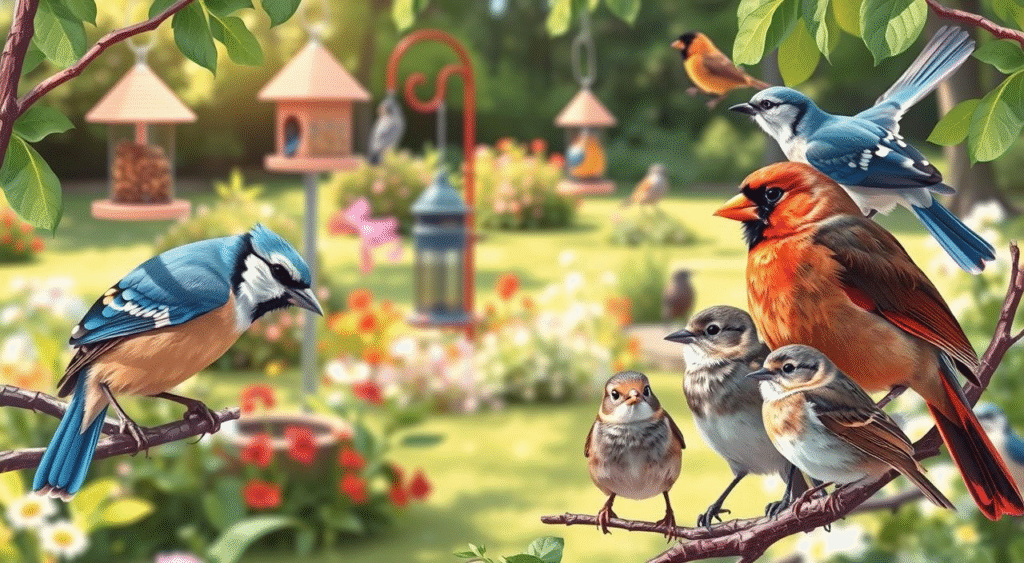
Here are the birds beginners encounter most often, organized by where in the yard you’ll actually first notice them. Ranges vary by region — check the eBird bar charts for your specific county to see which of these are expected near you and when.
Regular Feeder Visitors
| Bird | The field mark that clinches it | What to actually watch for |
|---|---|---|
| Black-capped or Carolina Chickadee | Black cap + black bib on a tiny body. No other common feeder bird has this combination at this size. | Arrives, takes one seed, flies to a branch 8–10 feet away, pins the seed under one foot, hammers it open. Comes back. Repeats indefinitely. Almost always the first bird to find a new feeder — sometimes within hours of setup. |
| Tufted Titmouse (eastern US) | Small, pointed grey crest; grey body; warm peachy-orange on the flanks; notably large dark eyes for its size. | Bolder than chickadees — tends to grab the largest available seed and carry it off. Sings a loud, clear “peter-peter-peter” from treetops early in the year, sometimes as early as January on warm mornings. |
| American Goldfinch | Breeding males (April–August): unmistakable lemon-yellow with black wings and cap. Winter birds: olive-drab — look for small size, wing bars, and distinctively bouncy undulating flight. | Flocks at nyjer feeders, clinging upside-down. One of the latest nesters in North America — still feeding nestlings in August in many areas, long after most other species have fledged and gone quiet. |
| House Finch | Streaky brown finch; males have reddish-raspberry on the face, breast, and rump — but brown streaking is always visible through it. That streaking is the fastest separation from Purple Finch. | Noisy flocks at seed feeders. Males sing a long, rambling musical warble from exposed perches starting in February — earlier than you’d expect. Common enough that learning “default finch” makes any unusual finch immediately obvious when it appears. |
| Downy Woodpecker | Smallest woodpecker in North America — sparrow-sized, black-and-white checkered back, short stubby bill that looks almost too small for a woodpecker. Males have a small red patch on the nape. | Works suet cages and small branches methodically, often checking the undersides of twigs. The short bill is the immediate separation from the similar Hairy Woodpecker — which has a much longer, more imposing bill and is noticeably bigger overall. |
| Northern Cardinal | Males: fully red, tall crest, heavy orange bill — among the most immediately recognizable birds in North America. Females: warm buff-brown with red-tinted wings, tail, and crest; the orange bill is the clinching mark in both sexes. | Prefers platform trays over tube feeders. Males begin singing from exposed high perches in early spring — sometimes as early as late January in the South. Learning the cardinal’s song is one of the fastest shortcuts to knowing that spring has biologically arrived, regardless of what the calendar says. |
| Blue Jay | Crested, blue-white-black, bold barring on wings and tail, black necklace at the throat. Loud. Nothing else at this size looks like this. | Grabs peanuts or sunflower seeds and caches them nearby. When a Blue Jay starts alarm-calling loudly from the tree line, look up — there’s usually a hawk, owl, or cat that every other bird in the yard is about to respond to. |
Ground and Lawn Birds
- American Robin: The orange breast is obvious — but the behavior is equally diagnostic and often more useful at distance. Robins run a short distance across the lawn, stop completely, tilt the head at about 45 degrees, and plunge the bill straight down for a worm. That specific run-stop-tilt-plunge sequence is as reliable a field mark as the plumage. Robins are much less dependent on feeders than most feeder birds — they’re hunting earthworms, berries, and insects, and may disappear from the yard entirely in winter, returning when the ground thaws.
- Mourning Dove: Plump, soft-looking, with a long pointed tail unlike any other common lawn bird and white outer tail feathers that flash when it flies. Usually found beneath feeders cleaning up fallen seed, often in pairs or loose groups. The hollow, descending coo — which carries further than you’d expect from a bird this size — gets mistaken for an owl by beginners more often than almost any other bird sound.
- Dark-eyed Junco: A reliable winter visitor across most of the US — arrives in fall, disappears in spring. Small, round, dark slate-grey above and white below with a sharp, clean border between the two. White outer tail feathers flash distinctively in flight. Scratches in leaf litter and beneath feeders in loose flocks. If your yard suddenly has small, dark-backed birds with white bellies in October, they’re almost certainly juncos.
Trunk Climbers and Bark Workers
- White-breasted Nuthatch: Climbs headfirst down tree trunks — a behavior so specific that once you’ve seen it, you’ll never confuse this bird with anything else. White face and chest, blue-grey back, rust-colored flanks. Makes a nasal, slightly honking “yank-yank” call. Visits suet and seed feeders but is most characteristic working bark.
- Red-bellied Woodpecker: Noticeably larger than a Downy — robin-sized and substantial. The “zebra-striped” black-and-white barred back is the fastest field mark. Males have a full red cap from bill to nape; females only on the nape. The “red belly” in the name refers to a faint pinkish wash on the abdomen that’s almost never visible in the field — ignore the name, focus on the striped back, the size, and the loud rolling call.
The Open-Area Specialists
- Eastern or Western Bluebird: Small, compact, deep vivid blue above, warm rusty-orange chest in males. Perches motionless on fence posts or low wires, scanning the grass below with a stillness that looks almost meditative — then drops in a short, precise dive to take an insect. Much smaller than a Blue Jay, no crest, almost silent by comparison. If you’re not specifically watching for bluebirds, it’s easy to miss them entirely while they’re sitting in plain sight.
Look-Alikes That Trip Up Beginners — And How to Separate Them

“Little Brown Birds” — Sparrows vs. Finches
This is the most common source of early frustration, and it’s completely understandable. But the separation is simpler than it looks once you know where to look:
- Finches have noticeably thicker, more conical bills — built for cracking hard seeds. They cluster at feeders, often in groups, and males show color (yellow in goldfinches, reddish in House and Purple Finches). If it’s clinging to a feeder tube, actively eating seeds, with a substantial-looking beak, it’s almost certainly a finch.
- Sparrows have a more moderate bill and spend considerably more time on the ground. Many show crisp, well-defined head patterns — bold stripes above the eye, eye lines, contrasting crown colors — that are actually quite distinctive up close. Song Sparrows, White-throated Sparrows, and White-crowned Sparrows all have head patterns that are identifiable clearly with binoculars at feeder distances. The “little brown bird” problem mostly applies to quick, distant glimpses. At normal feeder proximity, most sparrows are ID-able if you look.
Downy vs. Hairy Woodpecker — The Classic Beginner Rite of Passage
These two are legitimately similar, and confusing them is so common it’s practically a tradition. The keys:
- Bill length is the fastest separation. The Downy’s bill is short and stubby — almost disproportionately small for a woodpecker, roughly one-third the width of its head. The Hairy’s bill is much longer — roughly as long as the width of its head — a proper woodpecker chisel. This one field mark, seen clearly, is definitive. You don’t need size, you don’t need any other feature.
- Size comes second. Downy is sparrow-to-small-robin-sized (6.7 inches). Hairy is clearly bigger (9.2 inches). When both species visit the same suet feeder in the same week — which does happen — the size difference is obvious. Without a direct comparison, size alone is tricky to rely on.
- Behavior as a supporting hint. Downies work small branches, weed stems, and suet cages. If the woodpecker is hanging sideways on your suet cage, it’s almost certainly a Downy. Hairies tend to work larger trunks and are less consistently seen at hanging suet feeders.
House Finch vs. Purple Finch
House Finches are common and year-round across most of the US. Purple Finches are winter visitors across much of the East, year-round in parts of the Northeast and Pacific Coast. Male House Finches have red concentrated on the face and breast, with brown streaking still visible through the red — a “raspberry-washed brown bird” look. Male Purple Finches are more deeply saturated wine-red with a cleaner, bolder pattern — famously described as “a sparrow dipped in raspberry juice.” The females are the genuinely hard pair: female Purple Finches show a bold white eye stripe and strong facial contrast that female House Finches lack. If the female finch has a face that looks patterned and alert, look carefully — it may be a Purple Finch.
Northern Mockingbird vs. Gray Catbird
Both medium-sized, grey, and associated with shrubby edges. Mockingbirds are larger, with long tails, white wing patches visible in flight, and a habit of singing from the highest available perch — including at night, which startles people who’ve never encountered it. Catbirds are slightly smaller, darker grey, with a black cap and a rusty patch under the tail. The catbird’s mewing call — a nasal, descending sound that genuinely sounds like a cat — is so specific that once you’ve connected it to the bird making it, you’ll never misidentify a Gray Catbird again.
Blue Jay vs. Eastern Bluebird
This confusion is almost entirely name-based. In person, these two birds look nothing alike. Blue Jays are robin-sized, loudly patterned in blue, white, and black, with a prominent crest and a carrying call you can hear from inside a closed house. Eastern Bluebirds are much smaller, with a warm-orange chest, a smooth rounded head, and a quiet presence — they’ll sit on a wire above your lawn for five minutes without drawing a second glance from anyone who isn’t specifically looking for them. If you heard it from across the yard without trying, it was a Blue Jay. If you almost missed it entirely, it was probably a bluebird.
Learning Bird Sounds Without the Overwhelm
Bird song is consistently described as the hardest part of birding to learn. The realistic solution isn’t to memorize a hundred calls from an app while you’re indoors — it’s to build a small, solid sound vocabulary and add to it gradually, each new sound attached to a real observation.
- Start with five sounds and get them genuinely automatic before adding more.
The five worth learning first in most North American backyards: the Black-capped Chickadee’s “chickadee-dee-dee” call and its clear two-note whistled “fee-bee” song (the one that sounds like someone whistling a falling minor third — once you know it, you hear it everywhere in winter); the Northern Cardinal’s loud, liquid, repeated whistled phrases; the Blue Jay’s harsh “jay! jay!” plus the unsettling Red-shouldered Hawk mimic it sometimes deploys; the American Robin’s leisurely caroling at dawn; and the Mourning Dove’s hollow, descending coo that regularly gets mistaken for an owl. Those five cover the most common sound sources in most backyards. Get those automatic before adding anything else. - Pair every new sound with a visual, immediately.
Sounds heard without a visual impression are genuinely difficult to retain — they fade without a context to attach to. Sounds heard while you’re watching the specific bird making them tend to stick, sometimes for years. Every time you hear something unfamiliar, spend thirty seconds trying to locate the bird. You don’t need to ID it — just connect the sound to a visual impression of size, shape, and location. That connection is what makes the memory last. - Let location narrow the candidates before you’ve identified a note.
A complex, liquid song from dense shrubs near the ground is almost certainly a wren, thrush, or catbird. A clear, carrying whistle from the top of a bare tree is more likely a cardinal, vireo, or oriole. A sharp, mechanical hammering from inside a dead limb is almost certainly a woodpecker. The physical context doesn’t name the species, but it eliminates most of the field guide before you’ve parsed a single note. - Use Merlin Sound ID to learn, not to avoid learning.
Merlin’s Sound ID feature is genuinely impressive — it identifies birds calling near your phone’s microphone in real time, with a running list of what it hears. Use it to learn what you’re hearing but can’t locate yet, and to confirm or correct guesses. What you want to avoid is using it as a substitute for developing your own ear — because you can’t hold a phone up and watch through binoculars simultaneously. The app is a teacher. Use it like one, not like an answer sheet.
Why Your Yard Birds Change by Season
One of the most common questions from people in their first year of feeder watching: “The feeders were busy all January and now it’s June and barely anything is coming. Did I do something wrong?” No. This is completely normal, and once you understand why, the seasonal rhythm of your yard becomes one of the more interesting things to track.
Spring — Singing, Territory, and the Two-Week Window You Don’t Want to Miss
Spring is the most dynamic season in the yard. Resident birds that were quiet all winter suddenly become loud and territorial — a Northern Cardinal that’s been a polite feeder visitor for months will spend March singing loudly from the highest branch available. More interestingly, migrants passing through may appear briefly in your shrubs: warblers, orioles, tanagers, and other species that would never visit in winter. These transient visitors often show up after weather fronts, when birds have been pushed down during a night flight and land in whatever yard is in front of them. Check your yard in May more carefully than any other month. Some of the best backyard birding of the year happens in a narrow two-week window during peak migration — and if you’re not looking, you miss it entirely.
Summer — Insects, Nests, and Odd-Looking Juveniles
Feeder activity drops in summer for a simple reason: natural food is abundant. Insects peak, berries ripen, and most songbirds shift from seeds to protein-rich invertebrates to feed nestlings. A family of chickadees that ate your sunflower seeds all winter may barely visit the feeder in July because they’re making 300-plus insect-hunting trips a day to feed chicks in a cavity nearby. The birds haven’t gone anywhere — their priorities have shifted. You’ll also start seeing juvenile birds — young of the year that have just fledged — and they often look genuinely strange: patchy, short-tailed, with slightly oversized heads and uncertain movements. A young American Robin in late June looks confusing until it stands next to an adult and the family resemblance clicks into place.
Fall — Molt, Mixed Flocks, and Misidentification Season
Fall migration is less celebrated than spring but often produces more birds in total. Mixed-species flocks — chickadees, titmice, nuthatches, and warblers traveling loosely together — move through, and there are often brief appearances from species you’ve never seen before. The complication is molt: many birds are in non-breeding plumage in fall, which makes them noticeably duller. A molting male American Goldfinch in October looks almost nothing like the vivid yellow bird at your nyjer feeder in June — olive-drab, patchy, with only hints of yellow remaining. This is the season to lean more on size, silhouette, and behavior, and less on the color that worked so well in spring.
Winter — Feeders Earn Their Keep, Patterns Become Reliable
Winter is when feeders genuinely matter, and it’s also the best learning season for beginners. Natural food is depleted, temperatures are low, and birds that maintain year-round territories — chickadees, cardinals, woodpeckers, nuthatches — return to feeders reliably, often multiple times a day. The bird that was at your feeder at 7:30 this morning will probably be there again at 7:30 tomorrow. That repetition, more than any field guide, is what builds confident identification. You also gain winter-only visitors: Dark-eyed Juncos, White-crowned and White-throated Sparrows, and — during irruption years when northern food crops fail — Evening Grosbeaks, Common Redpolls, and Pine Siskins. Irruption years feel like the yard is suddenly full of birds you’ve never seen before, because it is.
Setting Up Your Yard for Better Observation
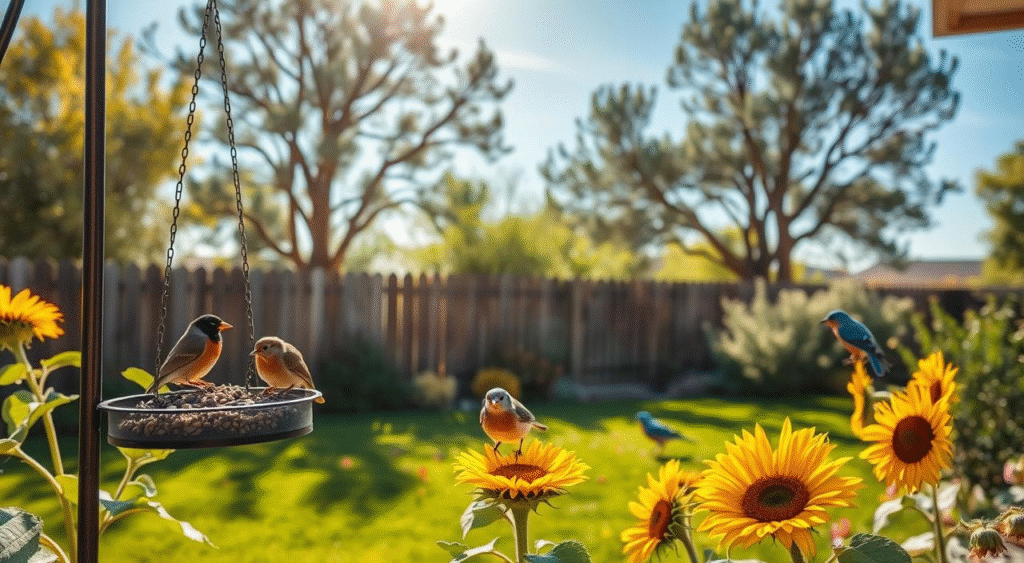
The most useful yard improvement for a beginning birder usually isn’t a better field guide or a nicer pair of binoculars. It’s a setup that puts birds where you can actually observe them — close enough to see field marks, in a location you look at regularly, with enough variety to attract species that seed feeders don’t reach.
Feeders That Create Observable Behavior
- Tube feeder with sunflower seeds: chickadees, titmice, finches, nuthatches. The tube forces birds to perch in one spot long enough to study — unlike a platform tray, where birds grab and leave immediately.
- Nyjer (thistle) feeder: American Goldfinches, House Finches, Pine Siskins in winter. Goldfinches at a nyjer feeder, clinging upside-down in vivid yellow and black, are one of the most satisfying early birding experiences available.
- Suet cage: woodpeckers, nuthatches, Carolina Wrens. Woodpeckers tend to stay at suet for extended periods, giving you unhurried time to see the bill length, head markings, and barring patterns that separate similar species.
- Platform or tray feeder at low height: cardinals, doves, juncos, sparrows. A low tray at roughly knee height brings in ground-feeding species that are uncomfortable on tube feeders and otherwise only appear beneath the feeder picking up scraps.
- Peanut feeder near the tree line: Blue Jays, chickadees, Red-bellied Woodpeckers. A handful of in-shell peanuts on an open tray near trees will bring Blue Jays in faster than almost any other single offering.
Water — The Most Underrated Bird Attractor in Any Yard
A clean, shallow birdbath — or better, a bath with a small dripper or recirculating pump — attracts species that seed feeders simply never reach. Warblers passing through in migration are insectivores that fly past a sunflower feeder without slowing down but stop for water every time. The sound of dripping water travels much further than any visual cue, which is why a dripper consistently outperforms a static dish. Keep it shallow (two inches maximum depth), change the water every two to three days, and scrub the basin weekly. A bath with stagnant green water attracts fewer birds and presents a real disease risk — the cleaning is not optional.
Position Feeders for the Observer, Not Just the Bird
A feeder six to eight feet from a window you look out of every morning will teach you more per week than a feeder in the far corner of the yard that requires binoculars to use. This seems obvious until you actually rearrange things and notice the difference. Window feeders — small feeders that attach directly to glass with suction cups — produce close-range observations that aren’t available at twenty feet. The detail visible at eighteen inches is qualitatively different from the detail visible at twenty feet. For learning purposes, close matters more than anything else.
Native Plants as Staging Perches
Native shrubs placed near feeders give birds a safe perch to evaluate the feeder before landing on it. Birds almost always pause somewhere first, and if that somewhere is a well-lit branch five feet from your window, you get observation time you’d otherwise lose. In spring and fall, native plants with berries or insect-supporting foliage also attract species that would never approach a seed feeder. A single serviceberry or native dogwood near your observation window does more for total bird diversity than any specialty seed blend.
Two Problems Worth Addressing Directly
- Window collisions. Birds striking windows is one of the largest sources of human-caused bird mortality in North America — estimated at 600 million birds annually in the US. The most effective solution: feeders placed either within three feet of the glass (so birds don’t build up dangerous speed) or more than thirty feet away. Window films and external marker patterns applied to the outside of the glass reduce strikes significantly.
- Outdoor cats. Domestic and feral cats are estimated to kill 1.3 to 4 billion birds per year in the US. Ground-feeding birds — sparrows, juncos, doves, towhees — are the most vulnerable, and they’re among the species beginners most want to practice identifying. Keeping pet cats indoors or supervising outdoor time dramatically improves yard safety for ground birds and, practically, increases how many birds you’ll actually see.
Tools and Apps Worth Using
Binoculars — The One Piece of Gear That Actually Changes Things
You don’t need expensive binoculars to identify backyard birds. You do need comfortable ones you’ll actually use. The standard beginner recommendation — 8×42 or 8×32 — gives enough magnification to see field marks clearly at feeder distances while remaining stable enough to hold steady for extended watching. More important than magnification: close focus distance. A pair that focuses as close as five or six feet is useful at window-feeder distances; one with a minimum focus of fifteen feet is considerably less so. A $70–$90 pair that feels right in your hands beats a $200 pair bought blind and then set aside because it’s uncomfortable. Try them before you buy if at all possible.
Merlin Bird ID — The Most Useful Beginner App, Used Correctly
Cornell Lab’s Merlin app (free, iOS and Android) does three things well for beginners: Photo ID accepts a photo and returns ranked likely species; the Bird ID wizard walks through questions about size, colors, behavior, and location; and Sound ID identifies birds calling near your phone’s microphone in real time. All three modes are useful. The key is using them as learning tools rather than shortcuts — run Sound ID while actively watching a bird, use Photo ID to check guesses after the fact, use the wizard to test your own reasoning. Used as a crutch, the app short-circuits the observation habit you’re trying to build. Used as a teacher, it accelerates it.
eBird — For Understanding Your Local Bird Context
eBird (also Cornell Lab, also free) is useful to beginners in a way that’s easy to underestimate. Pull up the Explore tool, enter your county, and look at the bar charts for any species — they show reporting frequency by week across all years of submitted data. Before a session, checking “what should I expect this week” gives you a specific set of candidates to watch for. After a session, it helps you understand whether the unfamiliar sparrow was predictable (it probably was) or genuinely unusual (worth a careful note and maybe a photo). Context makes observation more efficient.
A Regional Field Guide — Paper Still Has a Place
A regional guide — Peterson’s, National Geographic, or Sibley’s in eastern or western editions — is less overwhelming than a full continental book and more useful when you’re learning a specific region’s birds. The best field guide is the one you keep near your observation window and actually flip through after a bird shows up. Use it after observing, not during — looking through a guide while the bird is still there usually means the bird is gone before you find the right page. The habit of noting what you saw and then checking later produces better retention than consulting the guide while the bird waits (it won’t).
The Great Backyard Bird Count — A Useful Annual Focus Point
Held each February, the GBBC asks participants to count birds for at least fifteen minutes and submit checklists. For beginners, the value isn’t primarily the citizen science contribution (though that’s real) — it’s what a defined counting period does to attention. Fifteen focused minutes of watching, counting carefully, consistently reveals birds that casual observation misses. The counting format creates a reason to sit still and look carefully, which is the single most productive thing a beginning birder can do.
Backyard Birding Ethics — The Short Version
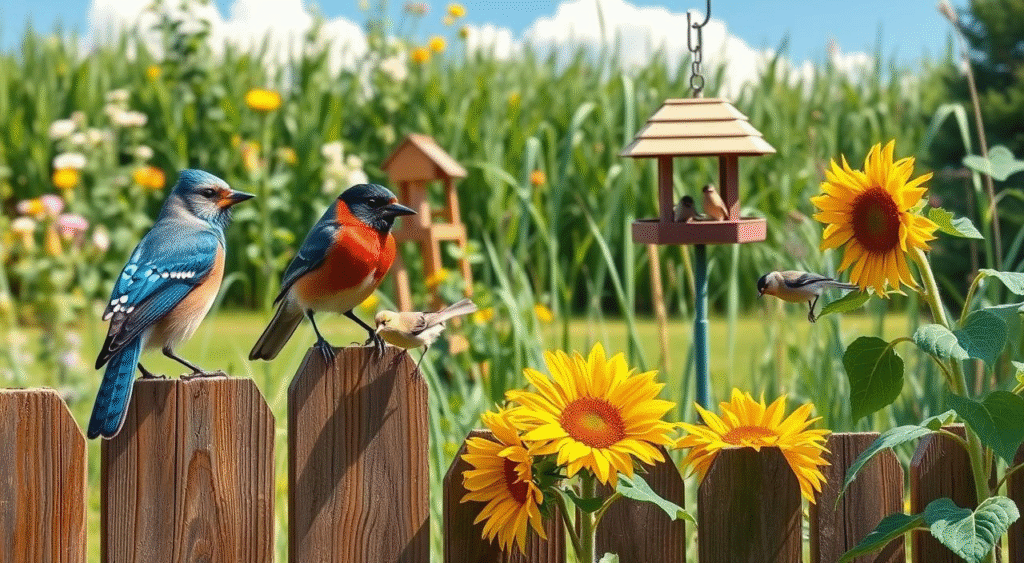
Most backyard birding ethics reduce to a single principle: the birds’ welfare comes before your ID opportunity. In practice, this means three specific things.
- Give active nests a wide margin. If you find an active nest — eggs, chicks, or a parent bird sitting unusually still in a fixed location — observe from a distance and leave it alone. Adults that feel threatened at a nest may abandon it. Young birds that fledge prematurely because a person got too close don’t always survive. Once per day from a respectful distance is enough if you’re monitoring. More than that, and you’re disrupting a process that doesn’t need your involvement.
- Clean feeders on a real schedule — not when you remember. Wet, clumped seed grows mold; a fouled water dish spreads salmonella and bacterial infections between birds feeding in close proximity. Cornell Lab recommends cleaning feeders with a 10:1 water-to-bleach solution at least once monthly, more often in warm weather. If you see birds sitting puffed up near the feeder, appearing lethargic, or showing eye discharge — particularly House Finches, which are susceptible to a specific conjunctivitis — take the feeder down, clean it thoroughly, and let the area clear for at least a week before restoring it.
- Pesticide use in your yard affects birds directly. A lawn treated with broad-spectrum insecticides looks fine but functions as a food desert for insectivorous birds during breeding season — when parent birds are making hundreds of insect-hunting trips daily to feed nestlings. Native plants that support caterpillars, beetles, and other invertebrates are the food supply infrastructure that makes bird nesting possible in suburban areas. If birds are nesting near your yard, their access to insects is partly your responsibility to protect.
Common Mistakes Beginners Make — And What to Do Instead
- ❌ Opening the app while the bird is still there.
This is the single most common beginner mistake, and the one that most directly limits how quickly you improve. You see a bird, you immediately reach for Merlin, and by the time it loads the bird is gone. The fix: keep eyes on the bird, run through the four questions — size, location, one field mark, behavior — then check the app. You’ll have specific information to work with and a much better chance of a correct ID. The app answers questions you’ve already formed, not questions you haven’t thought of yet. - ❌ Only recognizing the adult male.
Many beginners know the vivid adult male of a species and consistently miss females and juveniles. Female Northern Cardinals are warm buff-brown, not red — people who only know the male pass over them at feeders for months. Female House Finches lack the red entirely. Young American Robins are spotted and look genuinely unlike adults. Learning the female and immature plumages of your most common species effectively doubles what you can identify, because roughly half the birds in your yard at any given time are female or young of the year. - ❌ Treating an uncertain ID as a confident one.
Professional ornithologists leave birds unidentified. A bird that flew by in poor light before you got a real look is legitimately “unknown small brown bird” or “medium flycatcher, species uncertain.” Logging honest uncertainty is more useful than a guess — for your own learning and, if you’re using eBird, for the accuracy of the data. “I’m not sure” is a completely valid birding outcome. The habit of honest uncertainty, practiced early, produces better identification skills long-term than a habit of confident guessing. - ❌ Not knowing the local context before looking.
Five minutes on eBird’s bar charts for your county before a session changes what you look for and how excited to be when you see it. If White-crowned Sparrows peak in your county in late October, you have a reason to look carefully at every sparrow in that window. Context makes observation more efficient and much more satisfying. - ❌ Trying to learn too many species at once.
Cornell’s approach is worth absorbing here: learning ten species genuinely well — knowing how they move, sound, and behave, not just what they look like in a photo — is more useful than vague familiarity with a hundred. That depth with a smaller set gives you a perceptual baseline that makes every subsequent new species easier to place. The beginners who improve fastest are almost always the ones who go deep on their feeder regulars before rushing to expand the list. - ❌ Watching only at the feeder and missing everything else.
Seed feeders attract seed-eating birds. Warblers, flycatchers, thrushes, vireos, and many other species will never visit a sunflower feeder — but they stop at a birdbath, forage through native shrubs, and hunt insects in the lawn. Looking up, looking at the tree line, and treating the yard as a whole rather than just the feeder consistently produces species that a strictly feeder-focused approach misses entirely.
Pro Tips for Learning Faster
- Spend ten minutes watching one bird rather than ten seconds on ten birds.
This is the advice that experienced birders give beginners most consistently and that beginners ignore most reliably. Extended observation — watching a single chickadee for ten uninterrupted minutes — teaches more about how that species moves, feeds, responds to other birds, and sounds than a week of quick glances. It also establishes the behavioral baseline that makes every future sighting of that species faster to ID. If you leave every observation the moment you think you’ve got the ID, you never build that depth. - Keep a brief log near your observation window.
A small notebook — or a recurring note on your phone — where you briefly record what you saw and when becomes genuinely useful after three months. Patterns that are invisible in the moment become visible in the record: which species are daily, which appear only in certain weather, which have been showing up as “unknown sparrow” for weeks and clearly need investigation. The log doesn’t need to be formal. “7:45am — chickadees (4–5), one titmouse, cardinal pair, unfamiliar sparrow with bold white stripe above eye” is enough. - Submit eBird checklists from your yard — even short ones.
Your backyard checklists contribute to population monitoring data that researchers use. They also give you a cumulative yard species list, which most birders find motivating in a low-stakes way. And the act of submitting —