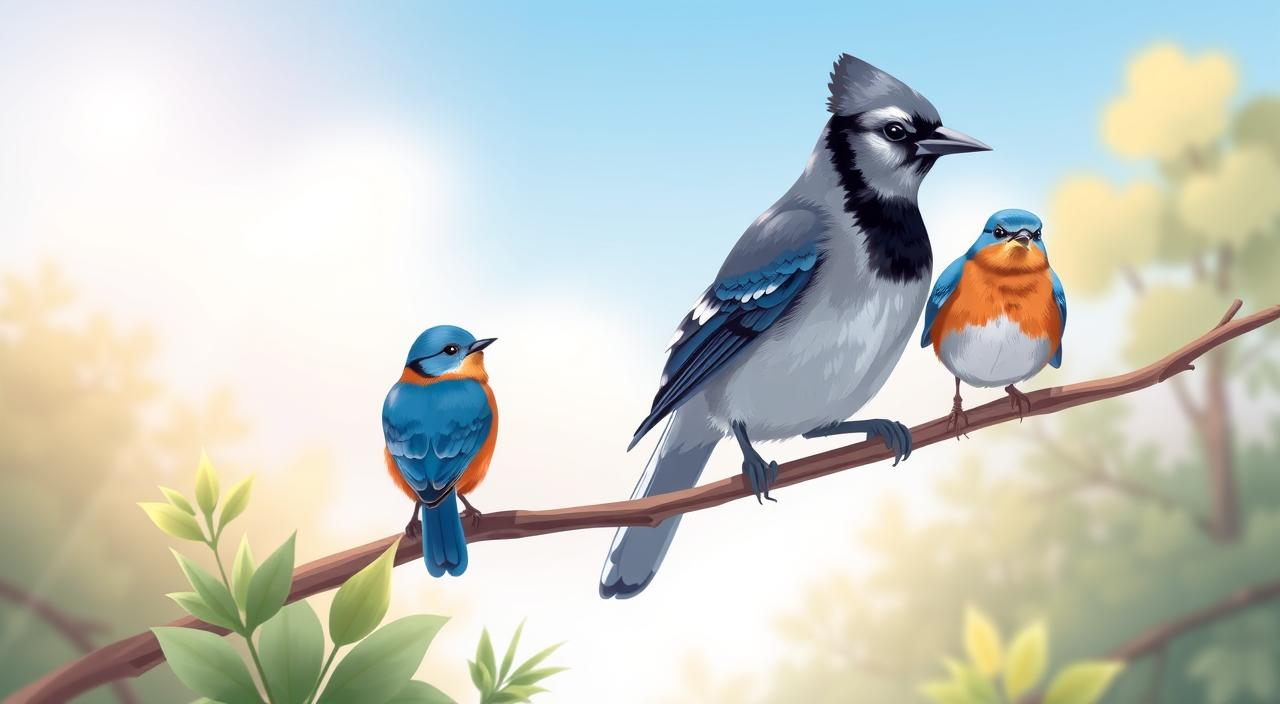
Something blue just crossed your yard. You watched it land on the fence for maybe half a second — then it was gone. Blue Jay or bluebird? The two names don’t help you here. The color was the only thing that registered, and it registered fast.
Here’s the thing that makes that half-second sighting confusing: these are not similar birds. They belong to completely different families, eat completely different foods, live in different parts of the yard, and behave so differently that once you know what to look for, you’ll never mix them up again. The confusion only exists because we named both of them after the same color, and because most people are working from memory of a glimpse rather than a side-by-side comparison.
This guide fixes that — with field marks that work in real conditions, not just in photographs. It also covers how to attract both species in the same yard without one crowding out the other, and which other blue birds regularly cause confusion along the way.
⚡ Can’t decide right now? Check these three things:
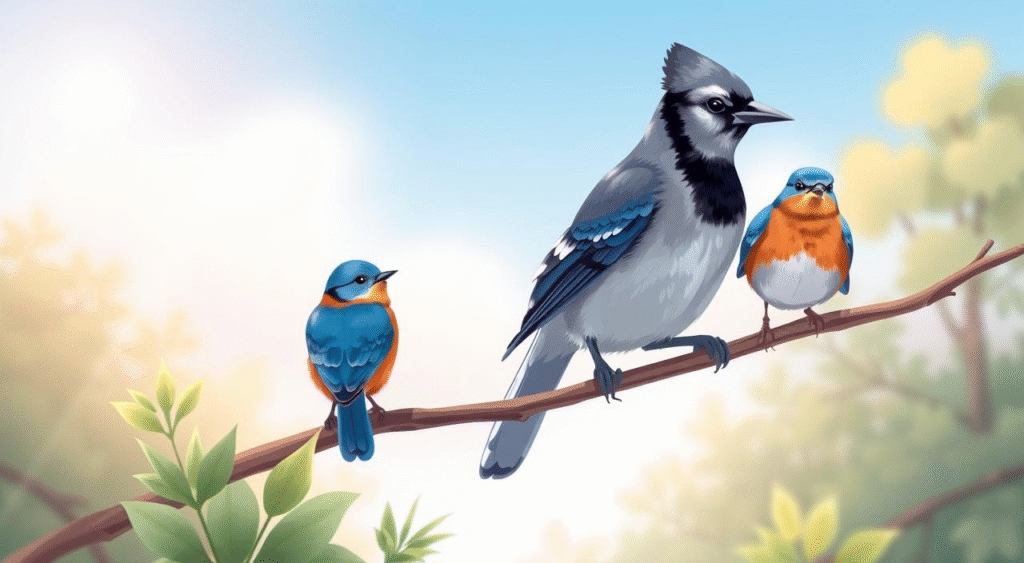
- Is there a crest? A raised, pointed crest on the crown = Blue Jay. Every time, no exceptions. Bluebirds have a smooth, rounded head at every age and in both sexes.
- What color is the chest? Warm rusty-orange across the breast = Eastern or Western Bluebird. Pale grey-white with a black necklace = Blue Jay. Mountain Bluebirds are all sky-blue — no orange anywhere.
- What does it sound like? Loud, sharp, you heard it through a closed window = Blue Jay. Soft warbled whistles you almost missed = bluebird. If you heard it clearly from inside the house, it wasn’t a bluebird.
10 Key Differences — The Fast Version
These are the field marks that experienced birders check first — reliable under real-world conditions, in a brief sighting, in imperfect light.
- Crest: Present = Blue Jay. Absent = bluebird. This one never fails under any lighting condition at any age.
- Body size: Blue Jays are roughly robin-sized — 11 to 12 inches, 2.5 to 3.5 ounces. Bluebirds are closer to a large sparrow — 7 inches, just over an ounce. The size difference in person is dramatic in a way it rarely looks in photographs.
- Color contrast: Blue Jays are graphic and high-contrast — crisp black, white, and blue with bold barring. Bluebirds look soft by comparison. Someone once described the difference as block print versus watercolor, which is surprisingly accurate.
- Face and neck: Blue Jays have a defined black necklace curving around the throat and up to frame the face. No bluebird has anything remotely like it.
- Chest: Eastern and Western Bluebirds have a warm rusty-orange breast. Mountain Bluebirds are pale sky-blue throughout. Blue Jays are grey-white below.
- At the feeder: Blue Jays want peanuts, sunflower seeds, and suet. Bluebirds ignore seed feeders almost entirely and come only for mealworms. If you watch what a blue bird eats at your feeder, the ID is immediate.
- Hunting style: Bluebirds perch somewhere elevated, go completely still, watch the ground, then drop in a short precise dive for an insect. Jays don’t hunt like that — they’re not built for it and they never do it.
- Habitat preference: Blue Jays want trees. Bluebirds want open ground. If the blue bird appeared in the middle of your open lawn near a fence post, it’s a bluebird. If it came from the oak tree at the edge of the yard, it’s a jay.
- Nesting: Blue Jays build cup nests in tree branches. Bluebirds need a cavity — a natural hole or a nest box. This is the reason bluebird boxes exist and the reason a jay would never use one.
- Sound: If you heard it clearly from across the yard, it was a Blue Jay. If you almost didn’t notice it, it was probably a bluebird. Volume is one of the most reliable fast-separation cues available.
Blue Jay vs Bluebird — Side-by-Side
| Feature | Blue Jay | Bluebird (Eastern / Western / Mountain) |
|---|---|---|
| Length | 11–12 inches | 6.5–8 inches |
| Weight | 2.5–3.5 oz — noticeably heavy for a “small” bird | ~1–1.1 oz — featherlight |
| Wingspan | 13–17 inches | 9–12 inches |
| Head shape | Prominent moveable crest — changes with mood | Smooth, round — no crest ever, at any age |
| Color pattern | Cobalt blue above, pale grey-white below, bold black necklace and barring | Eastern/Western: vivid blue above, rusty-orange chest. Mountain: sky-blue throughout, very pale belly |
| Bill shape | Strong, thick — built for cracking seeds and large food items | Short, slim, slightly drooped — insect-catching tool |
| Feeding behavior | Bold, assertive, dominates smaller birds, caches food | Quiet perch-hunter; uses mealworm feeders, ignores seed feeders entirely |
| Nesting | Open cup nest in a tree, 10–25 ft up | Cavity nester — natural holes or specifically-sized nest boxes |
| Calls | Loud, sharp, carries far — heard through closed windows | Soft, melodic, gentle warbled phrases — easy to miss entirely |
| Preferred habitat | Tree-rich areas: forests, wooded suburbs, parks with mature oaks | Open areas: fields, meadows, fence lines, orchards, golf course edges |
| Family (taxonomy) | Corvidae — crows, ravens, magpies | Turdidae — thrushes, American Robin |
1. Size and Shape — Trust Your First Impression
Blue Jay: Bigger Than You Expect Up Close
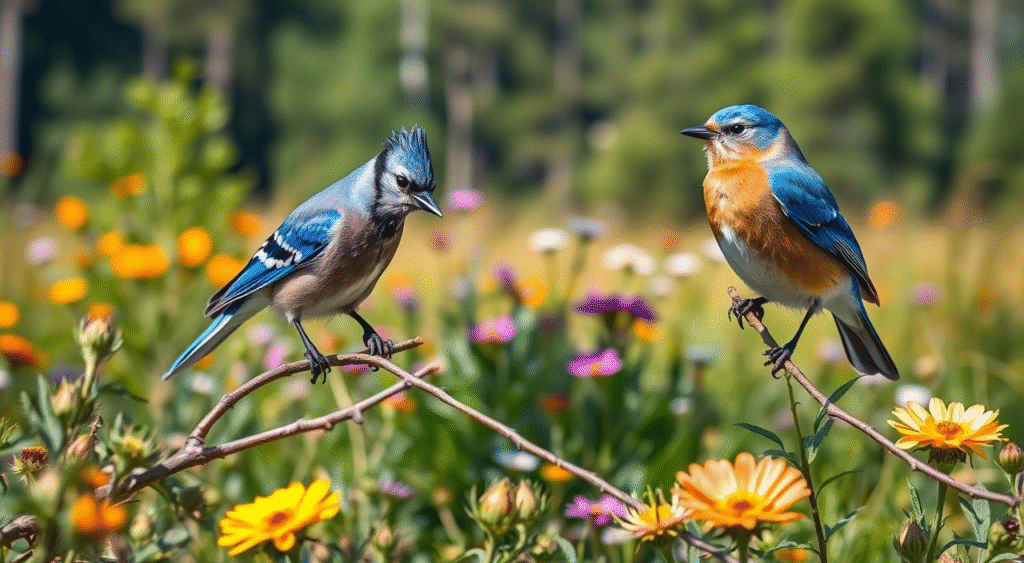
New birders are consistently surprised by how large Blue Jays are in person. At 11 to 12 inches and up to 3.5 ounces, they’re solidly robin-sized — not the “small backyard bird” category that most people picture at a feeder. When a Blue Jay lands on a platform feeder, the feeder moves. The long tail, thick neck, large bill, and moveable crest give it a silhouette that registers as substantial even at a distance. In flight, the wide rounded wings and deliberate wingbeats read immediately as a bigger bird than most people expect from a feeder visitor.
The crest is the feature that makes Blue Jays most immediately distinctive in the field, and it’s worth understanding that it’s not fixed. Jays raise and lower it continuously with their mood. An alert, agitated jay raises it nearly vertical. A relaxed, feeding bird holds it nearly flat — which changes the silhouette considerably and occasionally confuses people who expect the crest to always be obvious. The rule: if you see a bird that looks blue and crested at any point, that’s your Blue Jay.
Bluebird: Small, Round, Built for Perch-Hunting
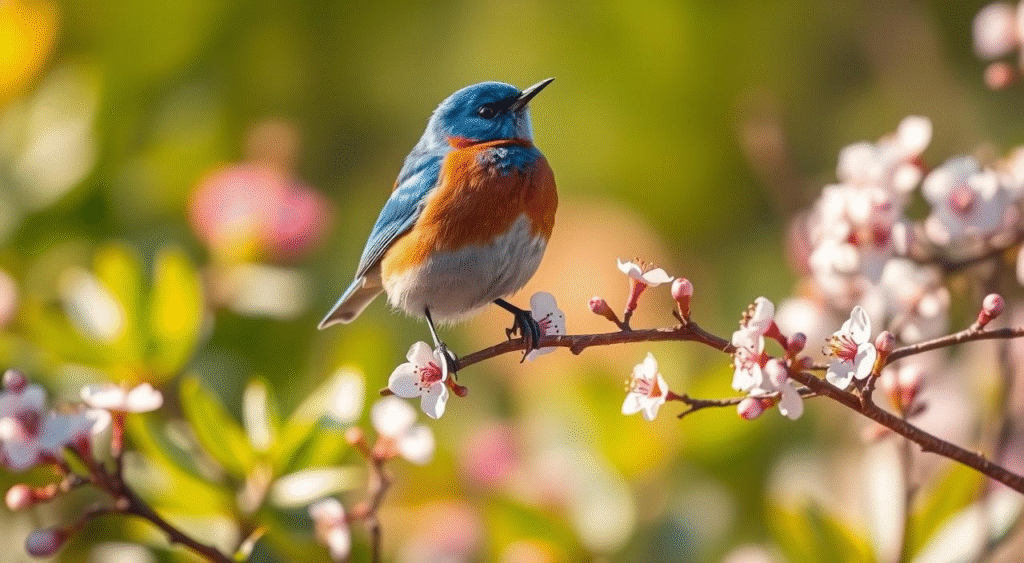
Eastern Bluebirds average about 7 inches and just over an ounce. If you’ve spent time watching sparrows at a seed feeder, a bluebird is in that size neighborhood — compact, round-bodied, with a short bill and a slightly top-heavy look when perched upright on a fence post. The wings are proportionally long for the body, which gives them a graceful, buoyant look in flight that’s quite different from the direct wingbeats of a jay. Someone once described Eastern Bluebirds as looking “very squishy and songbird-shaped,” which is an accurate and genuinely useful description. The body looks almost too round for the wings. Once you’ve seen a bluebird sitting completely motionless on a wire, scanning the grass below with an expression of serious intent, that silhouette doesn’t leave you.
2. Color Patterns — The Details That Clinch the ID
Blue Jay: Bold, Graphic, High-Contrast
Blue Jays look like they were designed with strong convictions. The blue across the back and wings is a rich cobalt — cool-toned, vivid, set against sharply defined black-and-white patterning. White spots on the wing feathers, black barring across the tail, and that black necklace curving around the throat and up to frame the face. The belly is clean pale grey-white. Nothing is subtle or blended about it. From twenty feet away in decent light, a Blue Jay reads as bold, patterned, and deliberate. Males and females are essentially identical in plumage — one of the few common backyard birds where you genuinely can’t tell sex from appearance in the field.
Bluebird: Warmer, Softer, and Species-Dependent
The three bluebird species are distinct enough that knowing which one occurs in your region matters:
- Eastern Bluebird (east of the Rockies): deep, intense blue on the head, back, and wings — sometimes with a slight purplish cast in certain light — and a warm rusty-orange breast and throat. The orange is the fastest field mark. Nothing else commonly seen at a backyard in the East has that color combination. Females are a washed-out version: grey-blue above, pale orange-brown below. Many people don’t recognize female Eastern Bluebirds as bluebirds at all on first encounter, which matters because they’re often the ones checking the nest box.
- Western Bluebird (Pacific Coast, inland West): similar to Eastern but with a slightly deeper blue extending onto the chest, and often a small patch of rusty color on the back. Critically: the throat is blue, not orange — the reverse of the Eastern pattern.
- Mountain Bluebird (mountain meadows of the West): the one that surprises people. Males are a pure, airy sky-blue throughout — no orange, no rust, no warm tones anywhere. They’re genuinely stunning birds, but they don’t match the “bluebird with the orange chest” image that most people carry. Female Mountain Bluebirds are mostly grey-brown with only faint blue on the wings and tail. If you’re expecting the classic bluebird look and a Mountain Bluebird shows up, it can take a few seconds to even realize what you’re looking at.
3. Behavior at Feeders and in the Yard
Blue Jay: The Smartest, Most Complicated Bird in Your Yard
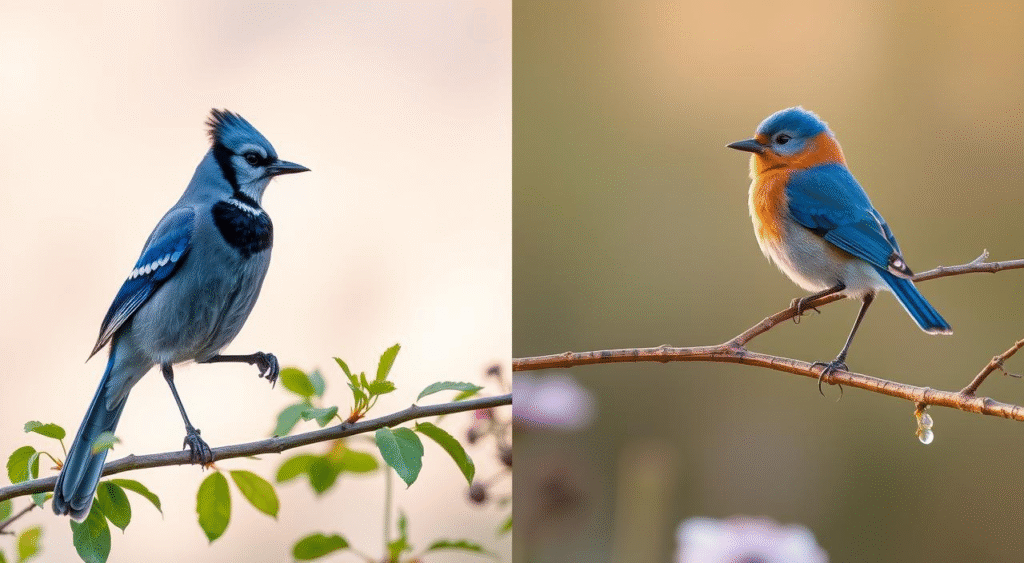
Blue Jays have been underestimated for decades, mostly because their loudness and occasional feeder dominance obscures what’s actually going on. The food-caching behavior alone is worth understanding: a jay that takes a peanut from your feeder is almost certainly carrying it to a burial spot 30 to 50 yards away, where it will locate it again months later with enough accuracy to suggest genuine spatial memory. This caching behavior has a side effect that’s well-documented in forest ecology research — jays bury far more acorns than they ever retrieve, and the forgotten ones sprout. Blue Jays are, in a very direct sense, one of the primary mechanisms by which oak forests expand and recover after disturbance.
The alarm call behavior is something most yard birders notice but don’t fully process. That harsh “jay! jay!” that echoes through the neighborhood isn’t indiscriminate noise. It’s a warning, and every bird in your yard knows it. Chickadees, juncos, and bluebirds all go still or take cover when a Blue Jay raises an alarm. When a jay starts calling hard at something in the tree line, it’s worth looking up. There’s usually something there — a hawk, a cat, occasionally something that turned out to be only marginally interesting, but the jay noticed it before anything else did.
The hawk mimicry is one of the more remarkable things a common backyard bird does, and it still surprises experienced birders. Blue Jays reproduce Red-shouldered and Red-tailed Hawk calls with enough accuracy that a seasoned birder can get fooled. The working theory — supported by observation but not definitively proven — is that the call may scatter other birds from a food source. If you hear a convincing hawk call and then can’t find a hawk anywhere, spend thirty seconds looking for a jay in the canopy before moving on.
Bluebird: Patient, Deliberate, and Easy to Overlook
Bluebirds hunt in a way that makes them look like they’re doing nothing, which is exactly the point. They find a perch — a fence post, a low wire, a dead branch with a clear sightline to open ground — and sit very still and scan. Then, in a movement that’s sudden and precise, they drop to the ground, take an insect, and return to a perch. This “perch-and-pounce” style means a bluebird can sit in full view for five minutes without attracting attention from someone who doesn’t know what they’re watching. It’s not inactivity — it’s a hunting posture optimized for a specific prey type in a specific habitat. The stillness is functional.
At feeders, bluebirds are specialists in a way that’s practically useful for yard setup: mealworms or nothing. Live mealworms are the preference; high-quality dried mealworms work reliably once birds are accustomed to them. A seed feeder simply doesn’t register as food to a bluebird. This is one of the genuinely practical reasons that running feeders for both species in the same yard works — they’re not competing at the same stations at all.
4. Habitat — Where Each Bird Actually Lives
Blue Jay: A Tree Is Not Optional
Blue Jays are a forest-edge species that have adapted well to suburban environments — as long as significant tree cover comes with the suburb. The key tree is oak. A neighborhood with mature oaks almost always has Blue Jays; a treeless development typically doesn’t, and the reason is direct: jays don’t just perch in oaks, they eat them, cache from them, nest in them, and use the canopy as a highway between feeding areas. If you want consistent Blue Jay presence in your yard and don’t have an oak, planting one is a longer-term strategy that pays off more reliably than any feeder setup — though oaks take time, and “longer-term” here means years, not weeks.
Bluebird: Open Ground Is Everything
Bluebirds need grass — specifically short, open grass they can see across clearly and hunt in without obstruction. The habitat preference is precise enough that bluebirds will avoid a yard that looks suitable but isn’t quite open enough, and use a yard next door that is. Historically they depended on natural cavities in old wooden fence posts and standing dead trees in farm fields and open meadows. Both of those features have largely vanished from agricultural and suburban landscapes: wooden fence posts replaced by metal T-posts, standing dead trees removed as hazards. The decline in Eastern Bluebird populations through the mid-20th century tracked almost directly with those habitat losses. The nest box programs that reversed that decline from the 1970s onward succeeded not just because people liked bluebirds — though they do — but because the boxes genuinely replaced a resource that had been eliminated from the landscape.
The habitat difference also explains why these two birds coexist in the same general neighborhood without much conflict. The Blue Jay is working the tree line and the canopy. The bluebird is working the open lawn at the edge of it. They’re not competing for the same space, and they don’t need to be managed to stay out of each other’s way — they’ll naturally separate if each part of the yard offers what they need.
5. Calls and Songs — Learn to Hear the Difference
Blue Jay: You’ll Know It When You Hear It
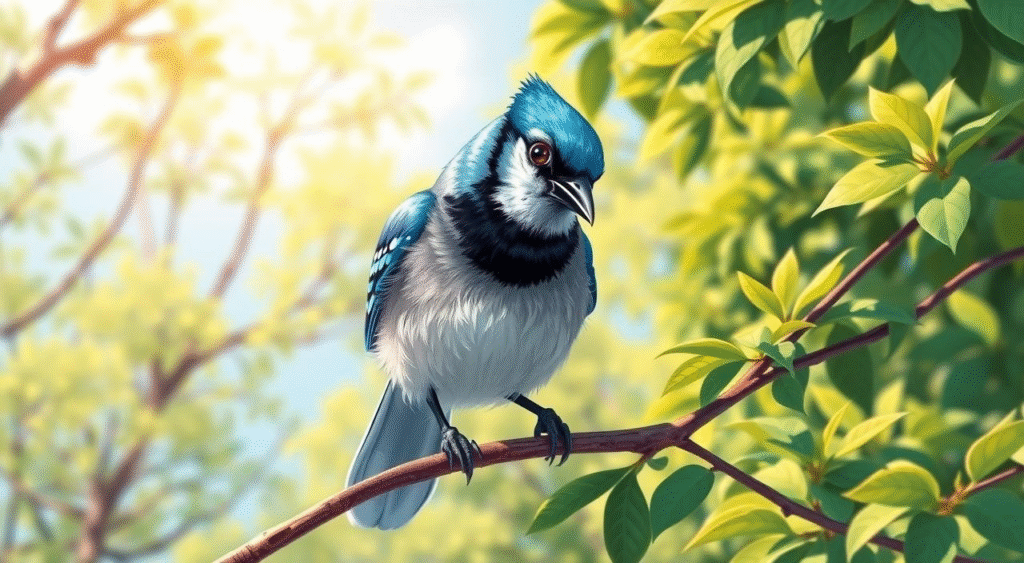
The standard Blue Jay call — a sharp, nasal “jay! jay!” — carries across an entire yard and through closed windows. But jays have a wider range than most people realize. There’s a soft, liquid, almost bubbly whisper song used between mated pairs that sounds nothing like the alarm call and nothing like a jay at all to someone hearing it for the first time. There’s a bell-like “tuledoo” call that has an almost musical quality. And then there’s the hawk mimicry, which has been discussed above — but the specific detail worth remembering is that the Jay’s version has a very slightly “canned” quality to experienced ears, though it takes time to develop that ear, and even experienced birders occasionally get fooled by it.
Bluebird: Easy to Miss, Worth Learning
The Eastern Bluebird’s song is a soft, warbled series of three to six notes — often transcribed as “chur-lee, chur-lee” or “truly, truly” — delivered from an open perch in a gentle, unhurried way. Nothing about it demands attention. The call notes are similarly understated: soft “chit” sounds and quiet melodic whistles. People who come looking for bluebirds expecting dramatic birdsong are routinely underwhelmed. You’ll usually spot them visually first and only realize they’ve been calling once you’re close enough to hear them clearly.
Learning the Eastern Bluebird’s song is one of the more rewarding steps in getting to know this bird. Once you know it, you can identify a patch of open lawn as bluebird territory from fifty meters away — before you see a bird — just from the soft warble drifting across the grass. That’s a different relationship with the yard than just watching the feeder.
6. What They Eat — and Why It Matters for Your Yard
Blue Jay: Omnivore, Opportunist, and Accidental Forester
Blue Jays eat a wide range of things — acorns and other nuts, seeds, fruit, beetles, grasshoppers, occasional eggs from other birds’ nests. That dietary flexibility is a large part of why they’re successful across such a wide range of habitats. The acorn relationship is genuinely worth understanding: studies have estimated that individual Blue Jays can carry and cache up to five acorns at once (some held in an expandable pouch in the throat), and a single jay may cache thousands of acorns in a season — far more than it can retrieve. The forgotten caches sprout. This isn’t an incidental detail about jay behavior; it’s a primary mechanism of oak forest expansion and recovery from disturbance. The Blue Jay in your yard is a forest ecologist whether it intends to be or not.
The occasional nest predation — eating eggs or chicks from other birds’ nests — is real, and it’s worth neither dismissing nor overstating. Studies of Blue Jay diet and foraging behavior consistently show that plant material and invertebrates account for the overwhelming majority of their food intake. The reputation as serial nest raiders is significantly exaggerated, though not invented. A Blue Jay that raids a nest is doing what opportunistic omnivores do. It’s not a habit that defines the species.
Bluebird: Insects First, Berries When Necessary
Bluebirds are primarily insectivores when insects are available. The perch-and-pounce hunting style is optimized specifically for beetles, grasshoppers, crickets, and caterpillars — larger prey items on or near the surface of short grass. As temperatures fall in autumn and insect populations crash, they shift reliably to berries: dogwood, holly, pokeweed, Eastern red cedar, winterberry. This seasonal shift is predictable enough that planting the right native berry-producing species is one of the more straightforward ways to extend bluebird presence through the colder months.
The pesticide issue deserves to be taken seriously rather than mentioned in passing. A lawn treated regularly with broad-spectrum insecticides looks fine but functions as a food desert for a bluebird actively trying to feed nestlings. Research on bluebird breeding productivity consistently identifies insect availability near nest boxes as one of the strongest predictors of whether a clutch makes it to fledging. The nest box is the door; the insect supply is what makes the house worth living in.
7. Nesting — One Builds from Scratch, One Moves Into a Cavity
Blue Jay Nesting: Secretive, Careful, and Easy to Miss
Blue Jays build sturdy open cup nests typically positioned in a tree fork at 10 to 25 feet, often under leaf cover. The nest is built from twigs, grass, moss, and bark strips, sometimes with the cup interior reinforced with rootlets and feathers. Both sexes participate, with the male often gathering material while the female places it.
The behavioral shift during nesting is striking enough to confuse people who’ve been watching jays through winter. A pair that was loud, conspicuous, and feeder-dominant through March becomes notably quiet and almost invisible once incubation begins. This isn’t coincidence — jays with active nests actively suppress the behavior that would otherwise draw a predator to the nest site. If your Blue Jays seem to have disappeared in May, they almost certainly haven’t. They’re nesting within 150 yards, staying low-profile deliberately. They’ll reappear in June or July with fledglings in tow, at which point the noise returns immediately and the yard feels like it did in February.
Bluebird Nesting: A Box Is Not a Nice Addition — It’s a Necessity
Bluebirds can only breed where a suitable cavity exists. That’s the entire constraint. The female builds a neat cup of fine grass inside whatever cavity the pair selects; the male guards the territory and feeds the female during incubation. Eastern Bluebirds typically attempt two clutches per season across most of their range, sometimes three in the South — with the male continuing to feed fledglings from the first brood while the female begins laying the second clutch, a logistical feat that’s worth stopping to appreciate.
Entrance hole diameter is not a minor detail. The standard for Eastern Bluebirds is exactly 1.5 inches — large enough for the bird, small enough to exclude European Starlings. House Sparrows fit through a 1.5-inch hole, which is why monitoring boxes during the season matters. A House Sparrow establishing inside a bluebird box doesn’t just displace the bluebirds — it can kill adults at the nest. That’s not a worst-case scenario; it’s a documented and common outcome of unmonitored boxes in areas with high House Sparrow pressure.
How to Attract Both Species — Without One Dominating the Other
Attracting Blue Jays
- Peanuts — in-shell or shelled — are the most effective Blue Jay attractant. A handful of in-shell peanuts on an open platform tray will bring jays in faster than almost anything else. Place the tray near trees where jays can cache what they take.
- Sunflower seeds in a platform or tray feeder. Tube feeders with small perches don’t suit birds of this size — jays prefer to land, grab, and go. A platform gives them the room to do that.
- Tree cover nearby. A feeder in the middle of an open lawn with no trees within 30 feet will get significantly fewer jay visits than one near the edge of a wooded area or adjacent to a mature shrub. Jays want escape routes and overhead cover.
- Position Jay feeders away from bluebird stations. Keep them at least 30 feet apart, ideally around a corner so they’re not in direct line-of-sight of each other. Jays will investigate mealworm dishes with the opportunism that characterizes everything they do, but a physical separation makes chance visits much less frequent.
Attracting Bluebirds
- A correctly mounted nest box is the single most important thing. For Eastern Bluebirds: 1.5-inch entrance hole, 5×5-inch interior floor, 8 inches deep. Mount it on a smooth metal pole at 4 to 5 feet height in open area with at least 50 feet of clearance from dense vegetation. Face the entrance roughly east to southeast — morning sun warms the box; afternoon shade prevents overheating in summer.
- A predator baffle on the pole — not optional. A stovepipe baffle or commercial cone guard below the box addresses the most serious predation threats before they become a problem. A box without a baffle will be predated reliably over enough seasons. The baffle is doing more work than the box in most suburban settings.
- Live or dried mealworms in an open dish on a separate post in the open, near but not adjacent to the nest box. Start with the dish open and visible; once bluebirds are visiting consistently, you can add a cage or dome to exclude starlings.
- Native berry-producing plants at the yard edges: Eastern red cedar, native hollies, winterberry, dogwood, and pokeweed extend bluebird use of the yard through fall and winter when mealworm maintenance becomes less practical.
- Stop insecticide use in areas where bluebirds forage. A visually perfect lawn treated with insecticides is functionally a food desert during the breeding season. The nest box is a door; the insect supply is what makes it worth nesting.
Other Blue Birds That Trip People Up
About 2% of North American bird species show blue plumage, but several appear regularly in backyards and consistently cause confusion. Here are the ones worth knowing before the next quick sighting at the window.
Indigo Bunting — The Vivid Imposter
The male Indigo Bunting in breeding plumage is one of the most intensely saturated blue birds on the continent — a true, deep cobalt with almost no other color visible. At a quick glance, it could read as either a small bluebird or a very small jay. The distinguishing features are immediate once you know them: Indigo Buntings are sparrow-sized, around 5 inches — noticeably smaller than even a bluebird. They have a short, conical seed-cracker bill. There’s no orange, no rust, no warm tones anywhere. And they favor brushy woodland edges and overgrown margins rather than the open lawn a bluebird uses. Female Indigo Buntings are entirely brown, which generates genuine confusion from birders baffled that such an unremarkable bird could be the same species as the vivid male.
Steller’s Jay — The West Coast Blue Jay
West of the Rockies, the Steller’s Jay fills essentially the same ecological niche as the Blue Jay — large, crested, loud, corvid. The distinguishing features are reliable: the head, neck, and chest are a deep sooty black or dark charcoal, contrasting with deep blue wings and tail. There’s no white in the pattern. Where Blue Jays are blue, white, and black with bold barring, Steller’s Jays are dark blue and near-black with much less contrast. Both species occur in a narrow overlap zone through the Mountain West.
Scrub-Jays — Jay Shaped, No Crest
California Scrub-Jays and Woodhouse’s Scrub-Jays look like someone removed a Blue Jay’s crest and erased the black-and-white detail. They’re jay-shaped and jay-sized, with blue on the back and wings, but without the crest and without the bold necklace pattern. Florida Scrub-Jays are a separate threatened species in a restricted central Florida range, notable for being extraordinarily approachable — they were studied intensively for decades, became habituated to humans to a degree unusual for wild birds, and will sometimes land on a researcher’s hand to take food.
Belted Kingfisher — The One Near Water
Occasionally mistaken for a Blue Jay in flight — similar blue-and-white color scheme, similar size. But Kingfishers have an unmistakable oversized dagger bill, a shaggy crest quite different from a jay’s neat pointed one, and they’re almost always associated with water. If the “Blue Jay” is hovering over a pond or diving repeatedly toward a stream, you have a Kingfisher. Their loud rattling call is also immediately distinctive — nothing else commonly heard near water sounds like it.
Common Identification Mistakes — and What to Do Instead
-
❌ Calling every blue bird a “bluebird.”
“Bluebird” describes three specific species — Eastern, Western, and Mountain. Not any bird that happens to be blue. This matters in practice: if you tell someone you “saw a bluebird at your feeder” and it was an Indigo Bunting, you’ll get follow-up questions you weren’t expecting. When you’re unsure, say “a blue bird” rather than “a bluebird” until you’ve confirmed the ID. The distinction matters. -
❌ Making the call based on color alone.
Blue is one of the most variable colors under changing light. A Blue Jay in heavy shade looks nearly grey. A bluebird hit by direct afternoon sun can look electric and vivid in a way that’s genuinely surprising. Lead with shape, crest, chest pattern, and what the bird is actually doing — use color as confirming detail, not as primary evidence. -
❌ Not recognizing female bluebirds as bluebirds.
Female Eastern and Western Bluebirds are considerably duller than males: grey-brown above, pale washed-out orange-brown below, faint blue-grey on the wings and tail. Female Mountain Bluebirds are mostly grey. People who come looking for vivid blue males frequently overlook females entirely or misidentify them as “some kind of thrush” — which is taxonomically accurate but practically useless. If you see a small, round-bodied bird in bluebird habitat with faint blue on the wing edges and a hint of warm coloring on the chest, don’t dismiss it. -
❌ Assuming Blue Jays are bad for the yard and should be discouraged.
Blue Jays occasionally raid other birds’ nests, and that behavior is real. But systematic studies of Jay diet consistently show nest predation accounts for a small fraction of total interactions with other species. Their ecological contributions — acorn caching and forest regeneration, alarm calling that benefits every bird in the area, insect consumption — are substantial. Jays can crowd seed feeders in a way that affects smaller birds, but the solution is feeder management, not discouraging a species that’s doing mostly useful things. -
❌ Mounting the bluebird box in the wrong place, then wondering why it’s empty.
This is the most common reason new nest boxes go unused or attract House Wrens instead of bluebirds. Bluebirds need unobstructed sight lines in all directions from the entrance — they want to see predators approaching from a distance. A box within 20 to 25 feet of dense shrubs or tree overhangs will be avoided by bluebirds and typically claimed by House Wrens within a week. Moving the same box to a more open position in the middle of the lawn often produces bluebird occupancy within a season. Location is the variable that matters most — not box quality, not hole size, not paint color. -
❌ Adding an enclosure to the mealworm dish before birds are comfortable with it.
Bluebirds are cautious about novel structures. A new enclosed mealworm feeder in an unfamiliar yard can go completely uninvestigated for weeks even when bluebirds are present nearby. Start open — an uncovered dish on a post — to let birds find the food source and get comfortable with the location. Once you have regular visitors, add a cage or dome to exclude starlings and jays. Don’t add the enclosure first and then wait for birds to figure it out.
Pro Tips for Getting More From Both Species
-
Learn the Blue Jay’s hawk mimic call — it’s more common than most people realize.
Once you know the original Red-shouldered and Red-tailed Hawk calls and the slightly “canned” quality of the Jay’s reproduction, you’ll start noticing it several times per season. Knowing it’s a jay also tells you something: there was probably something interesting nearby that triggered it, or the jay is actively clearing the area. The call isn’t random noise — it’s information. -
Start a bluebird monitoring log from day one.
Checking a box every 4 to 7 days during breeding season takes about two minutes. Writing down what you find — number of eggs, nestling development, any evidence of House Sparrow intrusion — takes one more minute. Over several seasons, this creates a genuinely useful record of your local population’s breeding productivity. Submitting observations to Cornell Lab’s NestWatch puts those data points into the scientific record and contributes to long-term monitoring. It costs nothing and takes effectively no extra time. -
Two bluebird boxes at least 100 yards apart doubles your capacity without adding conflict.
Eastern Bluebirds are territorial during breeding season — a pair occupying one box will exclude other bluebirds from the immediate area. Two boxes 100 or more yards apart, or on opposite sides of a structure that breaks line-of-sight, can support two independent pairs. Over seasons, as young birds return to breed near their natal site, a two-box yard compounds into a more productive local population than a single box ever could. -
Check eBird’s species frequency graphs for your specific county.
eBird’s Explore tools show how often each species has been reported by month in your county, based on years of submitted checklists. For bluebirds, this tells you exactly when to have your box ready and your mealworm supply stocked in your specific area — not a regional average that may be off by weeks. For Blue Jays, it can flag unusual seasonal patterns like post-breeding dispersal movements when jay numbers sometimes spike briefly in unexpected areas. -
Plant native berry-producing shrubs at the yard edge.
Winterberry holly, native dogwoods, American beautyberry, pokeweed, and Eastern red cedar are reliable bluebird food sources through fall and winter. Planted at the edge of the open zone rather than in the middle of it, they don’t conflict with bluebird habitat requirements — and they provide perch-to-lawn sightlines that bluebirds use for hunting. The investment in native plants pays birding dividends for decades. -
If you see a bluebird in winter in an unexpected location, report it.
Winter bluebird sightings — particularly Mountain Bluebirds well east of their usual range, or Eastern Bluebirds in unusual numbers — are genuinely valuable data. eBird submissions of winter sightings contribute to tracking population patterns used in conservation planning. It takes three minutes to submit a checklist.
What People Actually Notice in Real Yards
Most people don’t confuse Blue Jays and bluebirds when they’re reading about them. They confuse them in real life, in motion, in a half-second. It usually starts with a flash of blue.
The most common story goes like this: something blue crosses the yard, lands on the fence, and by the time you get a good look, everything near it scattered. That’s almost always a Blue Jay. The scattering effect is a reliable tell — smaller birds read a jay’s arrival before most human observers do.
The bluebird encounter tends to look different. There’s a small blue bird that keeps landing on the same fence post, sitting completely still, staring at the ground — then dropping suddenly and coming back up. People who don’t know what they’re watching find it puzzling. That pause-and-drop is how bluebirds hunt, and once you’ve seen it a few times, you’ll recognize it at a distance before you’ve even confirmed the color.
The size difference surprises almost everyone who notices it for the first time. “I didn’t realize how big Blue Jays were until one landed at my feeder” is a comment that comes up constantly. And the inverse: “the bluebird looked smaller than I expected — kind of round and soft.” Both reactions are completely accurate, and both give you something reliable to use at the window next time.
Sound separates them even faster. “The loud one I could hear from inside the house” — that’s the jay. “The quiet one, I almost didn’t notice it at all” — that’s the bluebird. If you didn’t consciously hear it, it probably wasn’t a jay.
Feeders create the most confusion for new observers: someone puts out seed hoping for bluebirds, nothing comes, adds mealworms, and bluebirds appear. Meanwhile the Blue Jays are grabbing peanuts and disappearing immediately. The feeding behavior is the fastest way to confirm which bird you’re watching once you’ve got one in front of you.
And one of the most useful observations people make when both are present: “They don’t really interact — the jays stay near the trees and the bluebirds stay out on the lawn.” That’s why both can share a yard without significant conflict. They’re not competing. They’re just using different parts of the same space.
Frequently Asked Questions
Are Blue Jays and bluebirds related to each other?
Not at all, despite the name overlap. Blue Jays belong to the family Corvidae — the same group as crows, ravens, and magpies. Bluebirds belong to Turdidae, the thrush family, which includes the American Robin. The shared blue color is convergent evolution — two unrelated lineages arriving at similar coloration through completely different evolutionary paths. In terms of intelligence, diet, social behavior, and ecological role, they’re about as different as two common backyard birds can be. Naming them both after the color blue is a bit like calling a blue whale and a bluebell both “blue things” — technically accurate and practically unhelpful.
Do Blue Jays actually harm bluebird populations?
The concern is understandable given Blue Jays’ reputation as nest raiders, but the evidence doesn’t support treating them as a significant threat to bluebirds specifically. Peer-reviewed diet studies consistently show that nest contents account for a small fraction of Blue Jay food intake, and most of that opportunistic predation occurs on open cup nests — not on cavity nests inside boxes. The documented serious threats to bluebird nest success are House Sparrows (which actively kill adult bluebirds at boxes), House Wrens (which destroy eggs and young in neighboring boxes), and mammalian predators reaching boxes from below. A predator baffle on the pole addresses the last category almost completely. Blue Jays are not on the list of reasons bluebird boxes fail.
Why is my bluebird box empty after three months?
The most likely reasons, in rough order of frequency: the box is too close to trees or dense shrubs (50 feet of clearance from dense vegetation is the working minimum for Eastern Bluebirds); the entrance hole is too large (anything over 1.5 inches admits starlings); there’s no predator guard on the pole; or bluebirds aren’t present in the local population to recruit. If the box has been occupied by House Wrens or sparrows, that suggests it’s in the right neighborhood but the wrong micro-location — moving it further from vegetation is usually the fix. If it’s been completely ignored by every species for a full season, examine whether bluebirds are actually present in open areas within a half-mile. A box alone cannot create a population where none exists.
What does it mean when Blue Jays suddenly disappear in spring?
They’re nesting. Blue Jays actively suppress their normal conspicuous behavior during incubation and the early nestling period — they become quieter and less visible specifically to avoid drawing attention to the nest location. The same pair that was loud and feeder-dominant in March is almost certainly within 150 yards, being deliberately inconspicuous. Expect them back in June or July when fledglings begin accompanying the adults. The family group is usually larger and louder than the pre-nesting pair was.
Can I have both Blue Jays and bluebirds in the same yard at the same time?
Yes — and it’s genuinely manageable with a zoned approach. The key insight is that these species aren’t competing for the same resources in the same location. Peanuts and sunflower seeds near the tree line for jays; mealworm station and nest box in the open lawn for bluebirds. Keep the two stations spatially separated — 30 to 50 feet is typically sufficient. A yard can easily support a resident bluebird pair nesting in an open-lawn box while a Blue Jay pair nests in a tree 40 feet away, with both visiting their respective food stations throughout the day and almost no direct interaction between them.
The Bottom Line
These are not similar birds. They happen to share a color, and that color is the least reliable field mark available for either of them. Crest, chest color, size, hunting posture, sound, and which part of the yard they’re in — those are the things that make the ID reliable, fast, and ultimately automatic once you’ve watched both birds enough times to recognize what each one actually looks like when it’s doing what it does.
Once you can tell them apart at a glance, the yard changes. You start reading what each bird is doing rather than just registering that there’s a blue bird on the fence. The jay carrying a peanut to cache 40 yards away. The bluebird on the wire who just decided something in the grass is worth dropping for. Two completely different birds sharing the same yard, using it in completely different ways, for completely different reasons. That’s worth noticing.
Sources
- Cornell Lab of Ornithology — Blue Jay: Identification, size, behavior, range, habitat (All About Birds)
- Cornell Lab of Ornithology — Eastern Bluebird: Identification, habitat, nesting, diet (All About Birds)
- Cornell Lab of Ornithology — Western Bluebird: Identification and range (All About Birds)
- Cornell Lab of Ornithology — Mountain Bluebird: Identification (All About Birds)
- U.S. Fish & Wildlife Service — Migratory Bird Treaty Act (1918)
- U.S. Fish & Wildlife Service — Bird nest protection guidance
- Cornell Lab of Ornithology — Indigo Bunting (All About Birds)
- Cornell Lab of Ornithology — Steller’s Jay (All About Birds)
- Cornell Lab of Ornithology — California Scrub-Jay (All About Birds)
- Sialis.org — Distinguishing bluebirds from common look-alikes
- Birds & Blooms — Bluebird vs Blue Jay: How to Tell the Difference
- Reconnect With Nature — Blue Jay vs Bluebird comparison