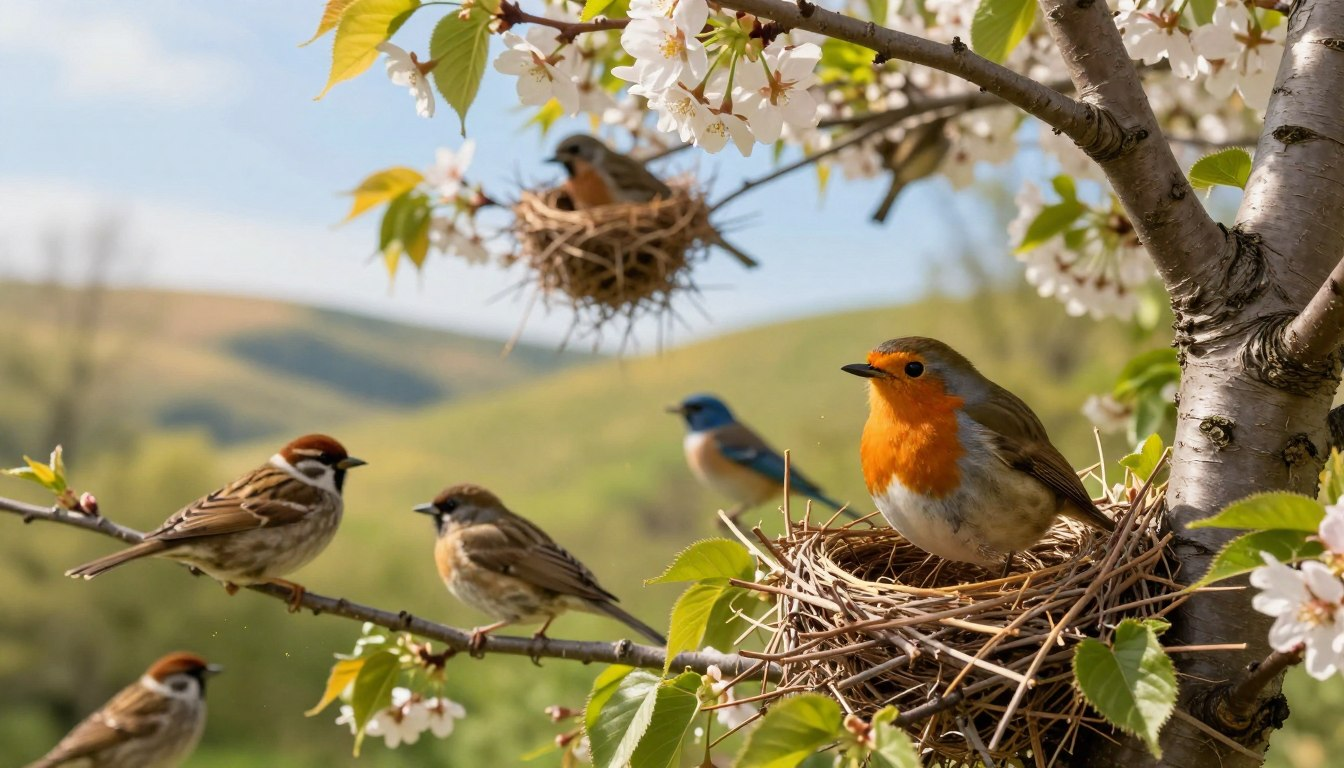
Here’s something that changes the way most people watch their gardens: nesting season doesn’t start in spring. Not for all birds, anyway. By the time you spot a robin carrying a beak full of mud across the garden in April, that bird has probably been defending a territory for six weeks. The Great Horned Owl down the road may be sitting on eggs right now — in February, in the cold, in the dark.
The question “when do birds nest in spring?” sounds like it should have a tidy answer. It doesn’t. What it has instead is something more interesting: a staggered biological calendar that reveals, species by species, exactly how each bird has carved out its own window in the year — shaped by what it eats, where it nests, what its chicks need to survive, and how precisely those requirements map onto the season’s food supply.
This guide gives you a month-by-month breakdown of what’s actually happening, honest regional context, the full nesting cycle in plain language, and what the law actually says about disturbing nests in the US and UK. Whether you’re planning yard work, installing a nest box, or just genuinely curious about the birds outside your window — here’s what you need to know.
⚡ Quick Answer: When Do Birds Nest in Spring?
- February–March: Early nesters begin — raptors, resident songbirds, cavity scouts
- April–June: Peak season for most backyard songbirds across North America
- June–August: Late nesters like the American Goldfinch are just getting started
Nesting season isn’t a date — it’s a rolling window that different species slot into based on biology, food availability, and local weather. Some birds are raising second broods before others have laid a single egg.
Why Birds Nest in Spring — and Why Not All of Them Do
The short version: longer days trigger hormonal changes that kick off breeding behavior. The biological term is photoperiodism — as winter fades and daylight hours increase, many bird species experience a hormonal cascade that initiates singing, territorial defense, pair bonding, and eventually nesting. It’s not temperature. It’s not a calendar date. It’s not some instinct to follow the crowd. It’s light — specifically, the ratio of daylight to dark hours in a 24-hour period.
But light is just the starting gun. What actually determines when a specific species commits to nesting is almost always food. Songbirds raise their chicks almost exclusively on protein-rich invertebrates — caterpillars, beetles, flies, crane fly larvae. The timing of a species’ nesting peak has been shaped, over millions of years, to line up with the annual peak in its primary food source. A Blue Tit in a British oak woodland times its breeding so the hatch coincides with the explosion of winter moth caterpillars emerging from the oak canopy in May. It’s a system tuned by evolutionary pressure to a specific biological window — and it’s remarkable that it works as precisely as it does.
This is also why climate change matters so directly for birds. When spring temperatures warm earlier, trees leaf out earlier, caterpillars emerge earlier — but the birds, still responding to day length rather than temperature, don’t always adjust in sync. That mismatch between when chicks hatch and when food peaks is one of the most intensively studied problems in contemporary ornithology. It’s not an abstraction. It shows up directly in nest success rates, brood sizes, and population trends.
And it explains the late nesters in a way that makes immediate sense once you see it. The American Goldfinch doesn’t nest in spring at all — deliberately. It waits until mid-summer because it feeds its chicks primarily on plant seeds and thistle down, materials that aren’t available until July. The Goldfinch didn’t miss the memo about spring. It’s running on a completely different food calendar, and it’s been doing so successfully for longer than humans have been watching.
What People Notice in Real Yards — and Often Misread
Spend a single spring actually watching birds in your yard with some attention and a few patterns emerge quickly — the kind that don’t always match the tidy timelines in field guides.
The most common surprise is how early everything starts. Nesting feels like an April or May event, but the signals are already there weeks earlier. Birds begin singing from different perches, holding specific locations in the yard more deliberately, chasing each other out of certain areas with real commitment. At the time it just looks like “more bird activity.” In hindsight, it was territorial behavior — the first, decisive step in nesting that most people don’t recognise while it’s happening because it doesn’t look like nesting yet.
Then comes what experienced birders sometimes call the quiet period, and it catches people out every year. Sometime in early summer, usually June, the yard suddenly feels emptier. The dawn chorus fades. Birds seem less visible. The natural conclusion is that nesting has wrapped up for the season. In reality, that’s often when things are at their most delicate. Fledglings — young birds that have just left the nest but cannot yet fly properly — are scattered through low shrubs and ground cover, staying as still and invisible as possible while their parents feed them quietly. The activity hasn’t stopped. It’s changed texture, become harder to read, gone underground. Walking through the yard at this stage and not noticing anything isn’t reassuring — it’s exactly the situation in which a cat or a careless boot does the most damage.
Hedges and shrubs are another reliable blind spot. Most people only register how heavily they’re used for nesting once they actually stop moving and watch for a few minutes. A bird disappearing into the same section of a hedge, reappearing a minute later, then repeating the pattern — that’s almost always an active nest. The nest itself is usually completely invisible from the outside. The behavior around it isn’t, once you know what you’re looking for.
Month by Month: What’s Actually Happening Out There
The table below describes what you’d observe in a typical mid-latitude North American location. Warmer regions run four to six weeks ahead of this. Northern Canada and high elevations run the same amount behind. Think of it as a template rather than a fixed schedule — the birds are responding to local conditions, not the calendar on your wall.
| Month | What’s actually happening | Who’s involved | What it means for your yard |
|---|---|---|---|
| February | Most people don’t associate this month with nesting — but some of the most dramatic breeding events in the year happen here. Great Horned Owls are already incubating eggs in the cold. Resident songbirds start territorial singing on warm days, a full two months before casual observers notice “nesting season.” In mild-winter zones, early breeders may begin nest construction. | Great Horned Owl, Red-tailed Hawk, some year-round residents in warmer areas | This is the ideal month to clean out old nesting material and get boxes up or checked. Any major tree work should happen now — it’s the last genuinely safe window before things become complicated. |
| March | The first genuine wave of nest construction begins. Cavity nesters start investigating boxes with obvious intent — they’re not just exploring, they’re evaluating. Watch for birds carrying grass, hair, moss, or feathers. Courtship feeding is visible in some species. Territory boundaries are being actively and sometimes loudly contested. | Black-capped Chickadee, Downy Woodpecker, early American Robins, Eastern Bluebird in warmer areas | Stop trimming hedges and shrubs the moment you see birds carrying nesting material into them. The nest is already underway, whether you can see it or not. |
| April | Peak nest building and egg laying begins for most common backyard species. Migration pushes additional breeding birds through. The dawn chorus reaches its annual peak. Cavity nesters are actively incubating; cup nesters are still building or laying. The yard is at its busiest and most structurally complex. | American Robin, Song Sparrow, House Finch, White-breasted Nuthatch, Carolina Wren | Keep cats indoors. Reduce foot traffic near known or suspected nest sites. If a bird flushes off a hedge every time you walk past, there’s a nest in it. Give it space. |
| May | Early nesters have chicks in the nest and are running constant food delivery operations. Robins may be on a second clutch. Migrant warblers, vireos, and flycatchers arrive and establish breeding territories almost immediately. The yard is simultaneously finishing one cycle and beginning another. | Yellow Warbler, Red-eyed Vireo, Eastern Wood-Pewee; robin second broods beginning | Hold off on power-washing eaves, clearing ivy, or doing anything structural to climbing plants. Nest sites are often tucked into exactly those spots, invisibly. |
| June | Peak season for northern regions. Fledglings start turning up on the ground and in low shrubs — this is the “quiet period” that looks like the end of nesting but isn’t. Second and third broods are underway. Goldfinches are just beginning to nest. The calendar says summer; the birds say otherwise. | Most backyard species still active; American Goldfinch beginning to nest in many areas | Fledglings on the ground are normal and almost always fine. Their parents are within earshot, watching. Don’t pick them up. Keep pets away from low cover and long grass. |
How Timing Shifts by Region
Latitude is the single biggest variable in nesting timing, and it shifts things more than most people expect. A Northern Mockingbird in Miami operates on a completely different calendar than its counterpart in Virginia, which operates differently again from populations in New Jersey. Then add elevation — mountain populations of the same species often nest four to six weeks later than lowland birds twenty miles away — and what looks like “spring nesting” becomes a rolling sequence that plays out across four or five months depending on where you are.
| Region | Typical Active Nesting Window | What’s Distinctive Here |
|---|---|---|
| Gulf Coast, Florida, southern Texas | February through May; some species active year-round | Multiple broods are the norm, not a bonus. Some resident species never fully stop breeding. Winter visitors complicate the picture — what looks like a territorial bird in February may be a wintering individual still, not yet a nester. |
| Mid-Atlantic, Midwest, Pacific Coast (below 45°N) | March through July | The widest diversity of nesting species in the country, including residents and a large wave of breeding migrants. Most familiar backyard species fall squarely into this window. Two broods are common for many species. |
| New England, Great Lakes, northern Plains | April through July | A more compressed season with a sharper peak. Species that raise two broods further south often manage only one here. The May–June window is dense and intense — more species simultaneously active than at any other time of year. |
| Canada (southern provinces) | Late March through August | Canada’s federal guidance provides modeled nesting start, peak, and end dates by geographic zone — a genuinely useful planning tool for anyone making land-use decisions during the season. Use it before scheduling any large-scale work. |
| Mountain West and high elevations | 4–6 weeks later than nearby lowland areas | Don’t assume lowland timing applies at altitude. At 8,000 feet in the Colorado Rockies, spring arrives in May. Birds nesting there in June are on a perfectly normal schedule. The snowpack determines the season more than the calendar does. |
The Full Nesting Cycle — Longer Than Most People Expect
The visible part of nesting — eggs in a cup, adults flying back and forth with caterpillars — is just one phase of a much longer commitment. From the first territorial song to the day the last fledgling disperses from parental care, a single breeding attempt by a common backyard songbird typically runs six to eight weeks. Larger species run considerably longer. And birds often run overlapping cycles simultaneously: a robin incubating a second clutch in May while still bringing food to fledglings from the first one.
Understanding the stages matters practically. If you find a nest with eggs in late April, the adults may still be attending dependent fledglings in June. The nest being empty is not the end of the story.
| Stage | What’s Happening | Typical Duration |
|---|---|---|
| Territory and courtship | Male establishes and defends a breeding territory through song and physical display. Pair bonding follows. The nest site is selected during this stage — often driven more by the female than the male, who may show her several options before she settles on one. | Days to several weeks |
| Nest building | Some species work fast — the House Wren stuffs a cavity with sticks before the female has even seen it. Others, like orioles weaving a hanging pendant nest, take up to two weeks. Weather delays are common and normal. The nest you see is rarely finished in a single day. | 3 days to 2 weeks |
| Egg laying | Most songbirds lay one egg per day, usually in the morning. The full clutch — typically 3 to 6 eggs for common backyard species — is complete before incubation begins, so all chicks hatch within a narrow window rather than staggered across days. | 3–7 days for most songbirds |
| Incubation | One or both parents keep eggs at body temperature using a featherless “brood patch” — bare, blood-vessel-rich skin that transfers heat directly. This is the stage when adults are most deliberately still and quiet near the nest, which is exactly why it gets misread as abandonment. | 10–14 days for most small songbirds |
| Nestling period | Chicks are in the nest, growing rapidly, and generating a constant food demand. A pair of chickadees with a full nest may make over 500 food delivery trips in a single day — which is one reason disturbance near the nest during this period is so costly to the adults. | 10–20 days for most songbirds |
| Fledgling care | Young birds leave the nest but remain dependent on parents for food and protection. They hide in low vegetation, make short attempts at flight, and are supervised by adults who may look frantic to observers. This is the stage most commonly misread as abandonment — and it’s the one where well-meaning intervention causes the most harm. | 1–3 weeks depending on species |

Common Backyard Birds and When They Actually Nest
The table below focuses on North America. Timing is given as general ranges — your specific location, the year’s particular weather pattern, and local food availability all shift these dates in practice. The Goldfinch entry at the bottom is the one that consistently catches people off guard, and it’s worth understanding why it nests so late rather than just accepting it as an oddity.
| Species | Typical Nesting Window | What You’ll Notice — and What It Means |
|---|---|---|
| American Robin | Early spring through late summer; 2–3 broods common | Mud-and-grass cup nests on ledges, in shrubs, on structural brackets. Both parents feed the chicks. The male’s rolling, musical morning song — the sound most people associate with spring arriving — intensifies during breeding season and drops off sharply when chicks fledge. |
| Black-capped / Carolina Chickadee | April through June in most mid-latitude areas | Cavity nesters that excavate their own holes in soft dead wood or use nest boxes lined with moss and fur. The female incubates alone; the male feeds her on the nest. Once eggs appear, checking the box more than once a week does real harm. |
| Eastern Bluebird | March through August; commonly 2–3 broods | Needs open habitat — short grass, scattered perches, clear sightlines. The male scouts sites and shows the female options; she makes the final decision and builds the nest herself. A box in dense woodland won’t be used regardless of how well it’s built or how many years it’s been there. |
| House Finch | March through August; multiple broods | Extraordinarily tolerant of human proximity — will nest in hanging baskets, wreaths, drainpipe brackets, and dense ornamental shrubs inches from frequently used doors. The female does all incubating; the male feeds her throughout. Once eggs appear, the nest is federally protected under the Migratory Bird Treaty Act. |
| Song Sparrow | March through August in many areas | Nests on or near the ground, tucked into tall grass, dense shrubs, or low bramble. The clearest sign of an active nest is watching where the female disappears to after foraging — she’ll take the same invisible route every time. |
| Yellow Warbler and other migrants | Late April through July, after arrival from migration | Breeding territories are established quickly after arrival. Males sing intensely and constantly in the first week or two — almost compulsively so. Nests are small, neat cups built by the female in willows, alders, or dense streamside shrubs. The nest is easy to overlook; the male singing from a fixed perch is not. |
| American Goldfinch | June through August — deliberately | Not a late nester by accident. The Goldfinch times its nesting to coincide with peak thistle, milkweed, and coneflower seed production — used as both chick food and the soft plant down that lines its tightly woven nest cup. Nesting before those materials exist would make the system fail. If your Goldfinches haven’t nested by June, they haven’t started. They haven’t finished. |
How to Genuinely Help Nesting Birds
Give Them Space — Particularly in the First Two Weeks
The most helpful thing most people can do during nesting season costs nothing and requires no equipment: stay away from active nests. The window from egg-laying through the first week of incubation is when nests are most vulnerable to abandonment. The adults are still consolidating the decision to commit to that specific spot. Repeated disturbance — someone walking past daily, a dog working the perimeter of a shrub, a cat sitting ten feet from a box entrance — can tip that decision toward abandonment in ways that feel completely invisible from the outside. You don’t see the abandonment coming. You just find the nest cold on a Tuesday with no obvious explanation.
Cornell Lab’s NestWatch Code of Conduct is worth reading if you’re going to monitor boxes or nests with any regularity. The core of it is simple: keep visits brief, no more than once a week, don’t linger near the entrance, and never handle eggs or chicks unless you’re a licensed wildlife rehabilitator with a specific reason to do so.
What the Law Actually Covers
Most people are vaguely aware that disturbing nesting birds is “probably not great” but aren’t clear on exactly where the law draws the line. It draws it more firmly than most people assume.
In the United States, the Migratory Bird Treaty Act makes it a federal offence to take, pursue, hunt, capture, kill, or possess any migratory bird — which includes destroying or disturbing an active nest with eggs or dependent young. This applies during routine landscaping, construction, and property maintenance, not just deliberate interference. “I didn’t know there was a nest there” is not a legal defence, which is precisely why inspection before work starts matters and isn’t just good advice.
In the United Kingdom, the Wildlife and Countryside Act 1981 is explicit: it is a criminal offence to intentionally take, damage, or destroy the nest of any wild bird while that nest is in use or being built. It covers every wild bird in the UK — from a Blackbird in your hedge to a House Sparrow under your eaves. It is not limited to rare or protected species. The RSPB and RSPCA both advise specifically against hedge cutting between March and September for exactly this reason. Additional and heavier protections apply to Schedule 1 species.
The Habitat Work That Actually Changes Outcomes
- Plant native trees and shrubs. This isn’t decorative ecological advice — it’s the single most impactful thing a garden owner can do for nesting birds. A native oak supports hundreds of caterpillar species. A non-native ornamental tree supports almost none. Nestlings eat caterpillars. The logic is direct and the evidence behind it is substantial.
- Keep a shallow water dish clean and filled. Robins and Barn Swallows use wet mud as a structural nest material. A reliable source of soft mud in your yard during early spring directly supports nest construction — not just drinking and bathing.
- Leave the dead wood. A standing dead tree or a large dead limb is often the most valuable nesting habitat feature a yard contains. Woodpeckers excavate cavities in soft dead wood that are subsequently used by chickadees, nuthatches, bluebirds, and wrens. If a dead snag isn’t a safety hazard, the most useful thing you can do is leave it exactly where it is.
- Get nest boxes up in January or February. By March, cavity nesters are already making decisions. A box that goes up in April gets noted for next year. One that has been in place since February gets evaluated this year — that is the entire difference.
Mistakes That Harm Nesting Birds — Often Without Realising It
❌ Trimming hedges in April or May without checking first
Hedges are among the most heavily used nest sites for garden birds — robins, blackbirds, dunnocks, chaffinches, and sparrows all use them routinely. Before running a hedge trimmer along any planted boundary between March and September, stop and watch for sixty seconds. A pair of birds repeatedly disappearing into the same section of hedge means there is almost certainly a nest inside. In the UK, cutting that hedge is not inconsiderate — it is potentially a criminal offence under the Wildlife and Countryside Act 1981, regardless of whether the nest was visible before you started.
❌ “Rescuing” a fledgling on the ground
A young bird with visible feathers, sitting on the ground or in low vegetation, hopping but not flying well — that is almost certainly a fledgling going through the completely normal process of leaving the nest. Its parents are almost certainly within earshot, watching it carefully and continuing to feed it between your visits. Picking it up removes it from parental care and almost always reduces, not improves, its chances of survival. Unless it’s in immediate and unavoidable danger from a cat or traffic, place it in the nearest available cover and leave the area. The parents will find it. They are better at this than you are.
❌ Checking nest boxes every couple of days
It comes from caring — which is exactly what makes it a hard habit to break. But every approach and every opening during laying and early incubation registers as a potential predator event to the adults inside. Once a week, briefly, with minimum time at the entrance, is the outer limit during active nesting. During the first ten days after eggs appear, don’t open the box at all if you can avoid it. The birds aren’t waiting to be checked on. They’re waiting to be left alone.
❌ Using pesticides on lawns and gardens near nest sites
Songbird chicks are fed almost entirely on insects and invertebrates for their first weeks of life. A lawn treated with insecticide near an active nest doesn’t just reduce the available food supply — it means the caterpillars and beetles the adults are catching and delivering to the nest may be contaminated. The chicks receive a dose with every meal. The connection between pesticide use near active nest sites and poor nest productivity is well documented and not subtle.
❌ Installing nest boxes in late spring and expecting results that year
By mid-April, cavity-nesting birds that visit your yard have been scouting potential nest sites for weeks and may already be committed to locations elsewhere. A new box appearing in late spring registers as an option for next year. January or February is when boxes need to be in place and ready — not as a guideline, but as a practical consequence of how cavity-scouting behavior actually works.
❌ Assuming a quiet, still nest means abandonment
During incubation, adult birds are deliberate about minimising activity near the nest. Appearing absent is the strategy — it reduces the risk of drawing a predator to the location. A nest that looks inactive for a full morning or even a full day is very likely occupied and being incubated. Before concluding a nest has been abandoned, watch it from a comfortable distance for at least an hour. You’ll usually see the sitting bird shift position, or the other partner arrive to exchange incubation duties. The absence you’re interpreting as abandonment is probably intentional concealment.
Tips From Experienced Birders
- Do your hedge audit in late February, not March.
Walk every hedge and shrub in your yard in the last two weeks of February. Decide what, if anything, needs trimming and do it then — thoroughly. Once March arrives, the window for safe pruning closes fast. In the UK, the law applies from the moment a bird begins building, not from when eggs appear. February is your window. Use it. - Learn one specific thing about each species in your yard.
Knowing that Goldfinches nest late, that Robins use mud as a structural material, that Chickadees stuff nest boxes with moss before laying — these specific facts turn nesting season from a vague background event into something you can actually read in real time. Cornell Lab’s All About Birds covers every North American species in detail and is free. The BTO and RSPB have equivalent depth for UK species. - Take a dated photo when you find an active nest.
A photograph with the date lets you estimate where you are in the cycle — and when fledging is likely to happen. That’s not just interesting. It tells you when it’s safe to resume whatever yard work you paused. Otherwise the timing guesswork is just that: guesswork. - Tilt nest boxes very slightly forward when mounting.
A degree or two of forward tilt helps rainwater run off the roof and away from the entrance hole rather than dripping in during wet springs. Most nest box guides don’t mention it. It’s a small detail that makes a real difference in high-rainfall areas. - Don’t add perches to nest box entrance holes.
Native cavity nesters grip the entrance hole directly — they have no use for a perch and don’t look for one. Perches primarily benefit House Sparrows and give climbing predators a better foothold during raids. Remove any perch fitted to a box you’ve purchased. It was added for aesthetics, not birds. - Plant specifically for the late nesters.
If you want Goldfinches nesting in your yard, the single most useful thing you can grow is native thistles, coneflowers, or native sunflowers. These provide both the plant down Goldfinches use to line their nests and the seeds they feed their chicks. It’s a specific enough relationship that the planting decision directly and measurably affects whether nesting happens at all. - If a box sits empty for a full season, move it — don’t replace it.
An empty box after an entire breeding season is almost always a placement problem, not a box quality problem. Move it to a different location with better habitat match and more seclusion before the following January. If a box hasn’t been taken after two full seasons in the same spot, there’s a good chance the location is the issue. Changing position is almost always more productive than changing the box.
Frequently Asked Questions
Do birds actually start nesting in March?
Many do — and some start earlier. Cavity nesters like chickadees, nuthatches, and bluebirds begin seriously investigating nest sites in late February or early March in most mid-latitude regions. Resident songbirds begin territorial singing well before that. The popular image of nesting as an April or May event is accurate for the peak, but the groundwork is laid considerably earlier. In parts of the UK, Robins begin nest construction from late February onward on mild days — sometimes earlier.
What months are peak nesting season?
For most of the continental United States and southern Canada, April through June represents peak nesting — when the highest number of species are simultaneously incubating eggs or raising chicks. But “peak” is geographically dependent. In the Gulf states, peak activity starts earlier and ends later. In northern Canada and mountain regions it might run May through July. And some species — the American Goldfinch being the clearest example — don’t reach their peak until mid-summer, long after most people have stopped paying attention.
How long do birds stay in the nest?
For most common backyard songbirds, chicks spend roughly 10–20 days in the nest after hatching, following an incubation period of about 10–14 days. After that, they fledge and spend another one to three weeks under parental care before becoming genuinely independent. The full cycle from first egg to independent young typically runs six to eight weeks — considerably longer for larger species like raptors and waterfowl, which may remain dependent on their parents for months.
Is it safe to trim hedges in spring?
Potentially not — and in the UK, it may be a criminal offence if birds are actively nesting. The Wildlife and Countryside Act 1981 makes it illegal to intentionally damage or destroy the nest of any wild bird while it’s in use or being built. This applies to every wild bird, not just protected species. The RSPB advises specifically against hedge trimming between March and September. In the US, the Migratory Bird Treaty Act provides comparable protection for active nests of migratory species. The safe approach: inspect carefully before any cutting during the nesting window, and if you find an active nest, pause and wait for the full cycle to complete before resuming.
Do some birds really nest into summer?
Yes — more commonly than most people realise. American Robins routinely raise two or three broods, with the final one often fledging in August. American Goldfinches typically don’t begin nesting until June or July. Cedar Waxwings — another deliberate late nester — raise young well into August. And Mourning Doves in warmer climates will attempt nesting in almost any month of the year. The assumption that everything wraps up by the end of June misses a significant portion of the nesting activity that’s actually happening in your yard.
The Bottom Line
Nesting season is not a single event. It’s a staggered series of biological commitments that different species make at different points between February and August — each one timed to a specific food window, a specific habitat requirement, a specific strategy for getting chicks to independence alive. The more precisely you understand that, the more you can act on it: timing yard work to avoid disrupting an active nest, getting boxes up early enough to actually be found, or simply making sense of why the mockingbird started singing at 3 AM in February when spring still felt months away.
Understanding even roughly why the calendar works the way it does makes you a meaningfully better neighbour to the birds outside your window. They’re running on schedules shaped over millions of years. Your job isn’t to manage that — just to stay out of the way when it matters, and make the conditions a little easier when you can.
Sources
- Cornell Lab of Ornithology — NestWatch: nesting guidance and timing data. nestwatch.org
- Environment and Climate Change Canada — General nesting periods modeled by geographic zone. canada.ca
- Birds Canada / Project NestWatch — Late nesting patterns and monitoring resources. birdscanada.org
- Britannica — Photoperiodism. britannica.com
- NestWatch / Cornell Lab — Nesting cycle stages and species accounts. nestwatch.org/learn
- Audubon Society — American Robin species account. audubon.org
- NestWatch Code of Conduct — Minimising disturbance to active nests. nestwatch.org
- US Fish & Wildlife Service — Bird nests and federal protections. fws.gov
- Wildlife and Countryside Act 1981 — UK primary legislation. legislation.gov.uk
- RSPB — Wildlife and Countryside Act overview and nesting disturbance guidance. rspb.org.uk
- RSPCA — How to help nesting birds in the UK. rspca.org.uk
- Vine House Farm — Guide to putting up nest boxes. vinehousefarm.co.uk