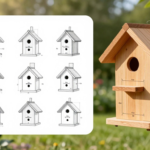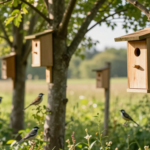
The “best” nest box placement is never just a number. It’s a combination of height,
direction (orientation), habitat, and predator protection.
This guide gives you a practical, per-species cheat sheet plus simple rules you can use anywhere.
Quick Takeaways (Read This First)
- Height: match the species’ natural nesting zone (low shrub layer vs. canopy vs. open pole/edge).
- Direction: aim the entrance away from driving rain and prevailing winds; avoid harsh midday sun where summers are hot. [1]
- Microclimate beats compass points: morning sun can help warm chicks, but overheating kills—shade and airflow matter. [1]
- Predators decide success: the best placement fails without a baffle/guard where predators are common. [1]
- Ethics: never move or repeatedly open boxes during active nesting unless you’re part of a trained monitoring program and following local guidance. [17]
The 5 Rules of Nest Box Placement

1) Pick “the right habitat,” not just the right tree
Most failures happen because a box is placed in the wrong habitat.
Bluebirds and tree swallows want open space; chickadees and nuthatches prefer woodland edges;
wrens often do best near brushy cover. Put the box where the bird already looks for nest sites. [1]
2) Match the height range for the species
If you mount a box outside the species’ normal nesting zone, it may stay empty even if the box is perfect.
Height also affects predator pressure—low boxes can be successful if they’re on a pole with a proper baffle. [1]
3) Aim the entrance to reduce weather stress
“North/east” is a common guideline because it often avoids harsh sun and prevailing storms, but it’s not universal.
Your goal is simple: keep wind-driven rain out, and keep the box from overheating. [1]
4) Predator-proof the setup
If you can do only one upgrade, install a predator baffle on pole-mounted boxes.
Avoid easy predator “launch points” (fences, roofs, stacked items) and keep the entrance clear of jump-off routes. [1]
5) Don’t “over-check” the box
Frequent disturbance can cause abandonment. If you monitor, keep checks brief and follow local wildlife guidance.
Avoid opening boxes during extreme cold/heat or heavy rain. [17]
How to Choose Nest Box Direction in Any Climate
The simple decision method
- Find your prevailing bad weather direction (where hard rain and wind usually come from).
- Aim the entrance away from that direction whenever possible. [1]
- Then manage sun:
Microclimate tips that outperform “compass rules”
- Shade matters: a box in dappled shade can outperform a perfectly “north-facing” box in full sun. [1]
- Ventilation + drainage: small vents under the roof and drain holes in the floor reduce heat and moisture problems. [18]
- Avoid heat traps: south-facing walls, reflective surfaces, and unshaded boxes in open yards during heat waves. [1]
Per-Species Placement Chart (North America)
Use this as a starting point. Local conditions (predators, heat, habitat, competition) can change what works best.
When a direction is listed as “away from prevailing winds,” prioritize that over strict compass points. [1]
| Species | Best habitat placement | Recommended mounting height | Direction / entrance orientation | Spacing guideline | Notes that improve success |
|---|---|---|---|---|---|
| Eastern Bluebird [2] | Open fields, meadows, short grass; near perches | 3–6 ft (0.9–1.8 m) | Face open area (often E/SE works well if weather allows) | ~300 ft apart (or more) | Pole + baffle is a top upgrade; avoid dense woods. |
| Tree Swallow [3] | Open areas near water/meadows | 5–6 ft (1.5–1.8 m) | Often east-facing; avoid strong prevailing winds | ~35 ft apart (or manage competition with bluebirds) | If pairing with bluebirds, use paired boxes to reduce conflict. |
| House Wren [4] | Gardens/edges with brush and shrubs | 5–10 ft (1.5–3 m) | Away from prevailing rain/wind; avoid baking sun | ~100 ft apart | Wrens may fill nearby boxes with sticks—space boxes thoughtfully. |
| Black-capped / Carolina Chickadee [5] | Woodland edges, mature yards with trees | 5–15 ft (1.5–4.6 m) | Away from prevailing wind; often N/NE works in hot regions | ~650 ft apart | They like a quieter area; avoid heavy foot traffic directly under the box. |
| Tufted Titmouse [6] | Deciduous woods and mature neighborhoods | 5–15 ft (1.5–4.6 m) | Away from prevailing wind | ~860 ft apart | Place near trees but not where squirrels can leap onto the box. |
| White-breasted Nuthatch [7] | Woodland edges, large trees | 5–20 ft (1.5–6 m) | Away from prevailing wind | ~650 ft apart | Mount firmly; wobbling boxes reduce occupancy. |
| Downy Woodpecker [8] | Wooded edges, parks, tree-rich yards | 6–20 ft (1.8–6 m) | Away from prevailing wind | ~165 ft apart | Add wood chips/shavings inside (woodpeckers often prefer it). |
| Northern Flicker [9] | Open woods, edges, parks | 6–12 ft (1.8–3.7 m) | Often south or east (adjust for heat exposure) | ~330 ft apart | Wood chips/shavings recommended; keep entrance clear of branches. |
| American Kestrel [10] | Open country, farmland edges, grasslands | 10–30 ft (3–9 m) | Often south or east; prioritize shelter from storms | ~0.5 mile (or more) | Place with open flight access; mount securely. |
| Eastern Screech-Owl [11] | Wooded neighborhoods, forest edges | 10–30 ft (3–9 m) | Away from prevailing wind; reduce direct rain entry | ~0.25 mile (or more) | Mount securely; keep an open flight path to the entrance. |
| Wood Duck [12] | Over water or very near water | 6–30 ft (1.8–9 m) and >3 ft above high water | Often face toward open water / safe approach | ~0.25 mile (or more) | Include an interior ladder/mesh for ducklings; predator guards are critical. |
| Hooded Merganser [13] | Near water/forested wetlands | 6–25 ft (1.8–7.6 m) | Face away from wind-driven rain; keep approach open | ~0.5 mile (or more) | Use predator guards; avoid heavy disturbance during nesting. |
| Prothonotary Warbler [14] | Swamps and wooded wetlands | 4–12 ft (1.2–3.7 m) | Over/near water; minimize harsh sun exposure | ~100 ft apart | Mount on poles over water where feasible to reduce predators. |
Important: If invasive competitors are common in your area (e.g., House Sparrows or European Starlings in parts of North America),
use species-appropriate entrance sizes and follow local guidance for humane, legal management and monitoring. [1]
Quick Chart (UK / Ireland Basics)

In much of the UK, a common recommendation is to avoid hot south-facing “sun traps” and to aim entrances
to reduce wind-driven rain—often north-east works well. [15] [16]
| Species | Box type & habitat | Placement height | Direction | Extra placement notes |
|---|---|---|---|---|
| Blue Tit [16] | Small hole-fronted box in gardens/parks/woodland | 2–3 m | Entrance facing north-east; avoid south-facing walls | Avoid obvious sun traps; higher if disturbance risk. |
| House Sparrow [16] | Hole-fronted box (often multiple boxes together) | 2–3 m | North-east; sheltered from prevailing wind/rain | Colonial—several boxes close together can help. |
| Robin [16] | Open-fronted box placed in cover (vegetation/climbers) | Usually < 2 m | North-east; sheltered from wind-driven rain | Robins are wary—place where you won’t watch the entrance daily. |
Mounting, Spacing, and Predator Protection
Best mounting choice: pole + baffle
For many backyard situations, a pole mount with a proper baffle gives the highest “safety per effort.”
Tree mounts can work, but they often increase predator access unless you use effective guards and reduce nearby launch points. [1]
Spacing: territorial vs. colonial birds
- Territorial birds (many songbirds) do better with more spacing.
- Colonial birds (some species, like house sparrows in the UK) can accept clustered boxes. [16]
- Competition management: if two species fight (e.g., bluebirds vs. swallows), use paired boxes with intentional spacing. [2] [3]
Weatherproofing that helps every species
Troubleshooting: Why Birds Ignore a Nest Box
- Wrong habitat: box is in woods but the target bird nests in open areas (or vice versa).
- Overheating: full sun + poor ventilation + heat waves.
- Predators: no baffle/guard, or the box is reachable from a fence/roof/branch.
- Wrong height or direction: entrance takes the brunt of storms or intense afternoon sun.
- Too much disturbance: frequent checks, pets, or daily traffic directly beneath the box.
If a box stays empty for a full breeding season, relocate it in the off-season:
adjust habitat first, then address direction and shade, then upgrade predator protection. [1]
FAQ
What direction should a nest box face?
Face the entrance away from the direction that brings your harshest rain and wind. In many areas, that often results in an east or
northeast orientation, but local weather and shade matter more than a single compass rule. [1] [15]
What height is best for most backyard birds?
Many small cavity nesters do well between about 5–15 feet, but the “right” height is species-specific.
Use the chart above for the bird you’re targeting. [1]
Is it OK to mount a box on a tree?
It can work, but tree mounts often increase predator access. If you can, use a pole and install a baffle for better protection. [1]
When should I install or move nest boxes?
Install or relocate boxes in the non-breeding season (often fall/winter). Avoid moving boxes during active nesting. [17]
Editorial Note
This guide is designed for homeowners and backyard birders. If you’re managing habitat for sensitive or protected species,
follow guidance from local wildlife agencies and conservation groups.