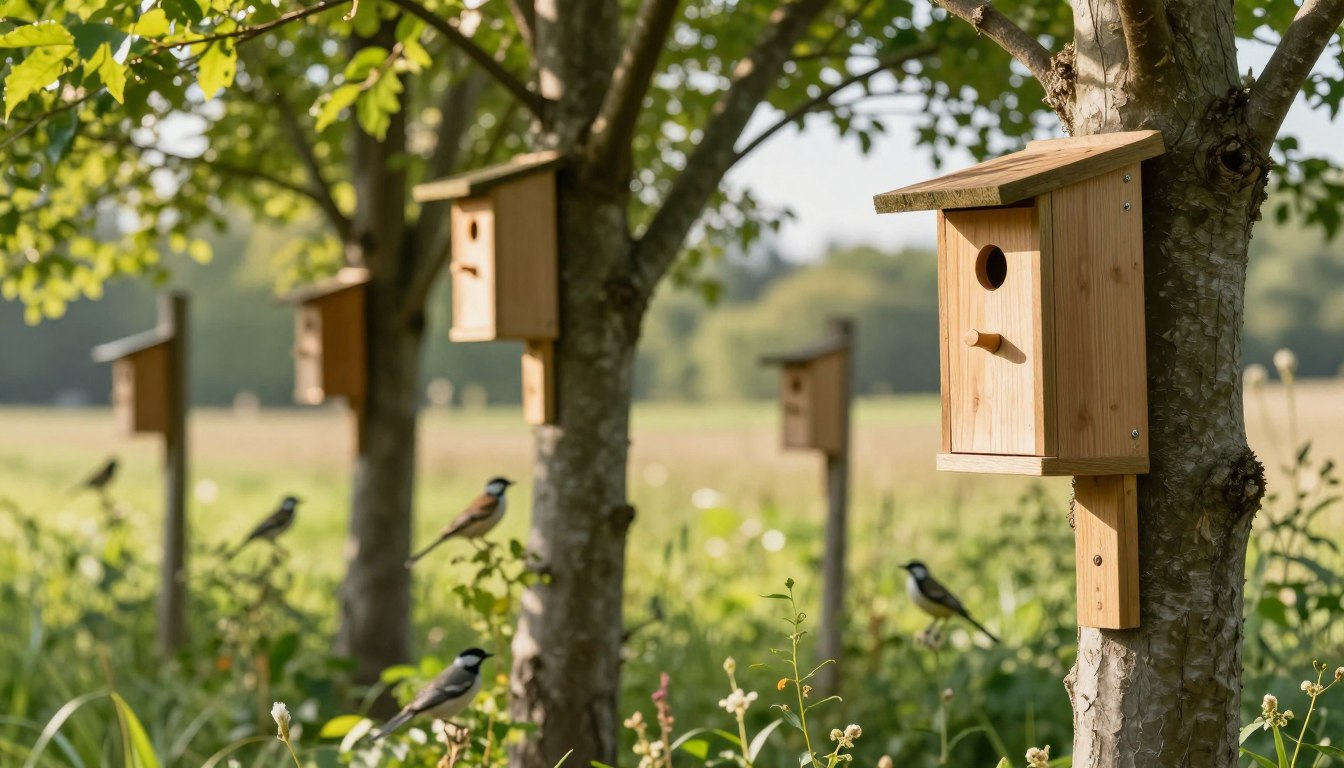
If you’ve built (or bought) the “perfect” nest box and birds still ignore it, placement is usually the missing piece.
Two choices matter most: mounting height and entrance direction (orientation).
This guide gives you a per-species starting point, then shows how to adjust for heat, wind, rain, and predators.
- Quick rules (works for most yards)
- Per-species placement table
- How to choose the best direction in your climate
- Predator-proof placement (the biggest win)
- Spacing & competition (why “too close” fails)
- Monitoring & maintenance without disturbing
- FAQ
- Sources
Optional: Watch this if need quickly first
Quick rules (works for most yards)
Fast default: If you only remember one thing, aim for an entrance direction that
avoids harsh afternoon sun and avoids the direction your strongest rain/wind comes from.
In many Northern Hemisphere locations that often means east / southeast (cool climates)
or north / northeast (hot climates). Then match the height to the species table below.
The 10-minute placement test (original, practical)
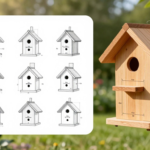
- Stand where the box will go at 2:00–5:00 PM on a warm day (or estimate). If the face of the box bakes in full sun then, rotate it or move it into dappled shade.
- Watch wind-driven rain. Your box should not face into the direction storms usually hit from.
- Check the “launch lane.” Birds want a clear flight path to the entrance—avoid dense branches directly in front.
- Make cleaning realistic. A box you can safely reach gets cleaned; a box you can’t reach becomes parasite-prone and gets abandoned.
Universal checklist
- Mount securely so the box doesn’t swing.
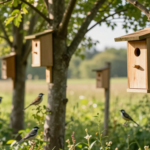
- Prefer poles/posts over trees when possible (easier to predator-guard).
- Keep the entrance clear of nearby branches/vines predators can use as “stairs.”
- Use shade/ventilation in hot regions; avoid boxed-in heat pockets.
- Avoid placing boxes near busy doors/walkways (some birds defend aggressively).
- Don’t add an exterior perch (it can help predators and invasive competitors).
Per-species placement table (height + direction + notes)
Measurements are starting points. Local habitat, predator pressure, and heat exposure can justify small adjustments.
Heights shown in feet and meters (rounded).
| Species (or group) | Structure type | Best height | Entrance direction | Placement notes that actually move the needle |
|---|---|---|---|---|
| Eastern Bluebird [1] | Cavity nest box | 4–6 ft (1.2–1.8 m) | East | Face toward open habitat. If Tree Swallows compete, pair boxes 15–20 ft apart (two boxes = fewer fights). |
| Tree Swallow [2] | Cavity nest box | 5–6 ft (1.5–1.8 m) | South or East | Works best in open areas near water/meadows. Add a predator guard on the pole. |
| House Wren [3] | Cavity nest box | 5–10 ft (1.5–3.0 m) | Any | Place within ~100 ft of woody cover, but give a clear flight path. Keep wren boxes away from boxes meant for bluebirds/swallows to reduce conflict. |
| Carolina Wren [4] | Cavity box / sheltered box | 3–6 ft (0.9–1.8 m) | Any | Often succeeds near porches/sheds in sheltered spots. Prioritize cover from heavy rain. |
| Black-capped Chickadee [5] | Cavity nest box | 5–15 ft (1.5–4.6 m) | Away from prevailing wind | Partial sun is helpful; avoid deep shade and avoid boxes facing into the windiest storms. |
| Tufted Titmouse [6] | Cavity nest box | 5–15 ft (1.5–4.6 m) | Away from prevailing wind | Forest edges/yards with mature trees. Stable mounting matters more than “perfect” compass direction. |
| White-breasted Nuthatch [7] | Cavity nest box | ~5 ft (1.5 m) | East (avoid hot afternoon sun & wind) | If your summers are hot, keep the entrance out of direct late-day sun. |
| Red-breasted Nuthatch [8] | Cavity nest box | 5–15 ft (1.5–4.6 m) | Away from prevailing wind | More likely to use boxes where natural dead-tree cavities are limited. |
| Northern Flicker [9] | Large cavity box | 6–12 ft (1.8–3.7 m) | South or East | Needs wood chips/shavings inside; angle slightly forward so fledglings can climb out. |
| Purple Martin [10] [11] | Colony housing / gourds | 10–15 ft (3.0–4.6 m) | Often South or West, but wind/rain matters | Keep a wide open “flight bowl” (no nearby trees/buildings). If storms hit hard from one direction, face entrances away from that direction. |
| Eastern Phoebe [12] | Nest shelf (open platform) | 3–16 ft (0.9–4.9 m) | Any | Place under eaves/overhangs near cover. Great alternative to “problem nests” on light fixtures. |
| Barn Swallow [13] | Nest shelf/cup (not a cavity box) | Under eaves/soffits (usually 8–12+ ft / 2.4–3.7+ m) | Sheltered; avoid facing into heavy wind/rain | Mount on a building in a sheltered site. Avoid active doorways (they defend the nest). Ensure mud is available nearby. |
| Wood Duck [14] | Waterfowl nest box | 6–30 ft (1.8–9.1 m) | South or West | Best near/over water; if on land, place within ~100 ft of water and use a predator guard. |
| Hooded Merganser [15] | Waterfowl nest box | 6–25 ft (1.8–7.6 m) | Toward water | Install near or over water; add wood shavings inside. |
| Mallard [16] | Waterfowl nesting structure | ~3 ft (0.9 m) | Away from prevailing wind | Not a typical backyard “birdhouse” use-case—this is for wetland/open-water management. Follow local wildlife guidance. |
Important accuracy note: “Direction” is not a magic trick. If a box faces “perfectly east” but gets cooked by afternoon heat reflected off a wall, it can still fail. Use the climate rules below.
How to choose the best direction in your climate
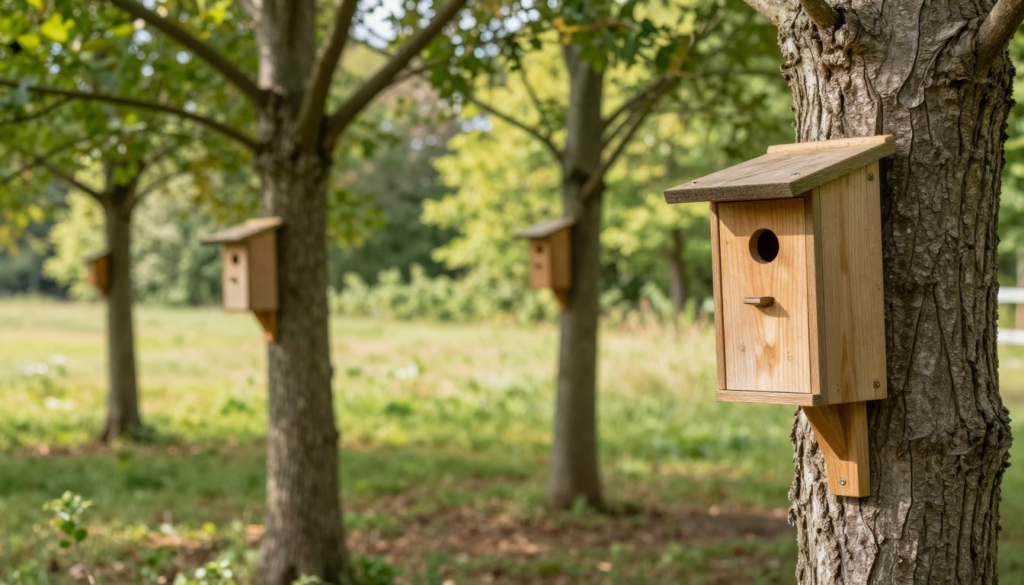
Rule 1: Avoid the most punishing sun
In hot climates, nest boxes can overheat quickly—especially if they get direct afternoon sun.
If your summers are warm, favor north / northeast or place the box where it gets morning sun and afternoon shade.
Rule 2: Don’t face into your storm track
Wind-driven rain chilling eggs is a real failure mode. A common guideline (especially in the UK/Europe)
is to face boxes between north and east to avoid strong sun and the wettest winds. [17]
For many North American yards, the best practical version is: face away from your prevailing wind
(or rotate the box slightly until rain doesn’t blow directly in).
Rule 3: If you’re in the Southern Hemisphere, flip the sun logic
In the Southern Hemisphere, the strongest sun often comes from the north/west, so the “avoid afternoon bake”
logic usually means you avoid north/west exposure and prefer entrances protected from that heat.
Simple decision: If you can’t decide, choose the direction that gives gentle morning light and protection from wind/rain—then make predator-proofing your #1 focus.
Predator-proof placement (the biggest win)
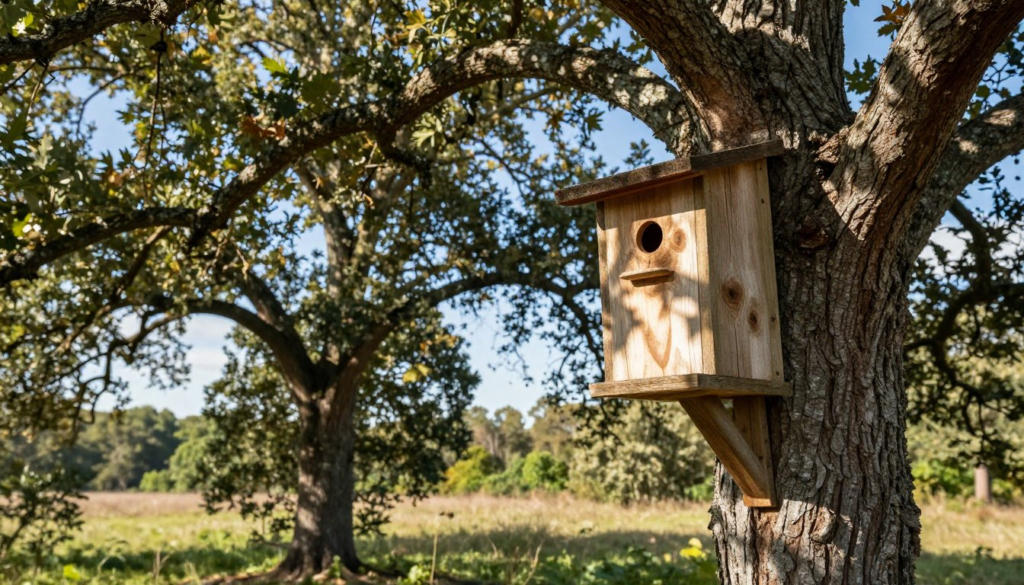
Most “mystery failures” aren’t about an inch of height or 10° of direction—they’re about predators and competition.
Best practice hierarchy
- Pole-mounted box + predator baffle (best all-around for backyards).
- Post-mounted with baffle (good).
- Tree-mounted without guards (easiest for predators).
Placement details that prevent problems
- Keep the entrance clear of nearby branches or structures predators can climb from.
- Mount solid—swinging boxes are often abandoned.
- For waterfowl boxes, predator guards and branch-free approaches are repeatedly recommended. [14]
Spacing & competition (why “too close” fails)
Many cavity nesters are territorial, and some species will harass others off a box. Use the spacing suggestions as a starting point, then watch behavior and adjust.
Two common, proven strategies
- Bluebird + swallow pairing: When swallows compete with bluebirds, two boxes placed relatively close together
can reduce fighting by giving each species an option. [1] [2] - Wren separation: If you want both wrens and bluebirds, don’t cluster their boxes together.
Wrens can be aggressive toward nearby cavity nesters. [3]
If invasive competitors are common in your area (e.g., House Sparrows, European Starlings), you’ll also want
species-appropriate entrance designs and active monitoring.
Monitoring & maintenance without disturbing
Clean, dry boxes get reused. But disturbance can cause abandonment—especially early in laying/incubation.
- Clean at the right time: do major cleaning outside the nesting season (late fall/winter is safest in many regions).
- Check quickly and gently: tap first, then open briefly; don’t linger staring into the box. [18]
- Don’t move active boxes: relocate only when you’re sure the box is not being used.
Legal note: Rules about disturbing nests vary by country/region. If you’re unsure, follow local wildlife guidance.
FAQ
Do nest boxes really need to face a specific direction?
Direction helps, but it’s usually secondary to heat exposure, wind-driven rain, and predator-proof mounting.
Use the species table as a starting point, then adjust to avoid harsh afternoon sun and storm-facing exposure.
Is it better to mount a nest box on a tree or a pole?
A pole/post is often better in backyards because it’s easier to add predator guards and keep climbing “routes” away from the box.
Why is my box empty even though the size is right?
Most common causes: too much disturbance, poor habitat match (e.g., bluebirds need open ground), too much shade or too much heat,
predator access, or competition from other cavity nesters.
Can I attract barn swallows with a normal birdhouse?
Usually no—barn swallows use open nest shelves/cups under eaves, not cavity boxes. [13]