Put hummingbird feeders out slightly before your area’s typical spring arrival window, and keep them up
slightly after your area’s typical fall departure window. Feeders don’t “stop migration,” and they can help birds refuel
during cold snaps, storms, and late-season movements.
[1][2][3]
Quick answer: When should I put hummingbird feeders out?
- Spring: set feeders out 7–14 days before your typical arrival window.
- Fall: keep feeders up 14–21 days after your typical departure window.
- Stop when: you’ve had 10–14 days with no visits and no local reports.
Timing shifts year to year with weather and flowering—treat dates as a seasonal window, then verify with live reports.
[1][4]
How to use this migration planning chart

- These are typical windows, not exact dates. Migration shifts with temperature, storms, and bloom timing.
- Best practice: plan with the windows, then confirm what’s happening this week using live reports.
- Species note: Eastern states are dominated by Ruby-throated Hummingbirds. Western states may include resident Anna’s plus migrants like Rufous.
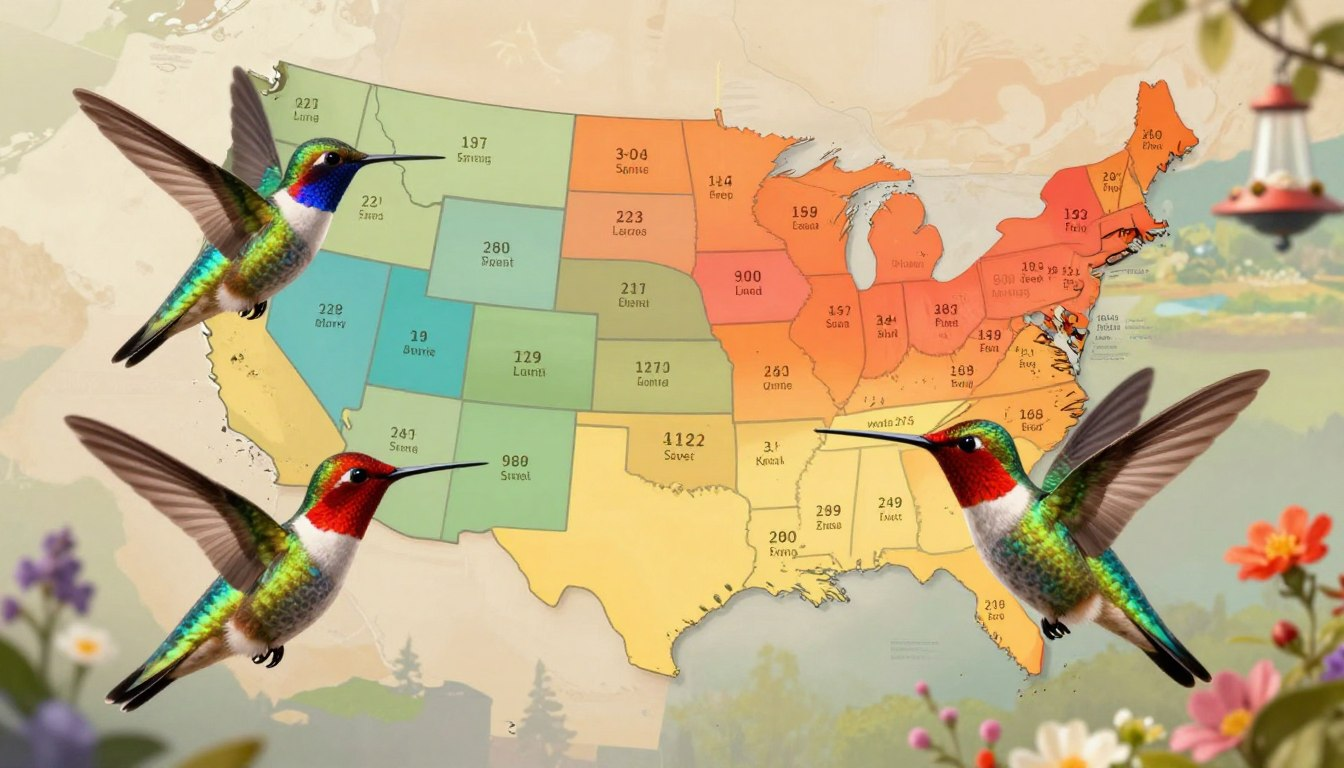
Why grouping improves accuracy: many neighboring states share similar timing. Grouping removes repetition and keeps the chart readable,
while still giving you the same planning window.
[1][4]
Migration windows by region + state (grouped)
Tip: If you’re near a border, use the earlier spring window and the later fall window between the two states.
Then confirm using live reports.
[1][4]
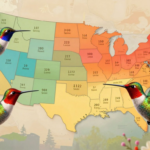
1) Quick regional overview (fastest way to plan)
| Region | Typical spring arrival | Typical fall departure | What most people notice |
|---|---|---|---|
| Northeast | Early May–Early Jun | Late Aug–Late Sep | Mostly Ruby-throated |
| Mid-Atlantic + DC | Early Apr–Early May | Late Aug–Oct | Mostly Ruby-throated |
| Southeast | Mid Feb–Mid Apr | Sep–Nov | Early arrivals common |
| South Central | Late Feb–Apr | Sep–Nov | TX/OK mixed species |
| Midwest | Early Apr–Late May | Late Aug–Oct | Ruby-throated peak later north |
| Great Plains | Apr–Early Jun | Late Aug–Oct | Some western overlap |
| Mountain West | Mar–Early Jun | Late Aug–Oct | Broad-tailed/Black-chinned common |
| Southwest | Mar–Apr | Sep–Oct | Desert species + migrants |
| Pacific West | Feb–Apr | Sep–Nov | Anna’s often resident |
| Non-continental | Varies | Varies | AK seasonal; HI no regular season |
2) Find your state (still complete, but not a giant wall of rows)
Northeast (ME, NH, VT, MA, RI, CT, NY, NJ, PA)
| States | Typical spring arrival | Typical fall departure |
|---|---|---|
| ME | Late May–Early Jun | Late Aug–Early Sep |
| NH, VT | Mid May–Early Jun | Late Aug–Early Sep |
| MA, RI, CT | Early–Mid May | Late Aug–Mid Sep |
| NY | Early–Mid May | Late Aug–Late Sep |
| NJ, PA | Late Apr–Mid May | Late Aug–Late Sep |
Mid-Atlantic + DC (DE, MD, DC, VA, WV)
| States | Typical spring arrival | Typical fall departure |
|---|---|---|
| DE, MD, DC | Late Apr–Early May | Late Aug–Late Sep |
| VA | Early–Mid Apr | Sep–Oct |
| WV | Mid–Late Apr | Late Aug–Late Sep |
Southeast (NC, SC, GA, FL, AL, MS, TN)
| States | Typical spring arrival | Typical fall departure |
|---|---|---|
| FL | Mid Feb–Mar | Oct–Nov |
| AL, MS | Late Feb–Mar | Sep–Oct |
| SC, GA | Mid Mar–Early Apr | Sep–Oct |
| NC, TN | Late Mar–Mid Apr | Sep–Oct |
South Central (KY, AR, LA, TX, OK)
| States | Typical spring arrival | Typical fall departure |
|---|---|---|
| KY | Early–Mid Apr | Sep–Oct |
| AR | Mid–Late Mar | Sep–Oct |
| LA | Late Feb–Mar | Oct |
| TX | Late Feb–Mar | Oct–Nov |
| OK | Late Mar–Apr | Sep–Oct |
Midwest (OH, IN, IL, MI, WI, MN, IA, MO)
| States | Typical spring arrival | Typical fall departure |
|---|---|---|
| OH, IN, IL | Late Apr–Early May | Late Aug–Late Sep |
| IA | Late Apr–Mid May | Late Aug–Mid Sep |
| MI | Early–Mid May | Late Aug–Mid Sep |
| WI | Mid May | Late Aug–Early Sep |
| MN | Mid–Late May | Late Aug–Early Sep |
| MO | Early–Mid Apr | Sep–Oct |
Great Plains (KS, NE, SD, ND)
| States | Typical spring arrival | Typical fall departure |
|---|---|---|
| KS | Apr | Sep–Oct |
| NE | Late Apr–May | Late Aug–Late Sep |
| SD | Mid–Late May | Late Aug–Early Sep |
| ND | Late May–Early Jun | Late Aug–Early Sep |
Mountain West (CO, WY, MT, ID, UT, NV)
| States | Typical spring arrival | Typical fall departure |
|---|---|---|
| NV | Mar–Apr | Sep–Oct |
| CO | Mid Apr–May | Late Aug–Late Sep |
| UT | Apr–May | Late Aug–Late Sep |
| ID | Late Apr–May | Late Aug–Mid Sep |
| WY | May–Early Jun | Late Aug–Mid Sep |
| MT | May–Early Jun | Late Aug–Early Sep |
Southwest (AZ, NM)
| States | Typical spring arrival | Typical fall departure |
|---|---|---|
| AZ, NM | Mar–Apr | Sep–Oct |
Pacific West (CA, OR, WA)
| States | Typical spring arrival | Typical fall departure |
|---|---|---|
| CA | Feb–Mar | Oct–Nov |
| OR | Mar–Apr | Sep–Oct |
| WA | Late Mar–Apr | Sep–Oct |
Non-continental (AK, HI)
| State | Typical spring | Typical fall | Note |
|---|---|---|---|
| AK | May–Jun | Aug | Rufous primary |
| HI | No regular hummingbird season | Check local rare-bird reports | |
Feeder rule of thumb: use the windows to avoid being late, then confirm with live maps and local sightings.
[1][4]
Feeder timing rules that work everywhere
1) Put feeders out early (it won’t “pull” hummingbirds north)
Migration timing is driven mainly by seasonal cues. A feeder helps birds refuel—especially around storms or cold snaps.
[3]
2) Leaving feeders up in fall does not stop migration
Keeping feeders available later can support late migrants and young birds topping off before long flights.
Feeders don’t prevent migration.
[3]
3) Make your plan “live” with real-time migration reports
For the best accuracy, combine this planning chart with current sightings (especially during unusual weather years).
[1][4]
Safe nectar recipe + cleaning schedule
The only nectar recipe you need
- Mix: 1 part white granulated sugar + 4 parts water
- Do not use: honey, brown sugar, artificial sweeteners, or red dye
- Optional: warm water helps dissolve sugar; let nectar cool fully before filling feeders
These basics are widely recommended because they avoid unsafe additives and reduce spoilage risk.
[2][3]
Cleaning schedule (prevents mold and illness)
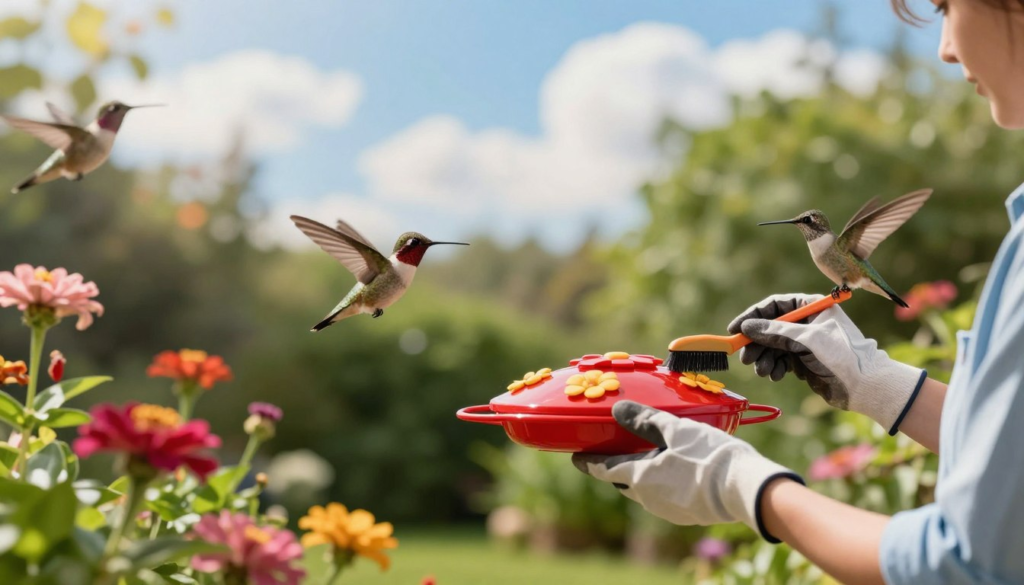
- Cool weather: wash and refill every 3–5 days
- Warm weather: wash and refill every 1–3 days (more often during heat)
- Always: scrub feeding ports and rinse thoroughly
Quick safety check: If nectar looks cloudy, smells fermented, or has dark specks, dump it and wash the feeder.
Adjusting for weather, altitude, and “winter” hummingbirds
Altitude and cold microclimates
Higher elevation and colder microclimates often mean later flowering and later hummingbird activity. Use the windows as a plan,
then confirm with live trackers.
[1][4]
Storm and cold-snap adjustment
- If a cold front hits during your arrival window, keep nectar available and fresh—arrivals may come in pulses after storms.
- On freezing nights, bring feeders in overnight and put them back out at sunrise.
FAQ
Will feeding hummingbirds make them dependent?
No. Feeders supplement natural nectar and insects—especially during migration and rough weather. Pair feeders with nectar plants for the best support.
[2][3]
Should I stop feeding so they migrate?
No. Keeping feeders up later supports late migrants; it doesn’t “trap” them. Migration timing isn’t stopped by feeders.
[3]