Here’s a detail that most hummingbird feeder guides quietly skip over: Ruby-throated Hummingbirds cross the Gulf of Mexico in a single overnight flight. Five hundred miles of open water, no land, no stopping. They depart the Yucatán coast after dark and arrive — in Texas, Louisiana, Mississippi, the Florida Panhandle — having burned through almost everything they stored. Some land on the beach and sit for a few minutes before moving on. Others keep flying inland immediately.
By the time one of those birds reaches a backyard in Ohio or Pennsylvania, it has been traveling for days, fuel-stopping along the way at whatever is available. If your feeder isn’t out yet, it doesn’t wait. It has already learned, over its lifetime of migrations, to find what’s available and keep moving. The concept of pausing for a feeder that might appear later doesn’t exist in its decision-making.
That single fact — the feeder needs to be ready before they arrive, not when you first see one — is the most practically useful thing in this entire guide. Everything else is detail work: which states see which species, how to keep nectar safe in July heat, why taking your feeder in early in September is actively counterproductive for the birds that need it most, and why the Ruby-throat you see hovering at your window in August might not be the one that spent the summer in your yard at all.
This guide covers all of it, by state, with the kind of specificity that general migration articles tend to leave out.
⚡ Quick Answer: When to Put Out — and Take Down — Your Feeder
- Spring setup: 7–14 days before your region’s typical first-arrival window
- Fall takedown: 14–21 days after your typical last-sighting window
- The “done” signal: 10–14 consecutive days with no visits and no local sightings reported on eBird or Journey North
Migration timing shifts by two to three weeks depending on the year’s weather. Use the dates in this guide as your baseline — then confirm what’s actually happening this season with a quick look at Journey North’s live sighting map about ten days before your window opens.
How to Use This Guide — Including the Western US Caveat

The timing windows in this guide are built from decades of crowd-sourced sighting data on Journey North and eBird. They reflect when hummingbirds have historically been present in each region — which is different from when you should first start thinking about putting a feeder out. That window is 7–14 days earlier than the first-arrival dates shown here.
A few things to keep in mind before diving into the tables:
- Set your feeder out before the window opens, not at its start. “Typical spring arrival: Late April” means birds have historically first appeared in late April. Your feeder should already be stocked by mid-April — not filled on the day you expect to see the first bird.
- Near a state border? Take the earlier spring date and the later fall date from the two neighboring regions. You’re in the overlap zone — cover both sides of it.
- Check a live sighting map 10 days before your window. Journey North publishes real-time crowd-sourced sighting maps throughout spring migration. If birds are already being reported 200 miles south, your window is opening now — not in two weeks.
- Eastern US: mostly one species. East of the Great Plains, the Ruby-throated Hummingbird dominates almost exclusively. If you see a hummingbird in Ohio in May, it’s almost certainly a Ruby-throat — no identification work needed.
- Western US: considerably more complex. Anna’s Hummingbirds are year-round residents along much of the Pacific Coast. Rufous Hummingbirds migrate through the Mountain West twice annually — northbound in spring, southbound as early as July. Black-chinned, Broad-tailed, Calliope, Costa’s, Broad-billed, and others all have overlapping but distinct windows in the West. If you’re in Arizona, New Mexico, or southeastern California, species identification genuinely matters for timing in a way it simply doesn’t in the East.
Feeder Timing by Region and State
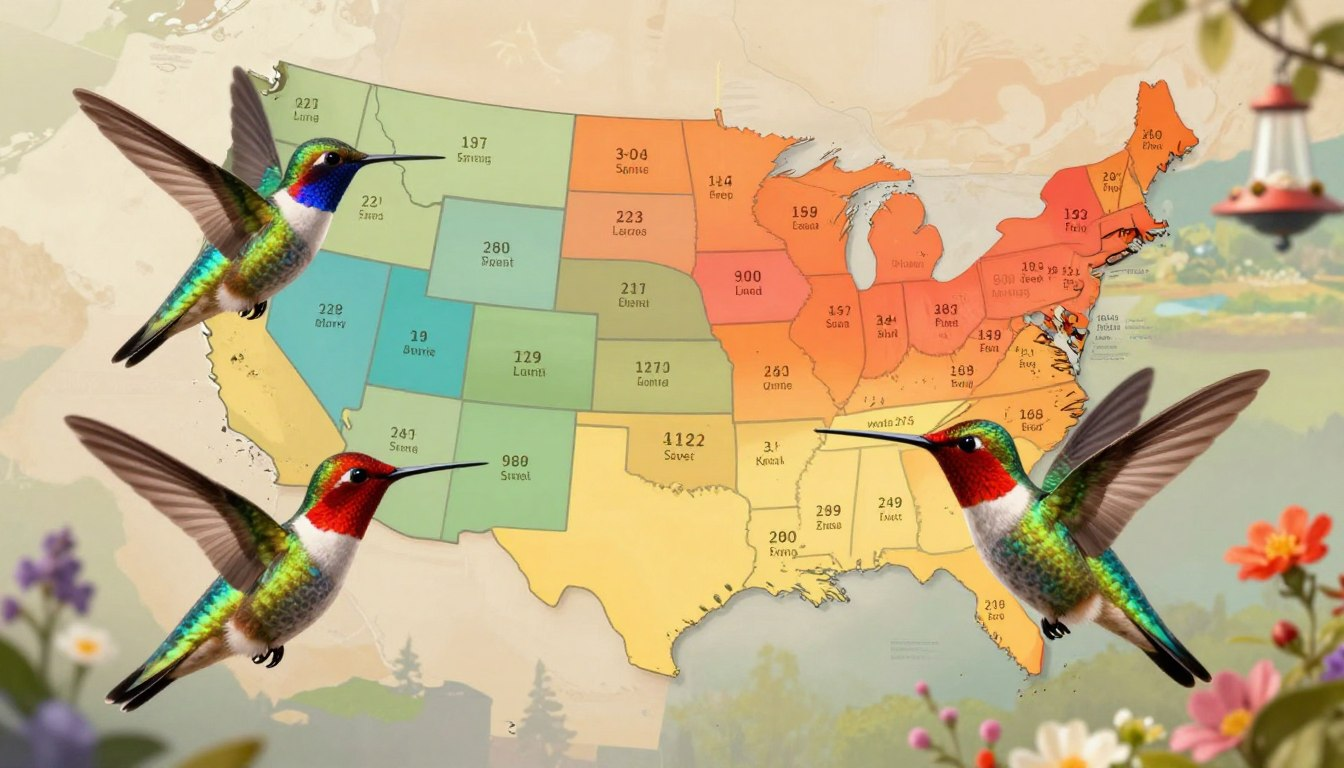
Start with the regional overview for fast planning, then expand your specific region for state-level dates.
Regional Overview — Fastest Way to Plan
| Region | Put feeder out by | Keep feeder up until | Primary species |
|---|---|---|---|
| Northeast (ME, NH, VT, MA, RI, CT, NY, NJ, PA) | Mid April (late April for ME) | Mid–Late October | Ruby-throated almost exclusively; occasional Rufous vagrant in fall |
| Mid-Atlantic + DC (DE, MD, DC, VA, WV) | Late March | Late October | Ruby-throated dominant; rare western strays possible in fall |
| Southeast (FL, AL, MS, GA, SC, NC, TN) | Early February (FL) to mid-March (NC/TN) | October–November | Earliest Ruby-throated arrivals in the country; some year-round activity in south FL |
| South Central (KY, AR, LA, TX, OK) | Mid–Late February | October–November | Ruby-throated in east TX/LA/AR; Black-chinned, Rufous, and others in TX west of I-35 |
| Midwest (OH, IN, IL, MO, IA, MI, WI, MN) | Mid–Late April (later for WI, MN) | Late September–Early October | Ruby-throated; peak timing shifts significantly between MO and MN |
| Great Plains (KS, NE, SD, ND) | Mid March (KS) to mid May (ND) | Late September–Early October | Ruby-throated; Calliope and Rufous possible in western counties |
| Mountain West (CO, WY, MT, ID, UT, NV) | Late March–Mid April (adjust later for elevation) | Late September–Early October | Broad-tailed, Black-chinned, Rufous; Calliope in migration; elevation shifts timing dramatically |
| Southwest (AZ, NM) | Mid–Late February | October–November | Up to 15+ species possible in SE Arizona; Broad-billed, Costa’s, Black-chinned, Rufous, Violet-crowned |
| Pacific West (CA, OR, WA) | Year-round for Anna’s; late January for migrants | Year-round in coastal areas | Anna’s resident all year; Rufous, Allen’s, Black-chinned migratory |
| Alaska | Early May | Late August | Rufous primary; Calliope possible in SE panhandle |
| Hawaii | No established resident hummingbirds. Occasional documented vagrants — monitor Hawaii rare bird alerts if interested | ||
State-by-State Timing — Click Your Region
Northeast — ME, NH, VT, MA, RI, CT, NY, NJ, PA
The Ruby-throated Hummingbird arrives in the Northeast in a north-to-south reverse gradient — southern NJ and PA see birds in late April, while Maine doesn’t typically see first arrivals until late May or early June. The entire region is essentially one species, one arrival wave. A warm spring accelerates it; a cold one delays it. Watch Journey North in April — if birds are already reaching Virginia, your window is approaching.
| State(s) | Feeder out by | Keep up until |
|---|---|---|
| Maine | Early–Mid May | Late September–Early October |
| New Hampshire, Vermont | Early May | Late September–Early October |
| Massachusetts, Rhode Island, Connecticut | Late April | Late September–Mid October |
| New York | Late April | Early–Mid October |
| New Jersey, Pennsylvania | Mid–Late April | Mid October |
Mid-Atlantic + DC — DE, MD, DC, VA, WV
Virginia and Maryland are among the first states where Ruby-throated Hummingbirds reliably establish territories after crossing through the Southeast. In a warm year, birds appear in southern Virginia in late March. The Mid-Atlantic also consistently produces a modest but real autumn fallout of late migrants in October — which is exactly why keeping your feeder up through that month pays off in a way that taking it in early doesn’t.
| State(s) | Feeder out by | Keep up until |
|---|---|---|
| Delaware, Maryland, DC | Mid–Late April | Late October |
| Virginia | Late March–Early April | Late October |
| West Virginia | Early–Mid April | Early–Mid October |
Southeast — FL, AL, MS, GA, SC, NC, TN
The Gulf Coast is the landing zone. Ruby-throated Hummingbirds arriving from their trans-Gulf crossing make landfall in Louisiana, Mississippi, Alabama, and the Florida Panhandle — and they arrive exhausted and genuinely hungry. The beach and coastal vegetation near the landing points is worth watching in late February: the birds don’t come in like casual visitors, they come in like they need to eat immediately, because they do. South Florida is a different situation entirely — some Ruby-throateds may be present year-round in the southernmost areas, and winter Rufous individuals turn up regularly at feeders in the Panhandle and east coast.
| State(s) | Feeder out by | Keep up until |
|---|---|---|
| Florida | Early February (or year-round in south FL) | November |
| Alabama, Mississippi | Mid–Late February | October–Early November |
| Georgia, South Carolina | Early–Mid March | October |
| North Carolina, Tennessee | Mid–Late March | October |
South Central — KY, AR, LA, TX, OK
Texas is the most species-diverse state east of Arizona for hummingbirds, and the difference between eastern and western Texas is significant enough that it’s almost two separate planning exercises. The eastern third is Ruby-throated territory — same as Louisiana and Arkansas. But west of roughly Interstate 35, the Hill Country and Trans-Pecos region hosts Black-chinned Hummingbirds as breeders, Broad-tailed as migrants, and Rufous moving through in late summer. A birder in Alpine sees a completely different feeder than a birder in Houston. If you’re in western Texas, local birding groups are more useful than any regional chart.
| State(s) | Feeder out by | Keep up until |
|---|---|---|
| Kentucky | Late March–Early April | October |
| Arkansas | Early–Mid March | October |
| Louisiana | Mid–Late February | October–Early November |
| Texas (eastern) | Mid–Late February | October–November |
| Texas (western Hill Country / Trans-Pecos) | Early–Mid March | October–November (multiple species) |
| Oklahoma | Mid–Late March | October |
Midwest — OH, IN, IL, MO, IA, MI, WI, MN
Missouri is on a genuinely different feeder calendar than Minnesota — birds arrive in Missouri in early April and don’t typically reach Minnesota until mid-May. The wave moves roughly 20 miles per day northward through the Midwest, broadly following the bloom of native wildflowers. Illinois birders tracking eBird can watch the arrival front advancing through their state across two or three weeks in April — it’s one of the more satisfying real-time migration experiences available without leaving home.
| State(s) | Feeder out by | Keep up until |
|---|---|---|
| Missouri | Late March–Early April | October |
| Ohio, Indiana, Illinois | Mid–Late April | Late September–Early October |
| Iowa | Mid–Late April | Mid–Late September |
| Michigan | Late April–Early May | Mid–Late September |
| Wisconsin | Early–Mid May | Mid–Late September |
| Minnesota | Early–Mid May | Mid September |
Great Plains — KS, NE, SD, ND
The Great Plains is where Ruby-throated Hummingbirds approach the western edge of their reliable range. In eastern Nebraska and Kansas, Ruby-throateds are familiar and predictable. In the western counties of both states, the picture changes — the species becomes less consistent and Calliope and Rufous become plausible, particularly during late summer as southbound migrants move through. North and South Dakota have notably compressed seasons: birds arrive in mid-May and are largely gone by early September.
| State(s) | Feeder out by | Keep up until |
|---|---|---|
| Kansas | Mid–Late March | October |
| Nebraska | Mid–Late April | Late September |
| South Dakota | Early–Mid May | Late August–Early September |
| North Dakota | Mid–Late May | Late August–Early September |
Mountain West — CO, WY, MT, ID, UT, NV
Elevation dominates timing here more than any other variable — more than latitude, more than the weather in a given year. A Broad-tailed Hummingbird at 5,000 feet near Colorado Springs might appear by late April. The same species nesting at 9,500 feet in the San Juan Mountains won’t arrive until late May or early June. Colorado birders use a working rule that’s rough but reliable: add one week of delay for every 1,000 feet above 5,000 feet. Rocky Mountain National Park, sitting at 8,000–12,000 feet, runs a full month behind Denver — same state, completely different calendar.
The Rufous Hummingbird complicates the fall picture in a way that catches people off guard. Rufous breed as far north as southeast Alaska and begin their southward migration as early as mid-July — one of the earliest migratory departures of any North American bird. By August, Rufous birds are actively moving through the Mountain West on their way to Mexico. The visitors at your late-summer feeder may have nothing to do with your local breeding population. They’re travelers, moving fast, on a completely different schedule.
| State(s) | Feeder out by | Keep up until |
|---|---|---|
| Nevada (lowland) | Early–Mid March | October |
| Colorado, Utah (lowland) | Early–Mid April | Late September–Early October |
| Colorado, Utah (above 7,000 ft) | Early–Mid May | Late August–Mid September |
| Idaho | Mid–Late April | Mid–Late September |
| Wyoming | Late April–Early May | Mid September |
| Montana | Late April–Early May | Mid September |
Southwest — AZ, NM
Southeastern Arizona — specifically the Huachuca, Chiricahua, and Santa Rita mountain ranges — is arguably the most productive hummingbird location in North America for species variety. Ramsey Canyon Preserve in the Huachucas has documented 14 species. A single feeder station in Sierra Vista in a good late-summer season might host Broad-billed, Black-chinned, Broad-tailed, Rufous, Calliope, White-eared, Berylline, and Violet-crowned simultaneously. That’s not a typical feeder situation — it’s what the geography of the sky islands produces, funneling an extraordinary diversity of species through a narrow mountain corridor. For anyone outside that specific region: AZ and NM feeders can run year-round at lower elevations where winters stay mild.
| State(s) | Feeder out by | Keep up until |
|---|---|---|
| Arizona, New Mexico (lowland) | Mid–Late February | October–November (year-round in mild areas) |
| Arizona, New Mexico (sky islands, 5,000+ ft) | Late March–Early April | October |
Pacific West — CA, OR, WA
Anna’s Hummingbirds in coastal California, Oregon, and Washington don’t migrate. They’re year-round residents, and they need feeders through winter — not as a bonus, but as a genuine resource during cold snaps when native flowers aren’t available. An Anna’s male that has staked out a winter territory around your yard may genuinely depend on your feeder during a January cold spell in Portland. This is a year-round commitment, not a seasonal one.
The Rufous Hummingbird’s migration through the Pacific Coast is extraordinary relative to its size — breeding as far north as Alaska and southern Yukon, then moving south through the Pacific Flyway, sometimes at elevations above 12,000 feet. They’re stocky, aggressively territorial, and famously intolerant of other species at feeders. If something arrives at your California feeder in July looking like it owns the place and immediately starts chasing everything else away, it’s almost certainly a Rufous.
| State(s) | Anna’s feeder | Migratory species active window |
|---|---|---|
| California (coastal) | Year-round | February–November (Rufous, Allen’s, Black-chinned, Calliope) |
| California (inland / desert) | March–November | March–October (Anna’s, Costa’s, Black-chinned) |
| Oregon (western) | Year-round | March–October (Rufous peak April–August) |
| Washington (western) | Year-round | Late March–October (Rufous, Black-chinned) |
Alaska and Hawaii
Alaska’s hummingbird story is almost entirely the Rufous — one of the most remarkable migrations in North America measured by distance relative to body size. Rufous breed across southeast and south-central Alaska and begin their southward push in late July. The birds moving through the Mountain West in July and August are largely these Alaskan breeders on their way south. Hawaii has no established resident hummingbirds. Vagrants are documented but extremely rare.
| State | Feeder out by | Take down | Notes |
|---|---|---|---|
| Alaska (SE / south-central) | Early–Mid May | Late August | Rufous dominant; Calliope possible in SE panhandle; Anna’s increasingly documented near Ketchikan |
| Alaska (interior / far north) | Not expected | — | Check local checklists |
| Hawaii | No established resident hummingbirds. Extremely rare vagrants documented. Check Hawaii rare bird alerts. | ||
The Timing Rules That Apply Everywhere
The Feeder Needs to Be Ready Before They Arrive
Migration timing is set by biology — by day length, by hormonal cues, by internal calendars shaped over evolutionary time. A Ruby-throated Hummingbird doesn’t hold south because your feeder isn’t out yet. It arrives on schedule and moves on to the next viable fuel stop. Your job is to be a reliable stop on a route it was already flying — not to react to its arrival.
The concern people sometimes raise — that an early feeder pulls birds north before conditions are safe — reflects a genuine misunderstanding of how migration works. Hummingbird migration is initiated by photoperiod: the ratio of daylight to dark hours. A feeder cannot replicate that signal and cannot override it. An early feeder in Ohio doesn’t pull Ruby-throats out of Florida. It just means a refueling stop is available when the birds that were always going to reach Ohio arrive in Ohio. Those are different things.
Leaving the Feeder Up in Fall Doesn’t Trap Anyone
This misconception has circulated long enough and widely enough that it’s worth being direct about. The birds still visiting your feeder in late September and October in the northern states are not your summer residents that failed to leave. They are migrants from breeding grounds further north — in Canada, in the upper Midwest — passing through on their way to Central America. They need fuel. Removing your feeder because you’ve decided to “help them leave” is taking a resource away from birds that are already in active migration, have no need of encouragement, and would leave regardless.
The National Audubon Society is unambiguous on this: keeping feeders available through late fall can meaningfully support late migrants and young birds topping off energy reserves before long flights. The only legitimate reason to take a feeder in is 10–14 consecutive days of zero visits combined with confirmation from eBird or Journey North that birds have genuinely cleared your area.
Make Your Timing Plan “Live” With Real-Time Data
The single most precise thing you can do each spring is open Journey North about ten days before your regional window and see how migration is actually tracking that year. If spring is warm and birds are running two weeks ahead of historical averages, your feeder should be out immediately. If a cold late spring has held things back, you have more margin. This two-minute check in April is worth more than any static table of average dates. For fall, eBird’s species frequency graphs show exactly when hummingbird reports in your county typically drop to zero — a more accurate signal than any rule of thumb.
Nectar: the Correct Formula, the Wrong Additives, and How to Clean Properly
The Formula Is Simple — and Non-Negotiable
One part plain white granulated sugar dissolved in four parts water. That’s the complete recipe. The 4:1 ratio approximates the sucrose concentration of natural flower nectar — typically 21–25% sugar by weight — which is what hummingbird digestive physiology is built for. A stronger mix isn’t more attractive; it’s harder to process. A weaker mix provides insufficient energy for a bird running at 1,200 heartbeats per minute during hovering flight. There is no improvement on the formula worth attempting.
- Plain white sugar only. Granulated cane or beet sugar — they’re chemically identical once dissolved. Either works perfectly.
- Never honey. Honey ferments rapidly at feeder temperatures and promotes growth of Aspergillus mold, which causes aspergillosis — a fatal fungal infection of the respiratory tract. It was the original feeder medium before the risks were understood. It is definitively not recommended.
- Never brown sugar or raw sugar. Molasses residue and mineral compounds that provide no benefit and may interfere with digestion.
- Never artificial sweeteners. Zero calories means zero energy. A hummingbird drinking saccharine solution is expending flight energy to visit your feeder while consuming nothing useful.
- Never red dye. The belief that red dye attracts more birds is not supported by evidence. Most feeders already have red components that function as visual attractants. The dye adds nothing, and the National Audubon Society recommends against it as a precautionary measure.
- Warm water dissolves sugar faster — useful in winter. Let it cool completely before filling. Putting hot nectar in a feeder raises the internal temperature and accelerates early spoilage.
How Often to Clean — Specifically
The cleaning schedule isn’t a bureaucratic formality. Fermented nectar produces alcohol compounds that damage the liver in hummingbirds — the same mechanism as alcohol toxicity in other animals, scaled to a 3-gram bird. Black mold in feeder ports is obvious when it’s advanced. What you can’t see is the earlier-stage bacterial and fungal contamination that makes nectar harmful before it looks wrong. The feeder that looks fine but smells slightly off is already a problem.
| Temperature | Change nectar and clean every | Real-world context |
|---|---|---|
| Below 60°F (15°C) | Every 5–7 days | Early spring, late fall; Pacific Coast winter Anna’s feeders |
| 60–75°F (15–24°C) | Every 3–4 days | Typical active-season weather across most of the country |
| 75–90°F (24–32°C) | Every 1–2 days | Summer across the South and Midwest; most of July and August nationwide |
| Above 90°F (32°C) | Daily — or move to shade | Heat waves; direct sun exposure in summer. Nectar can reach harmful fermentation levels in under 24 hours. |
How to Actually Clean a Feeder
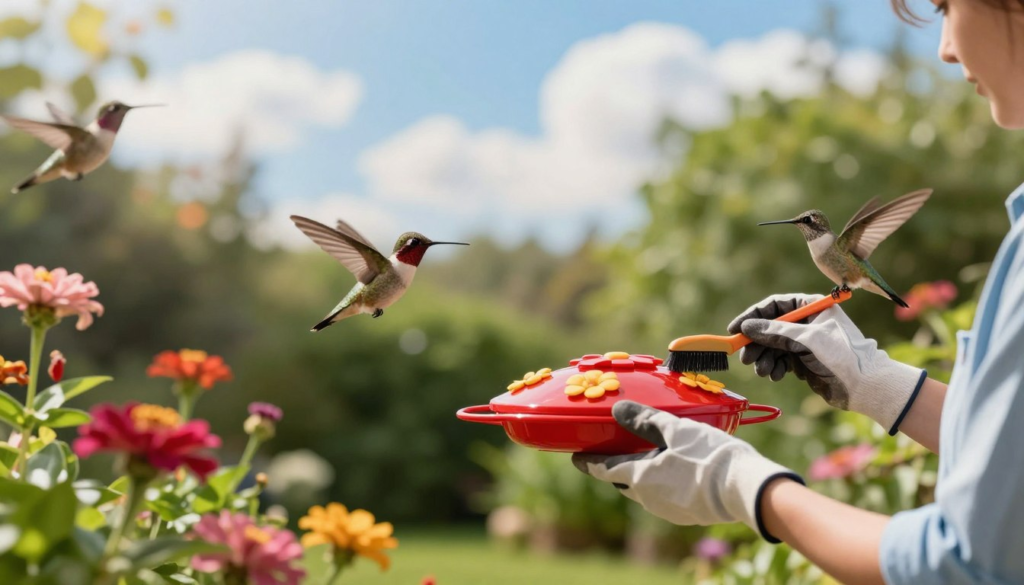
Rinsing with hot water and shaking isn’t cleaning — it’s rinsing. Biofilm builds up on interior feeder surfaces, particularly in ports and reservoir seams, and it doesn’t come off with a rinse. Here’s what actually works:
- Disassemble completely. Every removable part — ports, perches, base, ant moat if present. Cleaning a partially assembled feeder is cleaning the outside of the problem.
- Rinse with hot water first to dissolve crystallized sugar and loosen debris.
- Scrub every surface with a bottle brush — including the reservoir interior, every feeding port, and any tubing. Small port brushes or pipe cleaners reach the individual holes where mold establishes first.
- For routine cleaning: hot water and scrubbing is sufficient. Avoid dish soap — surfactant residue can remain in ports even after rinsing, and hummingbirds are sensitive to it. A dishwasher cycle works well for glass feeders that can tolerate the heat.
- For monthly deep cleaning or any visible mold: soak disassembled parts in a 2:1 water-to-white-vinegar solution for at least one hour, then scrub and rinse thoroughly. Alternatively, use a 10:1 water-to-bleach solution, soak for 15 minutes, then rinse very thoroughly and allow to air dry completely before refilling.
- Dry completely before refilling. Residual moisture in a sealed reservoir accelerates early fermentation.
The One Practical Trick That Actually Reduces Cleaning Frequency
Move the feeder out of direct afternoon sun. A feeder in full sun in Dallas in July can reach internal temperatures above 100°F by mid-afternoon — fermentation accelerates exponentially above 80°F. Moving it to a spot that gets morning sun and afternoon shade drops the average nectar temperature by 15–20°F and can effectively double the time before nectar needs changing. It also makes the feeder more comfortable for the birds using it. A north or east-facing location, or dappled shade from a nearby tree, is ideal in hot climates.
Elevation, Cold Fronts, and Winter Hummingbirds
How Elevation Changes Everything in the Mountain West
The elevation effect on timing is one of the most consistently underestimated variables in feeder guides, and in the Mountain West it matters more than latitude. In Colorado at 5,000 feet near Pueblo, Broad-tailed Hummingbirds may arrive in late April. At 9,000 feet near Crested Butte, the same species won’t appear reliably until late May. At 11,500 feet near Loveland Pass, the entire summer season lasts roughly ten weeks before conditions push the birds out. The flowering of native penstemons, scarlet gilia, and other mountain nectar plants is the real synchronizing factor — the birds arrive when the food does, and the food arrives when the altitude allows.
The working approximation Colorado birders use: add one week per 1,000 feet above 5,000 feet. It’s rough — individual years vary — but it reliably prevents the major timing errors that happen when someone applies lowland dates to a mountain location.
Cold Fronts Create Arrival Pulses — Not Gaps
During active spring migration, hummingbirds don’t fly into headwinds or heavy precipitation — they wait, sometimes for several days, and then move in concentrated bursts when conditions improve. If a cold front pushes through during your arrival window and feeder activity suddenly drops to nothing, don’t conclude the season is over or that you’ve missed it. Keep fresh nectar available. When the front clears and temperatures rebound, birds may arrive in a dense, brief overlap — a wave that looks nothing like the gradual individual trickle you’d see in a clear-weather spring. One quiet week followed by five birds at once is a front clearing, not a coincidence.
On nights forecast to drop below freezing during your active season — which happens in the Mountain West and northern states well into May — bring feeders inside before dark and put them back out at first light. Frozen nectar expands and cracks glass feeders. More practically, an early arrival that spent the night at your yard needs an accessible energy source at dawn, when body temperature is lowest and metabolic demand is highest.
Winter Hummingbirds — Where and Why
Pacific Coast — Anna’s Hummingbirds: They don’t migrate. Year-round residents throughout coastal California, western Oregon, and Washington — and their range is actively expanding northward. An Anna’s male that has established a winter territory around your yard in Portland or Seattle may genuinely depend on your feeder during a sustained cold spell in January. In below-freezing overnight temperatures, bringing the feeder in at dusk and putting it back out at dawn is more reliable than any heating solution.
Gulf Coast and Southeast — winter Rufous visitors: A small but well-documented population of Rufous Hummingbirds spends the winter along the Gulf Coast from Louisiana to Florida rather than completing their normal migration to Mexico. These birds appear at feeders from November through February, and they’ve been studied enough to establish that they’re not sick or lost — they’re following a genuine alternative wintering strategy. If something is visiting your feeder in coastal Louisiana or the Florida Panhandle in January, it’s likely a Rufous. Keep the feeder up and report it to eBird. Winter hummingbird sightings in this region contribute directly to ongoing research.

Mistakes That Actively Harm Birds — Not Just Missed Opportunities
- ❌ Waiting until the first sighting to put the feeder out.
This is the most widespread timing error, and it’s self-reinforcing — if you always put the feeder out after seeing your first bird, you’ll never know how many you missed in the days before. The first bird you see is not the first to arrive. It’s the first one that stopped long enough for you to notice it. Put the feeder out 7–14 days before your regional window opens, not in response to it. - ❌ Taking the feeder in at first frost.
A mid-September frost in Wisconsin or Minnesota is not a signal that hummingbird season is over. Late migrants from breeding grounds in Manitoba and Ontario may be moving through for another two to three weeks after your first frost. Bring the feeder in on nights it will freeze solid, put it back out in the morning, and keep it going until you’ve had 10–14 days of zero visits with no regional sightings on eBird to corroborate. - ❌ Adding honey to nectar.
This is genuinely dangerous, not just suboptimal. Honey at room temperature ferments and promotes Aspergillus growth — a mold that causes fatal respiratory infections in hummingbirds. It was used in early feeder guides before this was understood. There is no benefit to honey at a feeder and no reason to use it. - ❌ Not cleaning because “the birds are emptying it fast anyway.”
A feeder being drained quickly means birds are getting through nectar before it spoils — fortunate, but not the same as the feeder being clean. Biofilm builds on interior surfaces even when nectar is consumed rapidly. On a hot day, bacteria establish on feeder ports within hours. A fast-moving feeder still needs to be cleaned on the same schedule as a slow one. - ❌ Placing a single feeder where a dominant male can guard it.
A territorial male Ruby-throat will often spend more energy defending a feeder than he gets from it — and in doing so, block females, juveniles, and subordinate males from feeding. The solution is a second feeder placed around the corner of a building or fence, completely out of line-of-sight from the first. The territorial male can’t defend what he can’t see. Both feeders typically get used without conflict almost immediately. - ❌ Filling the feeder completely every time.
In hot weather, a full 32-ounce reservoir that your yard can’t empty in two days means you’re dumping 20+ ounces of spoiled nectar at every change. Fill to roughly what birds consume in the time between cleanings — not as much as the reservoir can hold. The goal is fresh nectar available at all times, not maximum volume.
Tips From Experienced Feeder Watchers
- Set a phone calendar reminder — not a mental note — for your regional window.
Every spring, people miss the opening of their window because March was busy. A reminder set two weeks before your feeder-out date, created right now, eliminates the problem permanently. Set the fall takedown reminder at the same time. - Native tubular flowers are not optional if you want reliable visits.
Trumpet vine (Campsis radicans), cardinal flower (Lobelia cardinalis), native red salvias, bee balm (Monarda), and native penstemons provide both nectar and a visual signal hummingbirds can detect from a distance. A feeder backed by native plantings consistently gets more traffic than an isolated feeder, because birds find the flowers first — and the feeder is right there. - Hydrogen peroxide is a legitimate, safer option for port mold.
Standard 3% pharmacy-grade hydrogen peroxide cleans feeding ports effectively, leaves no harmful residue, and doesn’t require the heavy rinsing that bleach demands. Apply with a small brush to blackened ports, let sit five minutes, scrub, rinse with hot water. It’s particularly useful for the small, hard-to-reach port interiors where mold establishes first. - A fine-mist sprayer or garden mister near the feeder is a high-value addition in summer.
Hummingbirds bathe by flying through fine water mist — not by using a traditional bird bath. A small mister on hot days draws birds that might not otherwise stop, and keeps regular visitors around longer. It’s one of the more cost-effective additions to a feeder station. - In the Mountain West, consider running two feeders at different elevations.
If you have access to locations 1,000–2,000 feet apart, the lower feeder will be active several weeks before the upper one in spring. In July, the upper one starts seeing early southbound migrants while the lower site still has active breeders. You’re covering two separate phases of the season simultaneously. - Report winter hummingbirds to eBird.
A hummingbird at your feeder in December in Michigan is genuinely unusual and worth three minutes of your time. Winter hummingbird records have contributed meaningfully to understanding Rufous range expansion and alternative wintering strategies. It enters the scientific record permanently. - Check glass feeders for hairline cracks before each season.
Glass feeders crack during freeze-thaw cycles in winter storage — sometimes in ways that aren’t visible until nectar starts leaking. Run your thumb around the reservoir and base before the first fill of spring. It takes fifteen seconds and avoids discovering the problem when the feeder is hanging full.
Frequently Asked Questions
Will leaving my feeder out in October trap hummingbirds in the cold?
No — and this is worth being direct about, because the belief causes real harm to late migrants. Hummingbird migration departure is triggered by shortening days and falling temperatures: biological signals that operate completely independently of what’s available at your feeder. A Ruby-throated Hummingbird in Wisconsin in September is not making a lifestyle choice to stay. When its biological clock and falling temperatures say “go,” it goes. Your feeder has no input into that calculation. Taking it in early removes fuel from birds that are actively migrating, not from birds that need encouragement to leave.
My feeder sits empty for days, then suddenly I get a rush of visitors. Why?
This is the migration pulse pattern — entirely normal and actually a sign the feeder is working. During active migration, cold fronts ground birds and they wait, sometimes for several days. When conditions improve, they move in concentrated waves. A quiet period followed by a burst of activity is almost always a weather front clearing. Keep fresh nectar available through the quiet stretches — the rush typically follows within a day or two of conditions improving.
Can I use dish soap to clean my hummingbird feeder?
The National Audubon Society recommends against it specifically because residue can remain in feeder ports even after rinsing, and hummingbirds are sensitive to surfactant contamination. Hot water and physical scrubbing handles routine cleaning effectively without any soap. For deeper cleaning or visible mold, a diluted white vinegar soak (2:1 water-to-vinegar, one hour) or hydrogen peroxide on affected ports is safer and more effective. If you use soap in an emergency, rinse with multiple hot-water flushes and allow to air dry completely before refilling.
I live in California — do I need to keep a feeder out in winter?
If you have Anna’s Hummingbirds — and in coastal or central California, you almost certainly do — yes. Anna’s are year-round residents and don’t migrate. In December and January, native flower availability drops and feeders become a primary energy source. An Anna’s male that has established a winter territory around your yard may genuinely depend on your feeder during a sustained cold spell. Keep it clean, keep it filled, and bring it in on any overnight freeze so it’s liquid and ready at first light.
Is it worth putting out a feeder if I’ve never seen hummingbirds in my yard before?
Usually yes, if you’re within the species’ range. Ruby-throated Hummingbirds actively patrol new territories during spring migration and will investigate red feeders visible from established flight paths. New feeders often go unvisited for a week or two, then suddenly get regular visitors once a scout finds them. Placing the feeder near red or orange flowering plants significantly speeds up discovery. If you’ve had a feeder out for a full season with nothing, the issue is almost certainly habitat — a yard with no native plants, surrounded by lawn, with poor sightline visibility from typical flight paths. Adding even a few containers of native salvias or cardinal flowers changes the equation noticeably.
The Bottom Line
The practical version of everything in this guide is: get the feeder out before they arrive, keep the nectar clean, and leave it up long enough to actually be useful to late migrants. The birds doing the traveling are running on biology calibrated over millions of years. Your feeder doesn’t change their schedule. It either fits into it or it doesn’t.
The more interesting version is paying attention to what’s actually happening — watching a Rufous arrive at your California feeder in July and knowing it probably bred in Alaska six weeks ago, or checking Journey North in early April and watching the arrival front advance northward in near real time. That’s not extra work. It’s what makes a feeder something more than a red plastic thing in the yard.
Sources
- Journey North — Hummingbird migration maps and real-time sighting reports. journeynorth.org
- National Audubon Society — Hummingbird feeding FAQ (nectar, feeder care, migration). audubon.org
- Cornell Lab of Ornithology / All About Birds — Ruby-throated Hummingbird species account. allaboutbirds.org
- eBird (Cornell Lab) — Regional species occurrence, frequency data, and sighting maps. ebird.org
- Birding Insider — Hummingbird migration guide and species movement patterns