
There is a particular kind of frustration that backyard birders know very well. You build a solid box — decent wood, correct hole diameter, ventilation slots, proper drainage. You mount it somewhere that feels sensible. And then spring comes and goes without a single bird giving it a second look. You check the entrance hole. You Google the species. You reread the dimensions. Everything checks out on paper.
The box isn’t the problem. It almost never is. What’s actually wrong is almost always one of four things that most placement guides treat as afterthoughts: habitat match, predator access, heat exposure, and timing. Get all four right and a well-built box will fill up. Get even one badly wrong — put a bluebird box in a wooded corner because that’s where the post was already sunk, or mount it on a tree because the hardware was on hand — and it won’t fill up, regardless of how much care went into building it.
What follows is a practical, per-species reference for North America and the UK, a direction-choosing method that works in any climate, and a straight-talking troubleshooting section for boxes that are already up and getting ignored. The compass rules are here, but they’re framed as what they actually are: shortcuts, not laws. Your yard’s specific conditions — where the afternoon sun hits, where the storms come from, what predators are active — take priority over any general recommendation this guide or any other guide can give you.
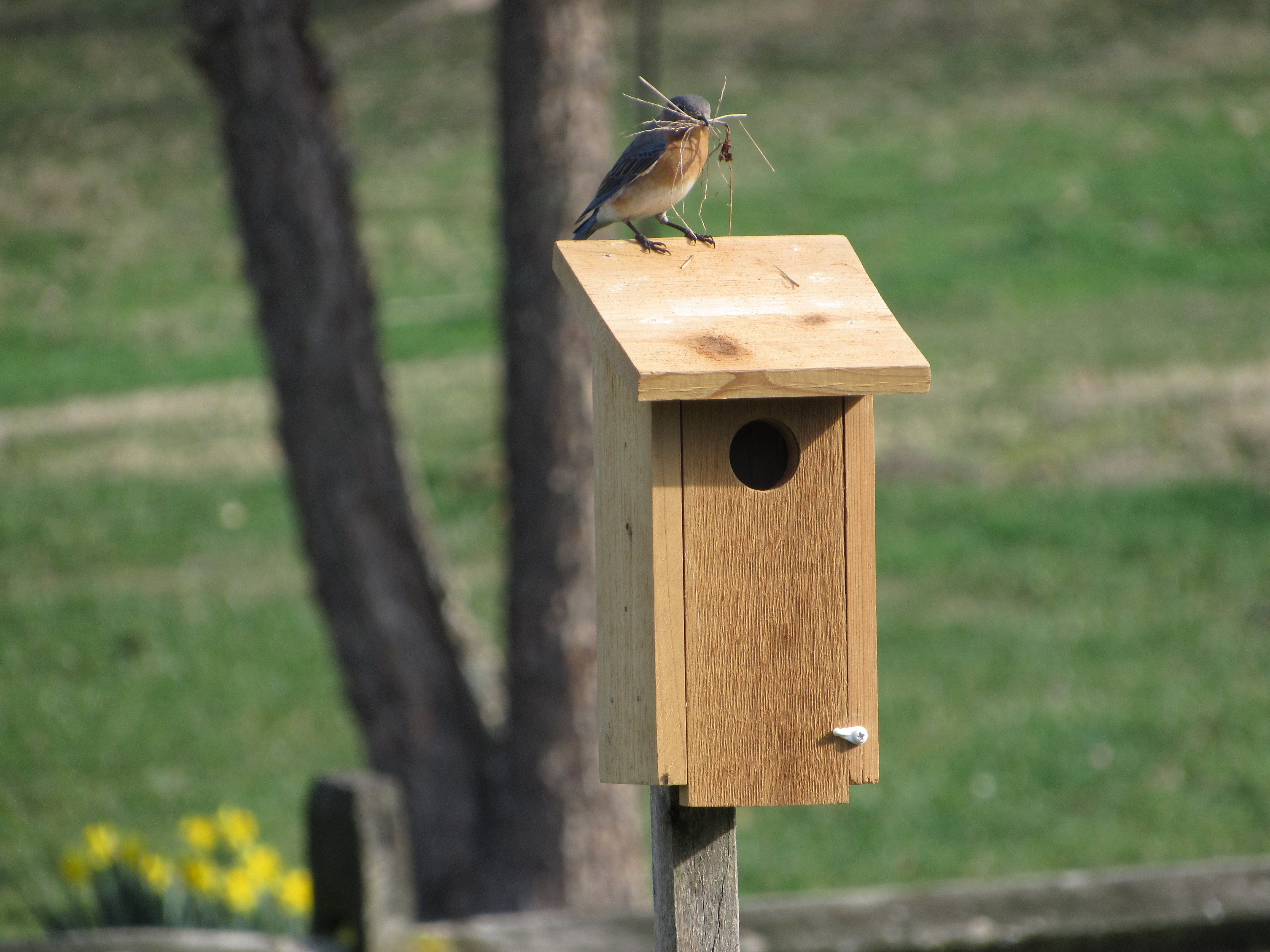
⚡ Read This Before You Mount Anything
- Habitat first, everything else second. A bluebird box in dense woodland is yard art. A wren box in an open field isn’t much better. Put the box where the bird already looks for nest sites — not where it looks good from the kitchen window.
- Height matters less than people think — within reason. What matters more is that the height falls within the species’ natural range and the mounting is secure, stable, and genuinely predator-proofed.
- Direction is really about three things: heat, wind, and rain. “Face it east” is useful shorthand for many North American and UK gardens. It is not a rule. Your actual yard conditions take priority over any compass default.
- Predator protection isn’t optional. A perfectly placed box on an unguarded tree will fail eventually. When it does, the adults often won’t return to that location — sometimes for an entire season, sometimes longer.
- Checking the box too often is a documented problem. During egg-laying and early incubation, repeated disturbance is one of the most consistent causes of nest abandonment in monitored populations. Leave it alone unless you have a specific reason to look.
The 5 Rules of Nest Box Placement
These aren’t personal opinions. They come from decades of nest box monitoring data — primarily Cornell Lab’s NestWatch program, which has gathered records from hundreds of thousands of nests across North America, and the BTO in the UK. Follow all five and you’ve addressed the overwhelming majority of what determines whether a box gets used. Miss one significantly and no amount of fine-tuning the others will compensate.
1. Match the Habitat Before You Pick the Mounting Spot
This is the rule that gets broken most often and noticed last. Bluebirds need open ground with scattered perching trees and short vegetation they can hunt from. A bluebird box in a shady, shrub-dense corner of the yard is functionally invisible to them — not because they can’t see it, but because that habitat isn’t where bluebirds look for nest sites. Chickadees and nuthatches, on the other hand, prefer woodland edges where they have tree cover, bark insects, and the structural complexity they use for foraging. A chickadee box on a bare pole in the middle of a mowed lawn is the wrong habitat, full stop.
Before picking a mounting spot, ask yourself: where does this species already spend time in my yard? The best box placement extends what birds are already doing — it doesn’t try to attract them to a corner they’ve shown no interest in.
2. Mount Within the Species’ Natural Height Range
Height reflects where each species evolved to find cavity nest sites: a low snag near a meadow fence post for bluebirds, a mid-height dead limb on a forest edge for chickadees, a high hollow in a mature trunk for owls. Birds scouting for nest sites have a sense of the vertical zone they’re searching. A box mounted well outside that range registers as wrong before they’ve even approached it.
That said, height within the natural range is far less critical than the mounting being stable and predator-proofed. A bluebird box at 5 feet on a baffled metal pole will consistently outperform the same box at the “perfect” 4 feet mounted on a wooden fence post with nothing to stop a raccoon. When height and predator protection compete for your attention, protect against predators first.
3. Aim the Entrance Away From Your Worst Weather
“North or east” is the shorthand you’ll read everywhere, including in this guide. The real goal behind that rule is simpler: keep wind-driven spring rain out of the entrance during cold April nights, and keep the interior from cooking in afternoon sun on July days when temperatures inside an unventilated box can kill eggs and chicks within hours. Those are two distinct problems that often share a single solution — facing away from your worst weather — but your specific yard conditions determine which direction that is, not a compass default.
4. Predator-Proof the Setup, Not Just the Box
Entrance hole plates help. A deep roof overhang helps. But the most impactful predator protection isn’t on the box at all — it’s on the mounting. A smooth metal pole gives climbing predators — raccoons, rat snakes, squirrels — nothing to grip. A stovepipe baffle installed below the box closes off virtually every remaining ground-based approach. Most nest box raids that people never see coming happen because the mounting was left unguarded, not because the box design was flawed. The box looked fine the whole time. The problem was underneath it.
5. Resist the Urge to Check It Constantly
The instinct to monitor closely comes from caring — which is exactly what makes this mistake so common and so hard to recognise. But during the egg-laying period and early incubation, an adult bird is making a threat calculation every time something large approaches the box. Repeated disturbance reads as repeated threat. Cornell Lab’s NestWatch program — with data from hundreds of thousands of monitored nests — lists frequent disturbance as a significant and documented cause of nest abandonment. Once a week, briefly, is the outer limit during the breeding season. During the most sensitive window — laying and early incubation — leave it completely alone unless you have a specific, concrete reason to look.
How to Choose Nest Box Direction in Any Climate
Entrance direction is the placement variable that gets the most attention and is probably the least decisive of the four main factors. A box pointing “wrong” in dappled afternoon shade on a baffled pole will almost always outperform a perfectly compass-oriented box baking against a south-facing wall with no predator protection. That’s not an exaggeration — it’s the consistent finding from monitored nest box programs, and it’s worth holding onto when the direction advice starts feeling complicated.
Use direction to control three specific things: afternoon heat, wind-driven rain, and morning warm-up. Nothing else.
The Three-Step Direction Method
- Identify your worst-weather direction. Where do your hardest spring rainstorms come from? That’s the direction you’re avoiding. In most of the continental US, that’s the southwest or west. In the UK and Ireland, it’s predominantly the west and southwest — the direction of the Atlantic weather systems that dominate British spring conditions.
- Face the entrance away from that direction. This is your primary constraint. Keeping cold, wind-driven rain out of a nest during a late April storm protects eggs and chicks more reliably than any compass adjustment.
- Then manage sun exposure based on your actual summer heat:
- Hot summers (most of the US south of the Great Lakes): avoid south- and west-facing exposures. North or northeast gives morning warm-up without the afternoon bake that can push interior temperatures past lethal thresholds by mid-July.
- Cool, wet climates (UK, Pacific Northwest, northern states): a little morning sun from the east or southeast helps warm chicks after cold nights — and doesn’t create an overheating risk in regions where July temperatures rarely threaten nest survival.
When Microclimate Beats the Compass
- Afternoon shade is worth more than a “correct” compass direction. A tree that casts shadow on the box from 1 PM onward solves the overheating problem regardless of which way the entrance faces. Use that shade if you have it.
- Ventilation does real work. Small vents cut near the roofline and drain holes in the floor reduce interior temperature and moisture — two factors that affect occupancy more than most people realise. A box with good airflow can tolerate more sun exposure than a sealed box facing “perfectly” away from it.
- Watch out for heat traps. South-facing brick or concrete walls absorb heat all day and radiate it through the evening. A box mounted on one of these surfaces in Tennessee or Georgia can reach lethal interior temperatures by mid-July regardless of entrance orientation. The wall is the problem, not the compass bearing.
- Southern hemisphere readers — reverse the sun logic. In Australia, South Africa, and South America, harsh afternoon sun comes from the north and west. The same principle applies — avoid the hot afternoon exposure — but the compass directions that achieve it are the mirror image of the Northern Hemisphere guidance.
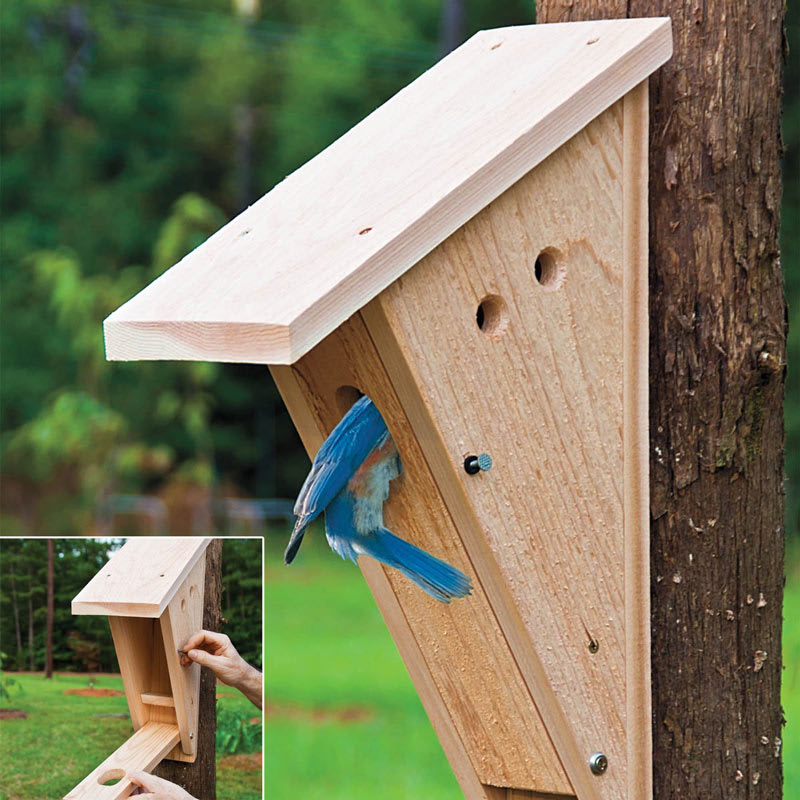
Per-Species Placement Chart — North America
These numbers come from species-specific nest monitoring data, primarily Cornell Lab’s NestWatch program. Use them as calibrated starting points — local predator pressure, summer heat, available habitat, and competition from House Sparrows or European Starlings will all shift what actually works best in your specific yard. Where a direction is listed as “away from prevailing winds,” treat that instruction as primary and the compass direction as secondary guidance only.
| Species | Best Habitat | Height | Direction | Spacing | What Actually Improves Success |
|---|---|---|---|---|---|
| Eastern Bluebird | Open fields, meadows, short grass near scattered perches | 3–6 ft (0.9–1.8 m) | Face open area; E or SE if local weather allows | 300 ft minimum between bluebird boxes | Pole + baffle is the most impactful single upgrade. Dense woodland nearby = no bluebirds, regardless of box quality. |
| Tree Swallow | Open areas near water or meadow edges | 5–6 ft (1.5–1.8 m) | East-facing; away from prevailing wind | 35 ft apart, or pair with bluebird box 15–20 ft away | Pairing with a bluebird box 15–20 ft apart eliminates most territorial conflict — both boxes fill instead of one being fought over all spring. |
| House Wren | Garden and yard edges with brush and shrubs nearby | 5–10 ft (1.5–3.0 m) | Away from prevailing rain; avoid afternoon sun | 100 ft apart | Wrens will systematically fill competing boxes with sticks. Keep their box well separated from bluebird and swallow boxes. |
| Black-capped / Carolina Chickadee | Woodland edges, mature yards with established trees | 5–15 ft (1.5–4.6 m) | Away from prevailing wind; N or NE in hot regions | 650 ft apart | Quiet placement matters — regular foot traffic directly beneath the box deters use even when everything else is right. |
| Tufted Titmouse | Deciduous woodland and mature suburban neighbourhoods | 5–15 ft (1.5–4.6 m) | Away from prevailing wind | 860 ft apart | Place near trees for habitat match, but not where squirrels have a clear jump to the roof. |
| White-breasted Nuthatch | Woodland edges, large mature trees | 5–20 ft (1.5–6.0 m) | Away from prevailing wind | 650 ft apart | Rock-solid mounting. A wobbling box deters nuthatches more reliably than almost any other single factor. |
| Downy Woodpecker | Wooded edges, parks, tree-rich suburban yards | 6–20 ft (1.8–6.0 m) | Away from prevailing wind | 165 ft apart | Fill completely with wood chips. Woodpeckers expect to excavate — an empty box feels wrong to them. |
| Northern Flicker | Open woods, woodland edges, parks | 6–12 ft (1.8–3.7 m) | South or east; adjust based on local afternoon heat | 330 ft apart | Fill with wood chips. Tilt slightly forward so fledglings can reach the entrance from inside. |
| American Kestrel | Open country, farmland edges, grasslands | 10–30 ft (3.0–9.0 m) | South or east; prioritise shelter from storms | 0.5 mile or more | Completely open flight path. A kestrel won’t approach a box where it can’t see the full approach route from a distance. |
| Eastern Screech-Owl | Wooded neighbourhoods, forest edges, mature suburban yards | 10–30 ft (3.0–9.0 m) | Away from prevailing wind; reduce direct rain entry | 0.25 mile or more | Unobstructed flight path to the entrance. Owls are far less tolerant of approach obstacles than songbirds. |
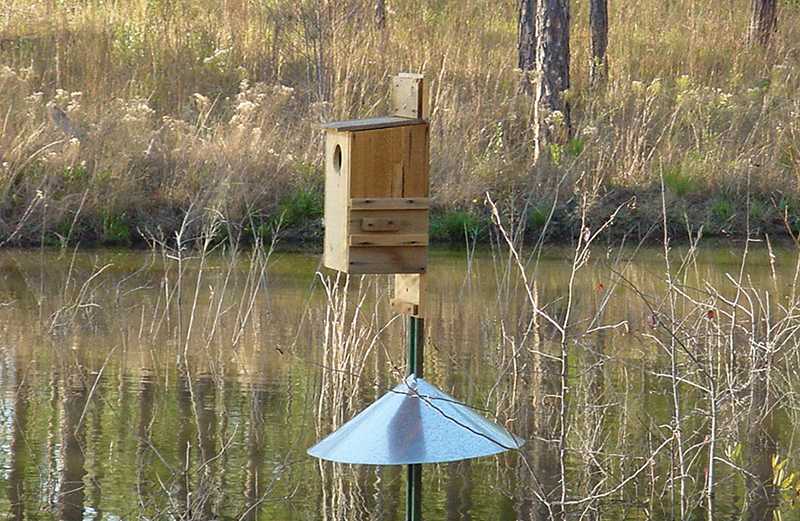
| Wood Duck | Over water or within 100 ft of water | 6–30 ft (1.8–9.0 m); at least 3 ft above high water mark | Face toward open water or safe approach route | 0.25 mile or more | Interior hardware cloth or roughened surface so ducklings can climb to the entrance. Without it, brood losses are common even in successful nests. |
| Hooded Merganser | Near water and forested wetlands | 6–25 ft (1.8–7.6 m) | Away from wind-driven rain; clear approach | 0.5 mile or more | Predator guard essential. Minimise all disturbance during nesting — mergansers are quick to abandon. |
| Prothonotary Warbler | Swamps and wooded wetlands | 4–12 ft (1.2–3.7 m) | Over or near water; avoid harsh direct sun | 100 ft apart | Mounting directly over water substantially reduces predator access — a bigger factor for this species than direction or height. |
Quick Chart — UK and Ireland
The RSPB and BTO both recommend facing boxes between north and east as a general rule for UK gardens — a position that avoids harsh summer sun and the dominant westerly weather systems that bring the wettest, windiest conditions across Britain and Ireland. That said, a sheltered east-facing spot on the north side of a stone wall can work well even if it technically breaks the “northeast rule.” Rules are shortcuts. Your yard is your yard. Watch it for a season before concluding that orientation is the problem.
| Species | Box Type and Habitat | Height | Direction | Practical Notes |
|---|---|---|---|---|
| Blue Tit | Small hole-fronted box; gardens, parks, woodland edges | 2–3 m | North-east; away from south-facing walls | The most widely used garden nest box in the UK — almost any well-placed box in a mature garden will attract them. Avoid obvious sun traps and south-facing walls that radiate stored heat into the evening. |
| Great Tit | Slightly larger hole-fronted box; similar habitat to Blue Tit | 2–4 m | North-east preferred | Needs a slightly larger entrance hole (28–32 mm) than Blue Tit. Often competes directly — separate boxes by at least 20–30 m where possible. |
| House Sparrow | Hole-fronted box; gardens, suburban areas, near buildings | 2–3 m | North-east; sheltered from prevailing wind and rain | Colonial by nature — several boxes placed close together on the same wall or eave is actively encouraged. An isolated single box rarely works as well. |
| Robin | Open-fronted box; set into thick vegetation or climbing plants | Under 2 m | North-east; well sheltered from wind and rain | Robins want concealment, not exposure. The box should be invisible from a distance and completely inaccessible to cats. Checking it daily will empty it. |
| Starling | Large hole-fronted box; open areas, farmland, older buildings | 3–5 m | North-east or under eaves | UK starling numbers have declined sharply — a box for starlings is genuinely useful conservation work in many areas, not a nuisance-management problem. |
Mounting, Spacing, and Predator Protection
Why the Mounting Matters More Than the Box
Spend time reading nest monitoring reports and a pattern becomes clear: most recorded nest failures attributed to predation involve boxes mounted on wooden posts, fence rails, tree trunks, or garden walls — surfaces that give climbing predators something to work with. The box design and entrance hole plate are secondary. The mounting is where predator protection either works or doesn’t.
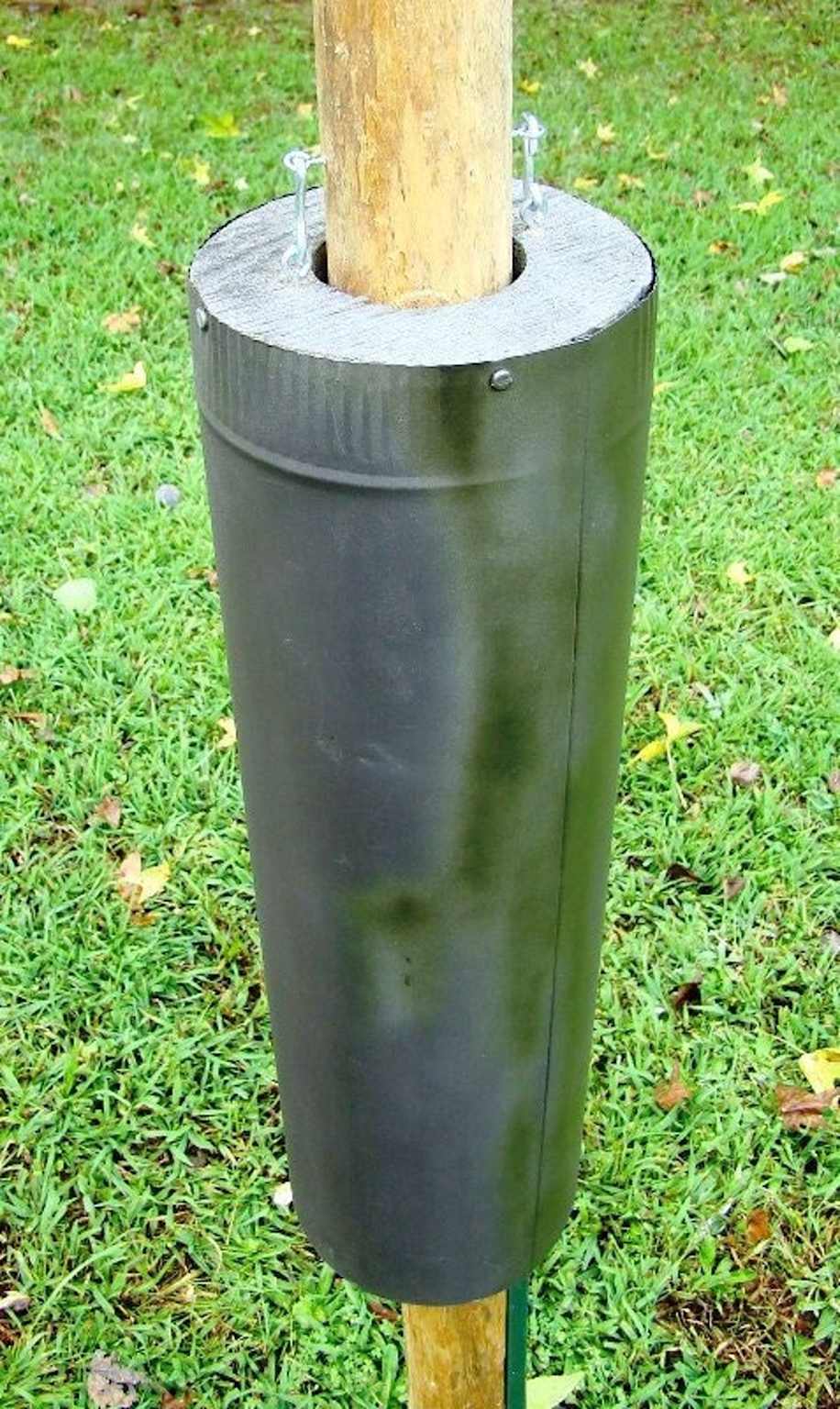
A smooth metal or PVC pole combined with a stovepipe baffle — roughly 8 inches in diameter, 24–36 inches long — installed below the box gives raccoons, rat snakes, and squirrels no viable route to the nest. The baffle needs to be at least 3 feet off the ground. The box needs enough horizontal clearance from nearby fences, branches, and structures that jumping onto the roof isn’t feasible. Cornell Lab’s NestWatch recommends a minimum roof overhang of 5 inches on the front face specifically to prevent raccoons from reaching down into the entrance hole from above — more than most commercial plans specify.
Spacing: What Works and What Doesn’t
- Most songbirds are territorial. More boxes close together does not mean more birds. Two bluebird boxes 50 feet apart don’t produce two bluebird pairs — they produce one defended box and one contested one. Give territorial species room to establish a clear territory before adding more.
- The bluebird-swallow solution is counterintuitive but proven. Tree Swallows and Bluebirds will fight over a single box all spring, with neither bird nesting productively. The fix — borne out by decades of nest trail monitoring — is to install two boxes 15–20 feet apart. Each species claims one, the territorial boundary becomes clear, and the aggression drops sharply. It works because proximity forces negotiated boundaries rather than a season-long unresolved dispute. It sounds backwards. It works.
- Colonial species work differently. Purple Martins, and House Sparrows in the UK, actively prefer grouped housing. The spacing rules that apply to bluebirds and chickadees are essentially reversed for these species — more boxes closer together is what they want.
Weatherproofing Details That Change Outcomes
- Roof overhang of 2–3 inches on sides and back; 4–5 inches on the front to reduce rain entry and raccoon reach
- Drain holes in the floor — at least two, 6 mm diameter — prevent water pooling during heavy rain from drowning eggs or chicks on the floor
- Ventilation gaps near the roofline keep interior temperatures manageable in summer; a box with no ventilation in full sun can become lethally hot even when facing “correctly”
- Wood thickness of at least ¾ inch (19 mm) throughout — thin wood conducts heat rapidly; thin metal and plastic boxes in direct sun are the worst combination available
Troubleshooting: Why Birds Ignore a Nest Box
A box that sits empty through an entire breeding season is telling you something specific. Work through this list in order — the answer is in the first two items far more often than anywhere else, and most people skip straight to the last three because they’re easier to check:
If a box stays empty for a full season, relocate it in the off-season. Change one variable at a time — it makes it considerably clearer what actually fixed the problem.
Common Mistakes That Leave Boxes Empty All Season
❌ Mounting on a tree trunk or fence post without any predator guard
Bark is a climbing surface. A rat snake will find it, quietly, at night, in the middle of a week when you think everything is going well. You’ll check the box three days later and find it cold and empty with no explanation. If a tree is genuinely the only option, fit a Noel guard (wire mesh cone) around the entrance hole at minimum — it’s not a full solution, but it reduces reach-in predation.
❌ Orienting the box for how it looks from the house
The box facing prettily toward the garden may be pointing directly into the afternoon sun or the prevailing spring storm track. Function first, aesthetics second — always. The birds will not appreciate the view.
❌ Going extra high “for safety”
Bluebirds want 3–6 feet. Mounting at 12 feet doesn’t improve predator protection without a baffle — it just makes the box harder to clean, harder to monitor, and harder to reach when something needs attention. The height is not the protection. The baffle is.
❌ Clustering same-species boxes
Two bluebird boxes 30 feet apart won’t house two bluebird pairs. They’ll produce one pair and one season-long territorial dispute. The boxes will show signs of attention all spring — and both stay empty.
❌ Installing during the breeding season
A box that goes up in late April or May is decoration for this year. The birds scouting your yard in February already committed to territories elsewhere weeks ago. Install in January or early February — before it feels like bird season — and the scouts will find it.
❌ Adding a perch to the entrance hole
Native cavity nesters don’t use them — they grip the entrance hole directly, the way they grip a natural cavity in a tree. House Sparrows and House Wrens do use them. Remove any perch that came pre-fitted to a box and don’t add one to a box you’ve built.
❌ Placing the box near feeders
Feeders concentrate traffic, aggression, and competition. Cautious cavity nesters — bluebirds and chickadees especially — find that environment stressful enough to avoid committing to a nest site nearby. Keep nest boxes and feeding stations in separate areas of the yard.
Practical Tips for Getting Your Box Occupied This Season
- Get boxes up by late January or February. Bluebirds scout nesting territories in late winter — well before the first warm days that most people associate with “bird season.” A box that appears in April is invisible to the scouts who already committed elsewhere in March. This is the single most actionable timing change most backyard birders can make.
- Install the baffle the same day as the box. Not after the first raid. Not when you notice the nest going cold. The same day, from the beginning. A raid in the first season can deter a pair from returning to that location even after you’ve added protection.
- Fit a metal entrance hole plate from day one. Squirrels will chew a wooden entrance hole wider during winter, slowly and invisibly, while the box sits empty. A 1½-inch bluebird hole can become a 2-inch starling hole before the season starts. A metal reinforcement plate is cheap, permanent, and solves this completely.
- Watch where your target birds already spend time. The best placement extends what birds are already doing in your yard. If bluebirds are perching on the fence line along the south edge, that’s where the box belongs — not the decorative corner near the patio that looks good in the morning light.
- Stop using pesticides near the box location. Cavity nesters raise their chicks almost entirely on insects. A heavily managed lawn is a food desert. Birds will pass over an otherwise ideal nest site if there’s nothing to feed chicks within foraging range.
- Clean boxes in late fall, not early spring. By early spring, scouts are already checking sites. An unclean box can deter use — but a box you disturbed in February has the same effect. Clean in November or December, leave it alone after that, and let the scouts find it ready.
Frequently Asked Questions
What direction should a nest box face?
Face the entrance away from wherever your harshest spring rain and wind come from. In much of North America that tends to produce an east or northeast orientation. In the UK, northeast is the standard RSPB and BTO recommendation for the same reason — it avoids both the dominant westerly weather and the strong summer sun. Local shade, shelter, and microclimate matter more than the compass direction itself. A well-sheltered box can face almost any direction and still succeed; a perfectly oriented box against a hot south-facing wall in Tennessee will struggle regardless.
What’s the best height for most backyard birds?
Most small cavity nesters are comfortable somewhere between 5 and 15 feet, but that range masks significant species-level variation. Bluebirds prefer 3–6 feet. Screech-owls want 10–30 feet. Wrens are flexible between 5 and 10. Height within the natural range is less important than habitat match and predator protection — a bluebird box at 5 feet on a baffled pole in open habitat will consistently outperform one at the “perfect” 4 feet on an unguarded wooden post in the wrong habitat.
Is a pole really better than a tree for mounting?
In most backyard situations, yes — significantly. A smooth metal pole leaves climbing predators with nothing to grip. Tree bark gives snakes and raccoons a textured climbing surface, and nearby branches create jump-on routes that no entrance guard can fully offset. Tree mounting can work — particularly for species that naturally associate with forested habitat — but it requires more active management and still benefits from a Noel guard at minimum.
My box is the right size and in reasonable habitat. Why is it empty?
The most likely answers, in order: predator pressure from a raid you didn’t witness, habitat mismatch for the specific species you’re targeting (the “reasonable habitat” assessment may be more off than it looks), overheating from afternoon sun or poor ventilation, or disturbance from checking too frequently. In the vast majority of persistent empty-box situations the answer is in the first two. Change one variable at a time — it’s the only way to know what actually worked.
When should I install or relocate a nest box?
Install new boxes or relocate existing ones in the non-breeding season — late fall through early winter is ideal. By late January or February, scouts in many species are already checking sites. If a box is in the wrong spot, note it during the breeding season, mark it clearly, and move it after the birds have finished and departed for the year. Never relocate an active nest box. In the US, UK, Canada, and many other countries, disturbing an active nest of a protected species is a legal matter, not just an ethical one — check your local wildlife regulations before taking any action during the breeding season.
The Short Version
Strip everything back and the list that actually changes outcomes is short: match the habitat, mount on a baffled pole, face the entrance away from your worst weather, give territorial species enough space to settle without fighting. Fix those four things and you’ve addressed the vast majority of placement failures. Everything after that — precise height within the species range, exact compass bearing, minor spacing adjustments — is genuine fine-tuning on top of a foundation that already works.
Get the box up in January. Install the baffle the same day. Clean in November and leave it alone after that. Don’t check it compulsively once it’s active — a weekly glance is enough, nothing during the most sensitive window. The birds will handle the rest. They’ve been doing this for considerably longer than birdhouses have existed. You just need to give them a setup that matches what they’re already looking for.
Sources
- Cornell Lab of Ornithology — NestWatch: Nest Box Placement
- NestWatch — Eastern Bluebird species account
- NestWatch — Tree Swallow species account
- NestWatch — House Wren species account
- NestWatch — Black-capped Chickadee species account
- NestWatch — Dealing with Predators
- RSPB — Nest box guidance
- BTO — Putting up a nest box
- NestWatch — Features of a Good Birdhouse
- Alaska Department of Fish and Game — Birdhouse Placement Tips