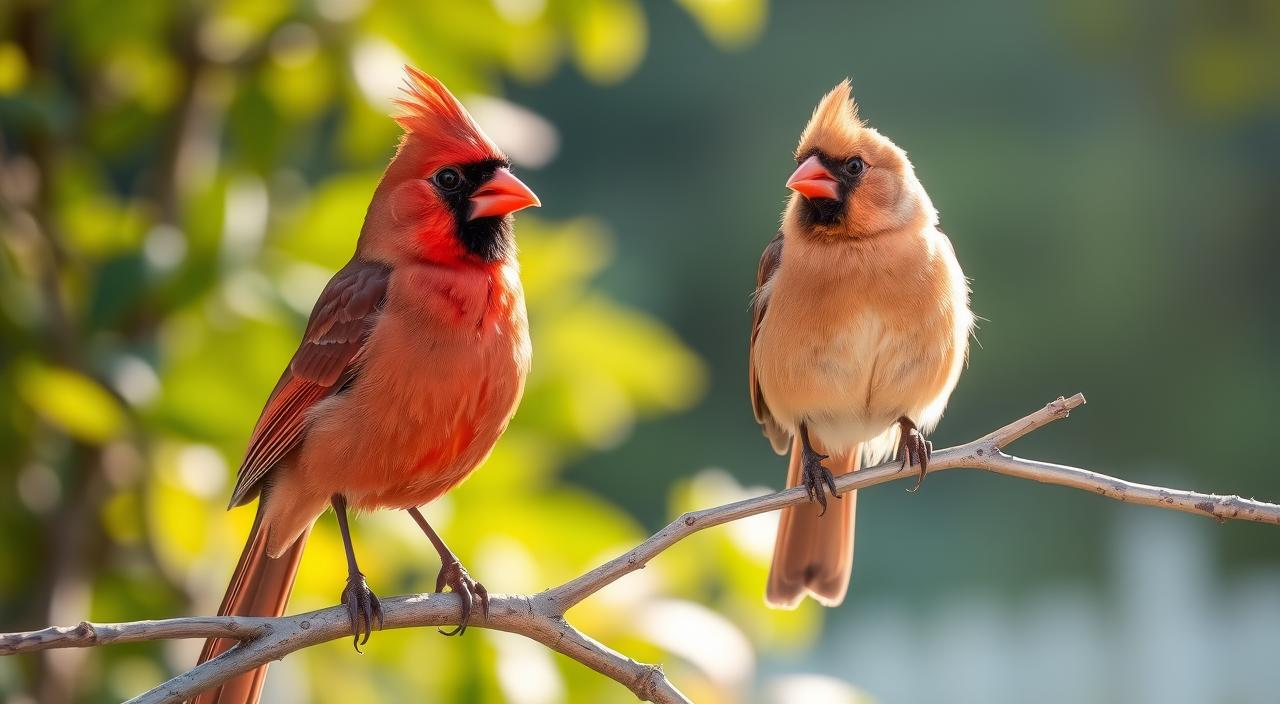
There’s a moment almost every backyard birder goes through at least once. A flash of red lands at the feeder — easy, obvious, unmistakable. Then a brownish bird drops in next to it. Same size. Same crest. Same heavy bill. And suddenly you’re not sure what you’re looking at.
That brownish bird is a female Northern Cardinal. And here’s something nobody tells you upfront: she’s not the dull version. She’s the deliberately camouflaged version, built for a yard that doesn’t notice her while she’s incubating eggs two feet off the ground in a dense shrub. Once you know what to look for, she’s immediately striking — warm tan plumage shifting into reddish-orange in the wings and tail, that same absurdly thick bill, that same pointed crest raised when she’s alert or annoyed. The difference isn’t dullness. It’s function. She and the male are doing genuinely different jobs, and their appearances evolved accordingly.
This guide gives you the shortest reliable path to telling them apart — in real light, through a real window, in the five seconds you actually have before the bird moves. No jargon, no memorization exercises. Just the two or three things that actually work every time.
⚡ The short version: Males are red overall with a bold black face mask. Females are warm tan with reddish-orange in the wings, tail, and crest. Both adults share the same thick orange-red bill — and both sing. The bill color alone separates adults from juveniles instantly. If you only remember two things: base color and bill color.
At-a-Glance ID Checklist — Use This Before Anything Else
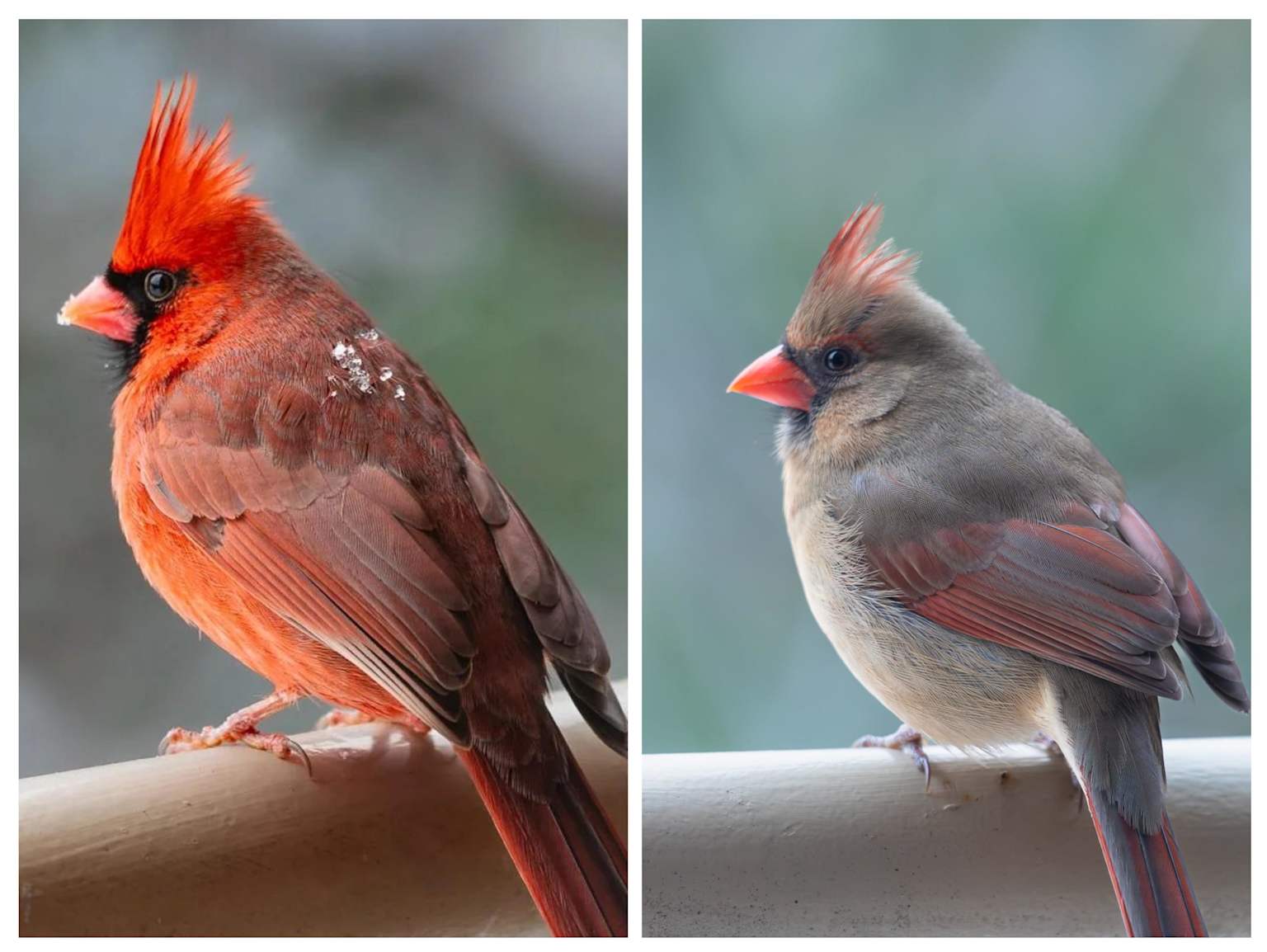
Work through these in order. You’ll usually have your answer before you reach the third one:
Overall base color — does the bird look red or tan?
This single question handles the vast majority of cardinal IDs. A bird that reads as red, even at distance or in poor light, is almost certainly a male. A bird that reads as warm brown — with reddish showing only in specific places like the wings, tail, and crest tip — is almost certainly a female. Don’t overthink it. If your first impression is “red bird,” it’s a male. If your first impression is “brownish bird with some red in it,” it’s a female.
>Face mask — sharp and dark, or soft and absent?
Males have a bold, cleanly defined black mask covering the face and looping around the throat. In females, there’s a faint smudging of dark around the base of the bill, but nothing that reads as a real contrasting pattern. From ten feet, the male’s mask is unmistakable. The female’s face looks open and plain by comparison.
>Bill color — orange-red or dark?
Both adult males and adult females have the same thick, warm orange-red bill. It stands out clearly against the plumage of both sexes. If the bill is dark — greyish or blackish — you’re looking at a juvenile, not an adult female. This single observation prevents the most common beginner misidentification.
>Context — are there two birds moving together?
A red cardinal and a tan cardinal working the same area of yard together, especially from February onward, are almost certainly a mated pair. Confirm the male and the other bird answers itself.
Male vs. Female vs. Juvenile — Full Comparison
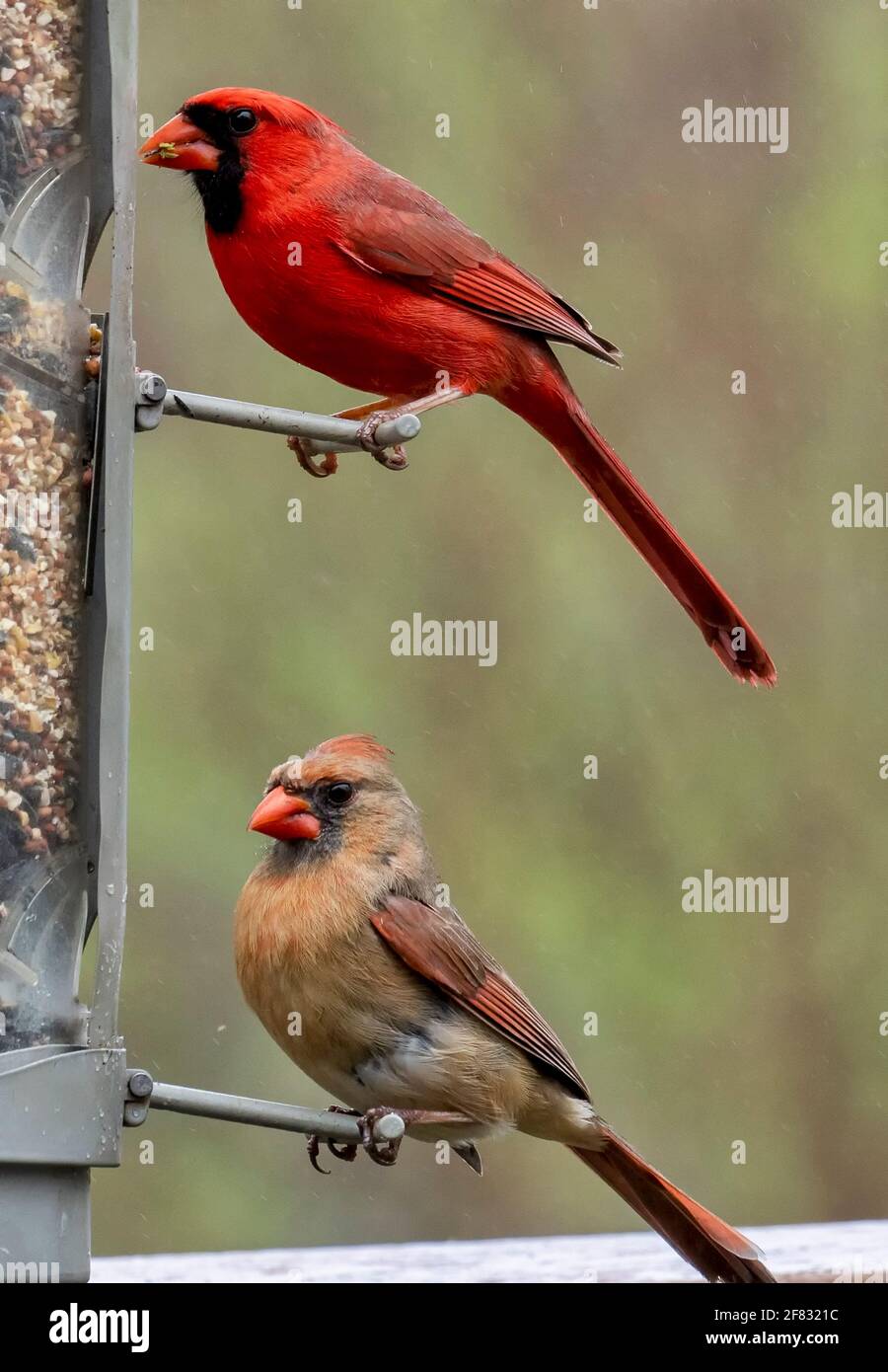
| Feature | Adult Male | Adult Female | Juvenile (either sex) |
|---|---|---|---|
| First impression | Unmistakably red — reads as a red bird from any angle in any reasonable light | Warm tan overall; reddish-orange concentrated in the wings, tail, and crest only | Grey-brown throughout; patchy or limited red; looks like it hasn’t finished developing |
| Face mask | Bold, sharply defined black mask — covers the face, loops around the throat | Faint dark area at bill base only; no real contrast | Minimal; the dark bill is the more obvious facial feature |
| Bill | Thick, warm orange-red; prominent against the black mask | Thick, warm orange-red — identical to the male’s; surprisingly vivid against the tan face | Noticeably dark — greyish to blackish. This is the fastest, most reliable juvenile field mark |
| Crest | Present; raised sharply when alert or displaying | Present; same shape and size — not a useful sex marker | Present but less defined in very young birds |
| Fastest single field mark | “All red” impression + sharp dark mask | Tan base color + reddish wing/tail accents + orange-red bill | Dark bill on a brown bird with a cardinal’s crest and shape |
| Behavioral tell | Sings from exposed, elevated perches; conspicuous and deliberate during breeding season | Feeds lower; stays near cover; still sings; more cautious at open feeders | Persistent begging calls near adults; movements look hesitant and uncoordinated |
Plumage Differences That Actually Work in Real Conditions
Start With Base Color — It Holds Up in Bad Light
There is no common backyard bird in North America that’s fully red like a male cardinal. The red covers the entire body, the tail, the wings, the crest — interrupted only by the black mask. At any distance, in any reasonable light, a male cardinal reads unmistakably as a red bird before you’ve consciously processed any specific feature. Cornell Lab describes the male as “perhaps responsible for getting more people to open up a field guide than any other bird” — and after years of watching feeders, that tracks. He announces himself.
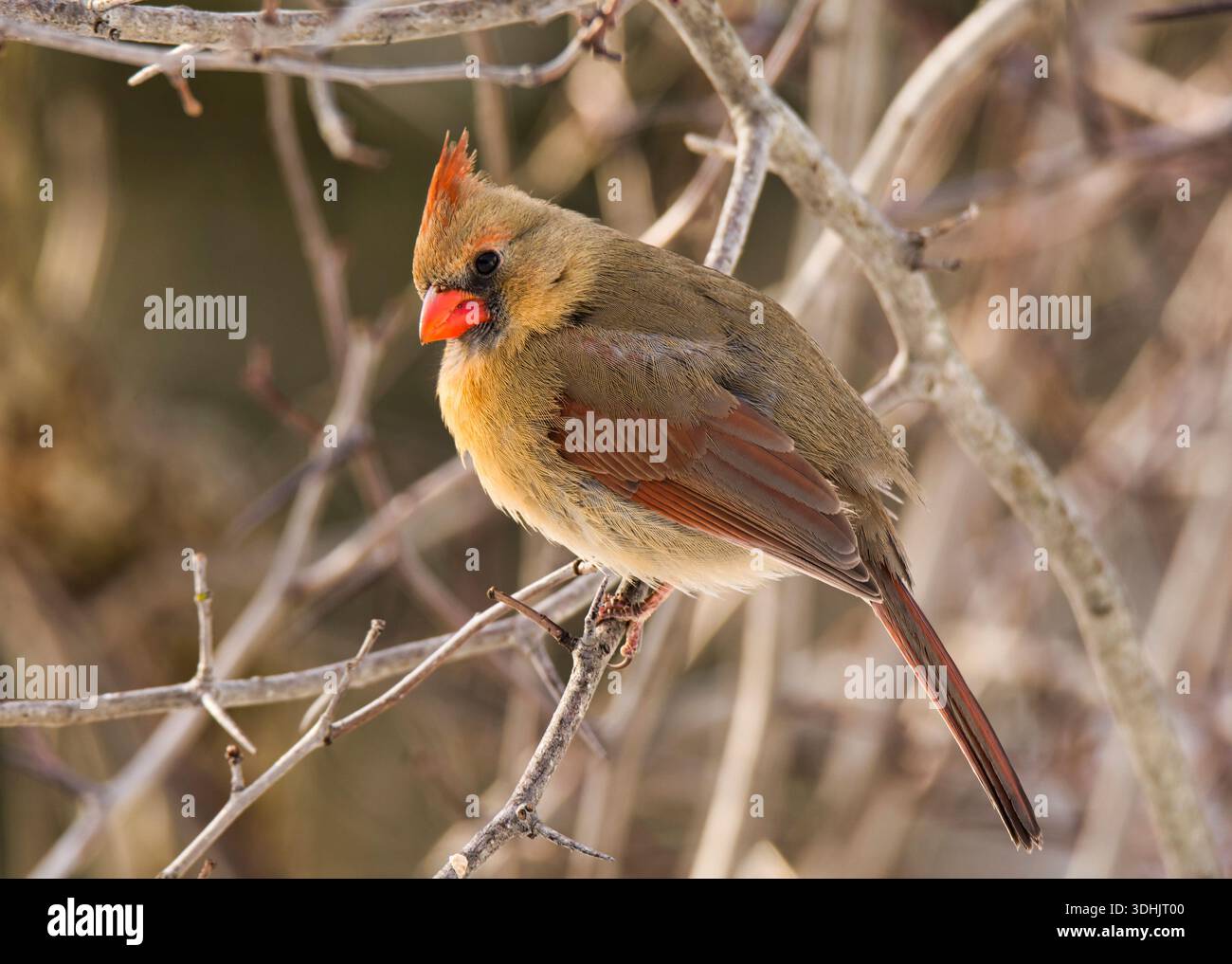
The female’s base color is warm tan — sometimes described technically as “buffy” or “fawn.” The reddish-orange isn’t absent, but it’s contained: the edges of the wing feathers, the tail, the crest, occasionally a warm flush on the chest. The overall impression is of a warm-brown bird that has red in it, rather than a red bird. That distinction — red bird versus warm-brown bird with red accents — is the fastest and most reliable separator between the sexes and holds up in almost every viewing condition, including through glass and in low morning light.
Why Males Sometimes Look Less Red Than You’d Expect
Here’s something that trips up more experienced birders than beginners: a male cardinal in deep shade can look surprisingly dull — dull enough to cause a moment of real doubt. The red coloration in cardinals is produced partly by carotenoid pigments obtained through diet rather than synthesized internally, which means red intensity varies between individuals based on food quality, age, and where they are in the annual molt cycle. A first-year male in his first fall is often a genuinely patchy bird — mostly reddish but with brownish feathers still visible, looking like something halfway between a female and a full adult male. People who’ve only seen the vivid adult males at summer feeders occasionally don’t recognize these birds at all in October.
The fix when color looks ambiguous: check the mask independently. A bird with a bold, high-contrast dark face mask is a male — full stop. The mask is a structural pattern and doesn’t fade with lighting the way color saturation does. If base color is genuinely uncertain, the mask settles it.
The Face Mask — What You’re Actually Looking For
On a male, the black mask is stark and precisely defined — it covers the face from around the eyes, sweeps across the throat, and borders sharply against the red of the head. You can see it clearly from fifteen feet without binoculars. On a female, there’s a faint dark area around the base of the bill, but it has nothing like the contrast or definition of the male’s mask. Her face looks comparatively open and plain. The practical rule: if you can see an obvious black pattern on the face, it’s a male. If the face looks unmarked and soft, it’s a female.
The Bill — The Most Underused Field Mark
Both adult males and adult females have the same thick, heavy, orange-red bill, and it stands out clearly against the plumage of both sexes. On the male, the bright bill sits right at the base of the dark mask, creating a vivid contrast. On the female, the warm orange-red bill looks almost surprisingly vivid against the tan face — it’s often the first feature that identifies a female feeding in a shrub when her body is partially hidden by foliage. If you can see the bill clearly and it’s orange-red, you’re looking at an adult regardless of whether the rest of the plumage makes immediate sense.
The bill’s most useful role, though, is age determination. Juvenile cardinals — both sexes — have a noticeably dark, greyish-black bill. An adult with a dark bill doesn’t exist. Dark bill equals juvenile. Orange-red bill equals adult. This one observation prevents the most common source of beginner confusion, which is calling a dark-billed juvenile an adult female.
One Thing the Crest Won’t Tell You
Both male and female Northern Cardinals have the same pointed crest — it’s one of the most recognizable things about the species and immediately distinguishes a cardinal from most other feeder birds at any distance. But the crest is useless for sex determination. Both sexes have it, in the same size and shape. Use it to confirm you’re looking at a cardinal. Don’t try to use it to determine which sex you’re looking at.
Behavior Clues at Feeders and in the Yard
Most cardinal IDs are solved by plumage before behavior enters the picture. But behavioral observation adds a useful secondary layer — particularly when the bird is partially hidden, the light is poor, or you’re hearing a bird before you’ve located it visually.
Where Each Sex Tends to Show Up
Male cardinals are conspicuous by design. During breeding season, they sing from the highest available exposed perch — the top of a dogwood, a bare fence post, the uppermost branch of a shrub — in long, repeated, carrying phrases. That combination of elevation, stillness, and song is a behavioral signature almost as useful as the plumage. A bird sitting openly at the top of something and singing repeatedly is more likely male than female by a wide margin. He is, quite deliberately, being seen and heard.
Females tend to feed lower and stay closer to cover. This isn’t absolute — females visit open platform feeders regularly, and in late winter when paired birds move together you’ll see them in the same places. But if you’re watching a cardinal that keeps slipping back into a dense shrub between feeder visits rather than sitting out in the open, it’s more likely female. The caution makes biological sense: a male on a visible perch is advertising territory. A female during nesting season benefits from the opposite.
The Mate-Feeding Behavior That Identifies Both Birds at Once
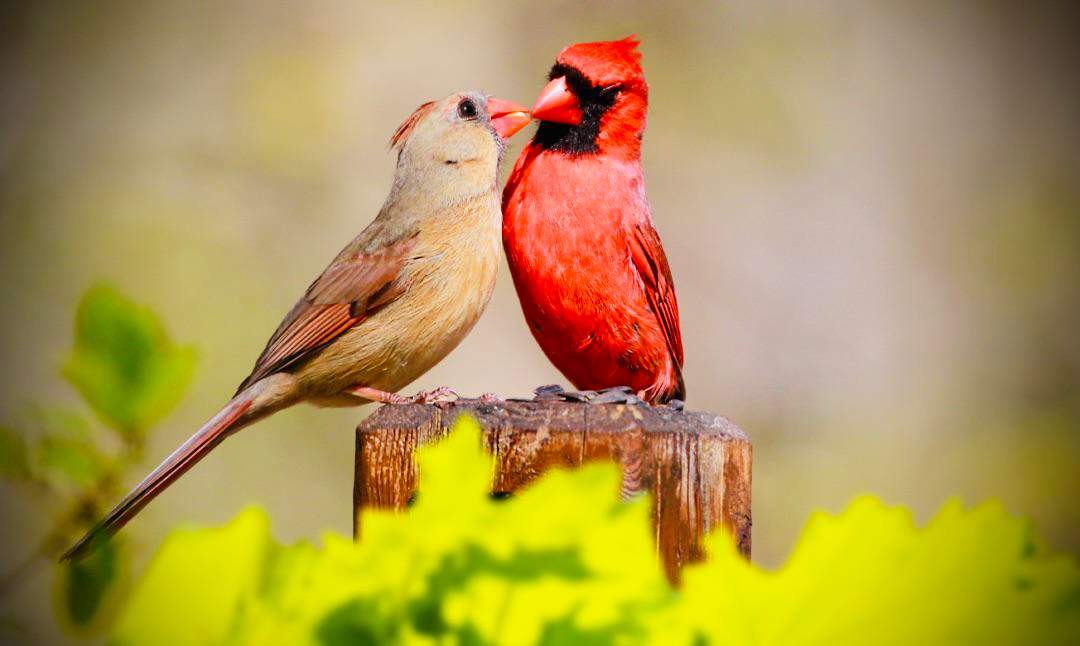
From late winter through early summer, male cardinals regularly feed females directly — approaching with a seed and passing it bill-to-bill. If you see two cardinals at close range and one is offering food to the other, you’ve instantly identified both: the one giving is the male, the one receiving is the female. This behavior is visible at feeders and in shrubs near them, and it tends to repeat multiple times during morning feeding periods. Once you’ve spotted it once, you can watch the pair for several minutes and confirm the ID more times than you need to.
Beyond its ID value, mate-feeding is genuinely worth watching for its own sake. It typically starts in February as pair bonds are being reinforced — sometimes on cold mornings when there’s still snow on the ground — and continues through the breeding season. The male isn’t just being romantic; he’s provisioning a female who can’t leave the nest during incubation.
What Nesting Behavior Looks Like
If you see a cardinal carrying nesting material — strips of bark, thin twigs, grass stems, leaves — it’s almost certainly a female. Female cardinals do essentially all of the nest building and all of the incubation; males don’t build. What males do during this period is provision: bring food to the female on or near the nest, and feed nestlings alongside the female once eggs hatch. Watching a pair through the breeding season is one of the clearest windows into which bird is which, precisely because their behavioral roles are so distinct.
Songs and Calls — Can You Actually Tell Them Apart?
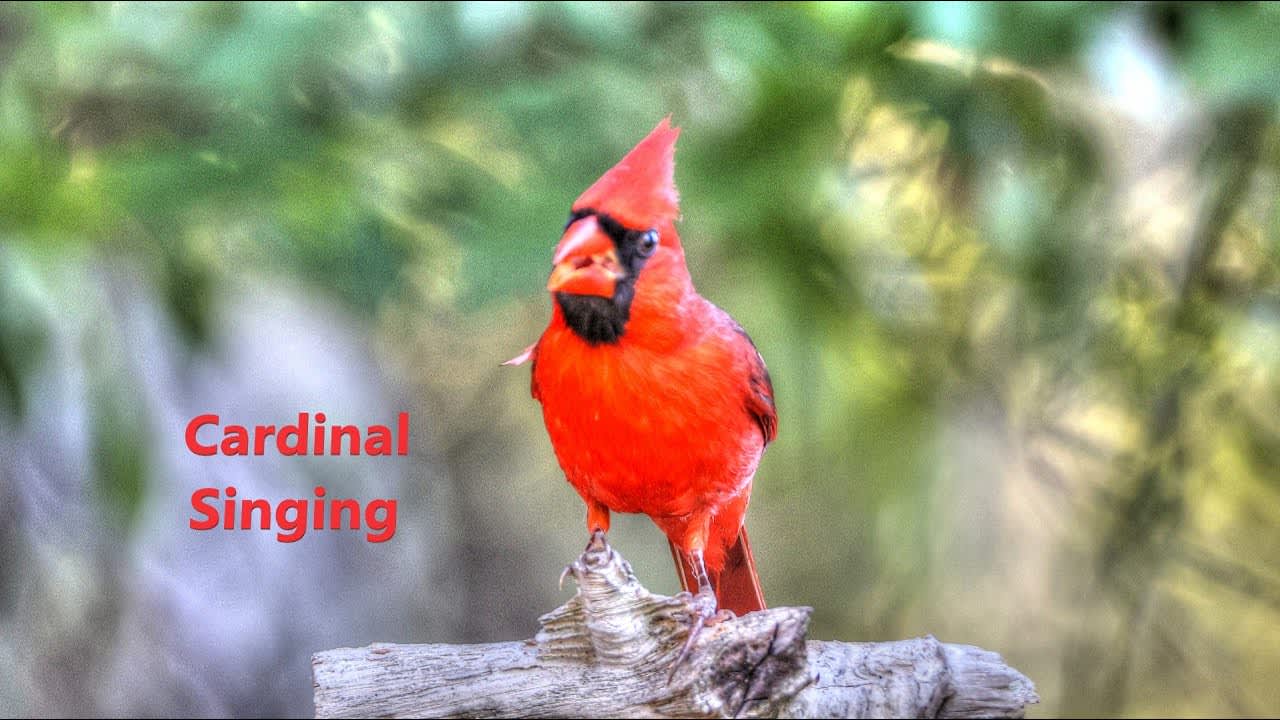
The fact that surprises the most people who’ve been watching cardinals for years: female Northern Cardinals sing. Not occasionally. Regularly. This is genuinely unusual among common North American backyard birds — in most species, full song is almost exclusively a male behavior. Female cardinal song is real, varied, and often identical in form to male song. Once you know this, you start questioning how many times you confidently identified a “singing male” without actually seeing the bird.
What Cardinal Song Sounds Like
The song is loud, clear, and carries well across a yard — one of the more distinctive backyard bird sounds in eastern North America. It comes in several forms, often described as “cheer-cheer-cheer,” “what-cheer-what-cheer,” or “birdy-birdy-birdy,” but the common thread is the quality: bright, whistled, slightly slurred phrases with a ringing character that cuts through ambient noise. Cardinals often sit high and repeat their song for extended periods in early spring, which makes locating the singer easier than with more secretive species.
The call — separate from the full song — is a sharp, metallic “chip” used by both sexes throughout the day as a contact and alarm signal. Once you’ve connected that chip note to a cardinal, you’ll start noticing cardinals in your yard that you hadn’t been registering before, because the call carries clearly even when the bird is completely hidden in dense shrubs. That sound is often how you find a female who’s been there all morning without advertising herself visually.
The Practical Reality of Sound-Based Sex ID
Here’s the honest answer: sound doesn’t reliably determine sex in a backyard setting. Both sexes produce overlapping song types, and the differences that do exist are subtle enough to require careful comparative listening that isn’t realistic through a window. What sound does reliably is tell you a cardinal is present and roughly where it is. The practical sequence — hear the song, locate the bird visually, confirm sex from the plumage — uses sound as navigation and plumage as the actual answer. Trying to skip the visual step is where confident wrong IDs come from.
Common Identification Mistakes — And What’s Actually Causing Them
Nearly every cardinal misidentification comes from the same root cause: relying on one feature when two are available. In good light with a clear view, base color alone is usually enough. In shade or through glass, you need the mask or the bill to back it up.
-
- >
❌ Calling a juvenile an adult female.
-
- First-year cardinals of both sexes are brown overall with patchy, incomplete red — they look vaguely female-like, which is why the confusion is so common. But juvenile cardinals have dark, greyish-black bills. Adult females have warm orange-red bills. That bill color is visible in almost any viewing condition and persists until the first molt is complete. Once you’ve registered “dark bill equals juvenile,” this mistake becomes essentially impossible to make again.
>
❌ Calling a male female because the red looks dull.
This happens almost exclusively in deep shade or through tinted glass. A male in heavy shadow can look strikingly different from the vivid bird at the feeder in morning sunlight — dull enough to cause genuine doubt. The fix is to check the mask independently of color. A sharp, strongly contrasting dark face mask means male. The mask is a structural pattern; it doesn’t fade with light levels the way color saturation does. If you’re uncertain about base color, the mask settles it.
>❌ Trying to use size.
Male Northern Cardinals are marginally larger on average — about 8.7–9.25 inches versus 8.2–8.5 inches for females. But that difference is essentially invisible at normal feeder distances unless both birds are directly next to each other at the same instant, which happens less often than you’d think even with a bonded pair. Size works occasionally as a secondary clue in direct comparison. As a primary ID tool, it’s nearly worthless. Use color and mask. Leave size out of it.
>❌ Assuming any singing bird is male.
Female cardinals sing regularly. If you hear cardinal song and automatically assume you’ll find a male when you locate the bird, you’ll occasionally be confidently wrong — and more importantly, you’ll stop observing carefully once you’ve spotted it because you think the question is already answered. Hear the song, find the bird, check the plumage. The song tells you where to look. The plumage tells you what you’re looking at.
>❌ Not recognizing the female as a cardinal at all.
Beginners who’ve only ever associated “cardinal” with the brilliant red male sometimes genuinely don’t identify a female as the same species. She looks wrong because she doesn’t match the mental picture. The two features that immediately confirm “female cardinal” even when nothing else is obvious: the pointed crest and the thick orange-red bill. No other common brown feeder bird has both. If a brownish bird at your feeder has a raised pointed crest and an unusually thick, warm orange-red bill, it’s a female cardinal — regardless of how little red is visible in the plumage.
Pro Tips for Faster, More Confident IDs
>Watch a pair together whenever you get the chance.
The easiest cardinal ID scenario by a wide margin is a male and female at the feeder simultaneously. Confirm the male — easy — then compare the female directly against him: bill color, mask contrast, base color. That side-by-side comparison builds pattern recognition faster than any amount of solo-bird study. Cardinals start pairing in late winter, and from February onward, pairs at feeders are common enough to give you regular opportunities if you’re paying attention in the morning.
>Train yourself to look at the bill first on brown birds.
The bill is the feature most people skip, and it’s the one that resolves the most confusion fastest. On any brownish cardinal-shaped bird, the bill gives you the age class instantly: orange-red equals adult; dark equals juvenile. That one observation answers the question “why doesn’t this bird look like either sex clearly?” more often than any other single feature.
>Watch February and March more carefully than any other months.
Cardinals start breeding earlier than most backyard birds — territorial singing begins as early as late January in the South, March in northern areas. During this window, males are loudly conspicuous, pairs are moving together, and mate-feeding behavior is visible at feeders. The combination of high bird activity and clearly defined pair behavior makes this the most productive period for building confident cardinal ID skills — and one of the more genuinely enjoyable stretches of winter feeder watching.
>
Don’t give up on ambiguous birds — work through what you can see.
First-year males in fall, females in worn late-summer plumage, juveniles in transition — these are the birds that don’t match the illustration cleanly. But they’re not unidentifiable. Dark bill on a brownish bird with a cardinal’s shape: juvenile. Orange-red bill plus tan base color: adult female. Reddish base color with patchy coverage and dark bill: first-year male coming into adult plumage. Work through the features systematically rather than deciding the bird is too confusing to deal with.
>Use the chip call to find birds you’d otherwise miss.
That sharp, metallic chip note carries well through vegetation and is distinctive enough to learn within a few weeks of regular feeder watching. Cardinals in dense shrubs, behind hedges, or feeding quietly on the ground frequently announce themselves with chip calls long before you’d see them visually. Once you’ve connected that sound to the species, you’ll discover you have more cardinals using your yard than you’d realized — many of them females who spend most of their time in cover.
How to Attract Northern Cardinals to Your Yard
Northern Cardinals are not difficult to attract. They’re year-round residents across most of their range, they respond quickly to the right food and cover combination, and once a pair has established territory in your yard they’ll return to a reliable feeder for years. A few specific decisions make a meaningful difference.
Food: What Actually Works
Black oil sunflower seed is the single most effective food for cardinals and works in almost any feeder type. Safflower seed is nearly as effective with a practical bonus: most House Sparrows and European Starlings ignore it, which makes a safflower-only feeder an efficient way to attract cardinals without simultaneously drawing in the species most likely to displace them.
Cardinals have thick, heavy, seed-cracking bills — they’re built for larger, harder seeds than small finches handle efficiently. Platform or hopper feeders suit them better than small tube feeders with short perches. A tube feeder doesn’t give a cardinal enough room to land comfortably and feed properly, and many will repeatedly approach and leave without eating. If you’ve set up a feeder and aren’t seeing cardinals despite having them in the neighborhood, check whether the perch design is the problem before blaming the seed.
Cover: The Most Important Variable Most People Ignore
A feeder in the middle of open lawn, fifteen feet from the nearest shrub, will draw fewer cardinals than the same feeder positioned near dense vegetation. Cardinals retreat to cover between feeder visits, rest in shrubs after eating, and build their nests in the same dense low thickets they use for cover throughout the year. A feeder offering food and immediate security together keeps birds returning reliably rather than visiting occasionally when nothing threatens them.
Native dense shrubs — viburnums, hollies, hawthorns, spicebush — are particularly effective because they serve multiple functions simultaneously: cover between feeder visits, potential nest sites in spring, and berry food that supplements the feeder through fall and winter. If you’re choosing one yard improvement beyond the feeder itself, a native dense shrub planted at the feeder edge will consistently do more for cardinal frequency than any seed upgrade.
Water
A clean, shallow birdbath — two inches at the deepest point — adds value that seed alone doesn’t provide. Cardinals drink and bathe year-round, and a water source within the same yard zone as the feeder keeps them on site longer and at more hours of the day. Change the water every two to three days in warm weather to prevent algae and mosquito breeding. A small recirculating pump or dripper is more attractive than a static dish, partly because the sound carries — cardinals will find it faster than they find a silent bowl.
Three Ethics Points Worth Taking Seriously
>Don’t trim dense shrubs from April through August without checking first.
-
- Cardinals typically nest two to six feet up in exactly the kind of thicket that gets cut back in spring. Two minutes of observation before picking up the hedge trimmer is enough. A pair making repeated short trips into the same shrub is almost certainly attending an active nest.
>Position feeders to reduce window collision risk. Feeders within three feet of a window, or more than thirty feet away, produce far fewer fatal strikes than feeders at intermediate distances. Cardinals are year-round residents visiting feeders multiple times daily — the collision risk compounds in a way it doesn’t for migrant species passing through briefly.
>Clean feeders on a schedule. Wet or clumped seed on a platform feeder is a disease transmission point. Cardinals can carry Salmonella at dense feeding stations. A monthly wipe-down with diluted bleach and regular removal of spoiled seed keeps a feeding station healthy for the birds using it — including the female cardinal who’s been coming every morning since October and whose presence you’re just now learning to notice.
FAQ — Northern Cardinal Male vs. Female
The Bottom Line
You don’t need to memorize a checklist. You need two observations to become automatic: base color and bill. Red overall is a male. Warm tan with red accents is a female. Orange-red bill is an adult. Dark bill is a juvenile. Everything else — the mask, the crest, the behavior — exists to confirm what those two features already told you.
The female cardinal is worth learning to look for deliberately, not just as the non-red bird at the feeder. She sings. She selects the nest site. She builds the nest. She incubates the eggs. On a cold February morning when she’s at the feeder — warm buff-tan, reddish crest raised sharp, that vivid orange bill — she’s not the dull version of the male. She’s a different bird doing a different job, and she’s genuinely worth a few extra seconds of attention.
Sources
>Cornell Lab of Ornithology — All About Birds: Northern Cardinal (Identification)
>Cornell Lab of Ornithology — All About Birds: Northern Cardinal (Sounds)
>Cornell Lab of Ornithology — All About Birds: Northern Cardinal (Life History)