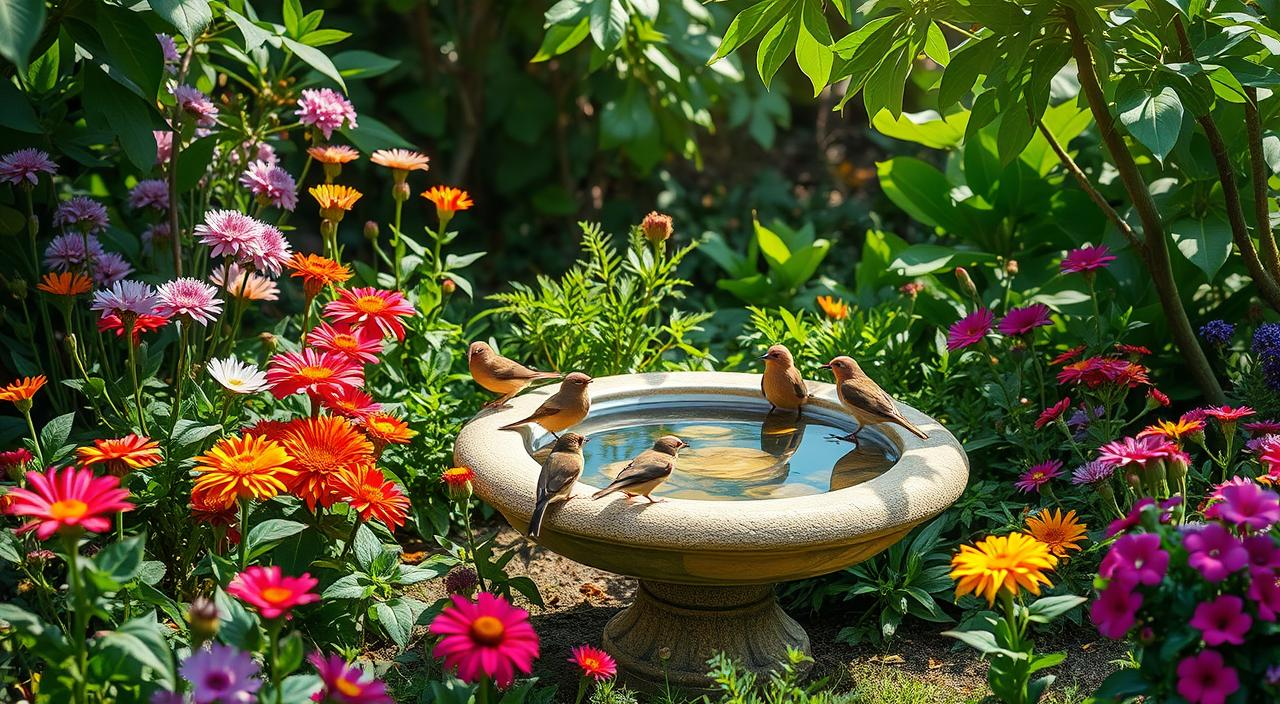
If birds ignore your birdbath, the issue is often simple:
the water is too deep, the sides are too steep, or the surface is too slippery.
This guide gives you a practical, bird-safe bird bath depth setup—and easy fixes if your basin is deeper than ideal.
Quick answer: best bird bath depth for most backyard birds
Most songbirds prefer shallow water with a gentle “walk-in” edge. Aim for:
- Edges (where birds step in first): 0.5–1 inch (≈ 1–2.5 cm)
- Center (optional, for medium birds): 1.5–2 inches (≈ 4–5 cm)
- Rule of thumb: keep most of the basin under ~2 inches and avoid steep, bucket-like sides
If your basin is deeper, you don’t need to replace it—create a shallow “beach” with flat stones (steps below).
[1][2]
Why bird bath depth matters
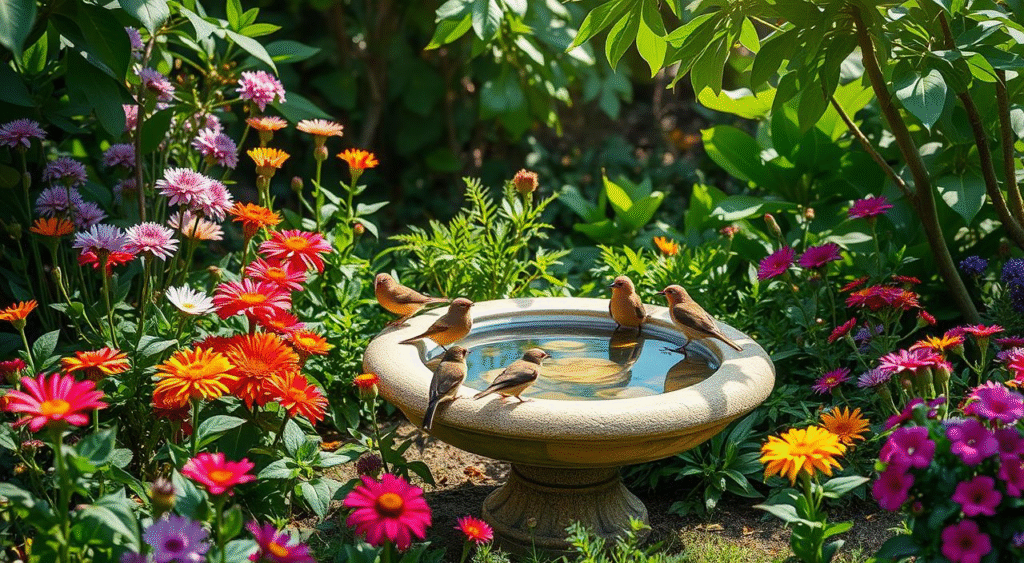
Most backyard birds don’t “swim” like ducks. They usually stand in shallow water and flick it through their feathers.
When water is too deep—or the sides are steep—small birds may avoid the bath because they can’t get stable footing or exit quickly.
The most bird-friendly basins have shallow edges, a gentle slope, and a non-slip surface.
[1]
Bird bath depth by bird type
Your goal is to include at least one shallow zone that small songbirds trust, even if you also allow a slightly deeper center for medium birds.
| Bird size group | Common backyard examples | Comfortable depth range | What to prioritize |
|---|---|---|---|
| Small songbirds | Chickadees, finches, sparrows, wrens | 0.5–2 inches (best near the rim) | Shallow “beach” edge + rough footing |
| Medium birds | Robins, jays, grackles | 1.5–2 inches (gentle slope) | Wider basin + stable water level |
| Ground-feeding medium birds | Mourning doves | 1–2 inches (wide, easy entry) | Wide rim / walk-in edge |
How to measure bird bath depth correctly
- Fill your birdbath to the level you normally keep it.
- Measure depth at the rim/edge (where birds step in first).
- Measure depth at the center.
- If the edge is deeper than ~1 inch, plan to add stones to create a shallow slope.
How to create perfect variable depth in any birdbath
Option A: Add flat stones to make a shallow “beach” (best upgrade)
This is the easiest fix for a basin that’s too deep or too slippery.
- Choose flat, stable stones (avoid rounded rocks that roll).
- Rinse well to remove dirt and grit.
- Stack stones on one side to create a gradual slope:
~0.5–1 inch at the shallow edge and ~1.5–2 inches toward the middle. - Wiggle-test everything. If stones shift, birds may stop using the bath.
Option B: Buy a sloped basin (best all-in-one design)
If you’re shopping for a new birdbath, look for a basin with a gradual slope (not steep walls).
It naturally creates multiple depth zones. [1]
Option C: Add a shallow tray insert
If your center is deep, place a wide, shallow tray insert inside the basin to create a broad shallow “platform,” then fill around it.
This can increase comfort without reducing total water capacity.
Best placement: where to put a bird bath
Placement matters almost as much as bird bath depth. Birds want visibility and a quick escape route.
- Near cover, but not inside it: close enough for an escape perch, far enough to reduce ambush risk.
- Partial shade is ideal: water stays cooler and may grow algae more slowly.
- Avoid window-collision hotspots: don’t place the bath where startled birds frequently fly straight into glass.
- Stable base: level the bath so water is calm and footing feels secure.
Placement guidance varies by yard, but the consistent theme is: safe sightlines + nearby perches + fewer hazards.
[3]
Keeping water clean (and keeping birds coming back)
Even a perfectly sized birdbath won’t get used if the water looks slimy or smells off. Fresh water is the #1 “return visit” trigger.
Simple maintenance schedule
- Refresh: every 1–2 days in warm weather (more often in heat waves).
- Scrub: about once a week (or sooner if algae appears).
- Daily quick check: remove leaves, seed hulls, and droppings.
Bird-safe cleaning steps
- Dump old water away from the birdbath area.
- Scrub the basin with a dedicated brush.
- Rinse thoroughly so no residue remains.
- Refill with clean water to your target depth (shallow edge + gentle slope).
Also, many birdbath guides recommend keeping water depth shallow (often around or under ~2 inches) for typical backyard birds.
[2]
Seasonal bird bath depth tips
Summer: manage heat + evaporation
- Keep a shallow edge even if you add slightly more water for evaporation.
- Consider a dripper or fountain attachment—moving water can attract birds and reduce stagnation.
Winter: prevent freezing safely
- If your area freezes, consider a birdbath heater designed for outdoor use and follow the manufacturer’s safety instructions.
- Keep the bath shallow so birds can stand comfortably at the edges.
Migration: make landing easy
- Add extra “landing” stones so tired migrants can step in gradually.
- Keep water fresh—migrants are more likely to stop when water looks clean and safe.
Troubleshooting: why birds avoid your birdbath
- Too deep or too steep: build a stone “beach” and keep edges under ~1 inch.
- Too slippery: add flat stones for grip.
- Bad location: move to a safer spot with partial shade and nearby perches.
- Dirty water: refresh more often—especially in hot weather.
FAQ: Bird bath depth
What is the best bird bath depth for small birds?
Most small songbirds prefer very shallow water—about 0.5–2 inches—especially at the edges where they first step in.
If your bath is deeper, create a shallow zone with flat stones so birds can walk in gradually.
How deep should the center of a birdbath be?
Can a birdbath be “too shallow”?
Yes. If water stays under about 0.5 inch, some medium birds may not bathe comfortably and water may evaporate quickly.
The usual fix is a slightly deeper center—not deeper edges.
Sources
- The Spruce — bird bath buying guide (includes practical depth guidance).
Read source - Better Homes & Gardens — bird bath cleaning guidance (includes refill frequency + shallow fill guidance).
Read source - Gardening Know How — bird bath placement considerations (common placement mistakes and safer setup ideas).
Read source
Editorial note: Avoid disturbing active nests and keep birdbath areas clean to reduce disease risk.