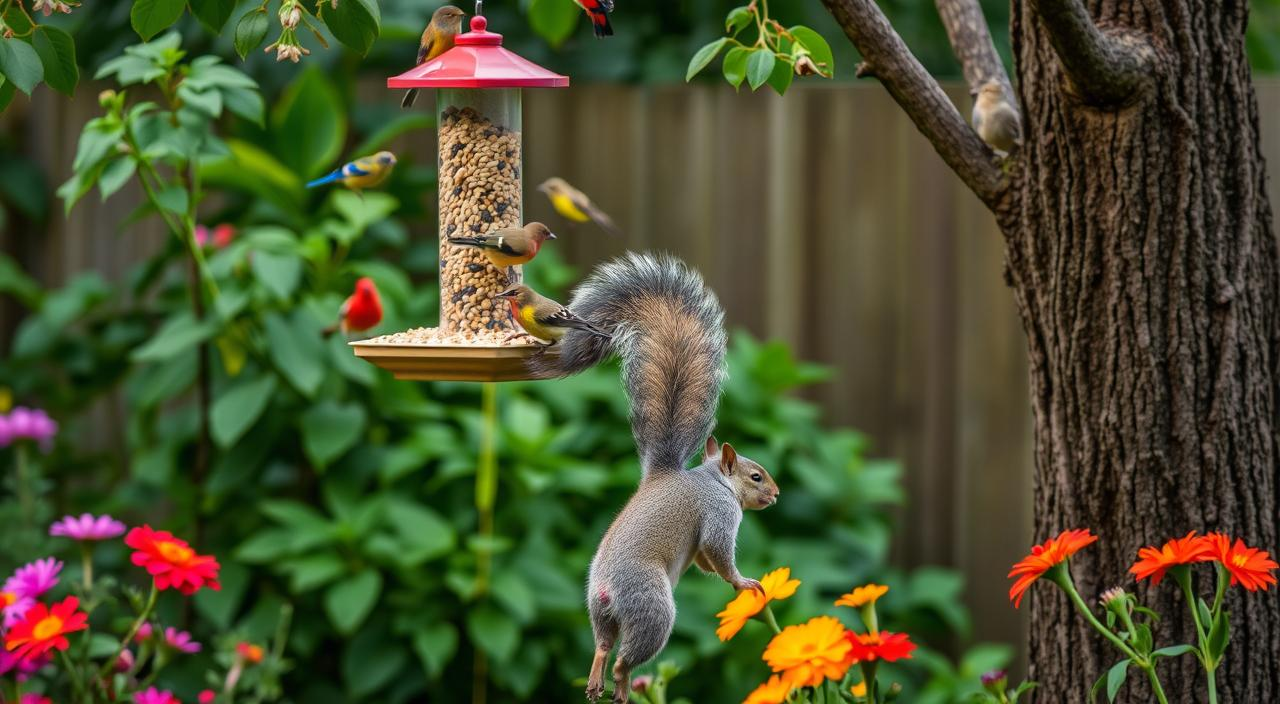
The first time I watched a grey squirrel defeat a “squirrel-proof” feeder, it took about forty seconds. It landed on top from a nearby branch — a branch I’d glanced at and mentally dismissed as too far away — sat there for a moment like it was reading the instructions, then started working the weight-activated ports from above. The ports, naturally, are on the sides. The top is just a flat surface with nothing clever about it at all.
That’s the thing about squirrels. They’re not outsmarting you. They’re not planning. They’re just testing everything within reach until something gives — and they have all day to do it. The problem isn’t that they’re clever. It’s that most feeder setups leave at least one thing that gives.
What actually works is closing all three gaps at once: access, reward, and spillage. Not two of them. All three. This guide walks through how to do that — in the right order, with the specific details that vague advice consistently leaves out.
⚡ Do this first — in this order
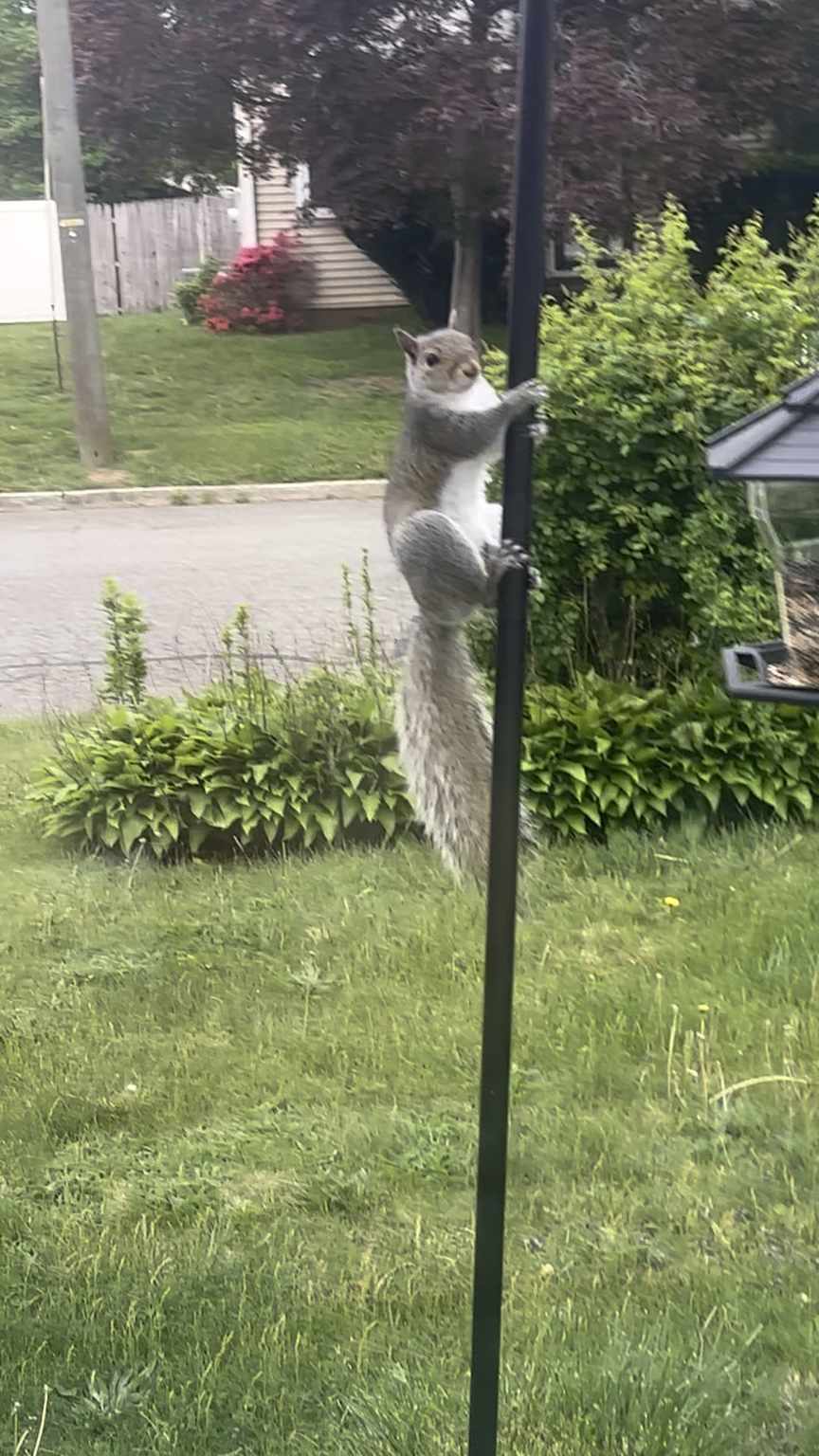
>Move the feeder to a smooth metal pole in open space — away from every fence, tree, deck rail, and shed corner within range.
>Install a quality pole baffle — dome or cylinder, at least 16 inches wide, mounted securely at 4–5 feet above the ground.
>Check your actual distances: at least 8–10 feet of horizontal clearance from anything a squirrel can jump from, and nothing overhead within 9 feet. [1]
>Clean up what falls. Spilled seed under the pole is a free second feeder that requires zero effort to use.
Why Squirrels Keep Coming Back — The Actual Reason
Here’s something most guides skip over: a squirrel doesn’t have a vague sense that your garden might have food. It has a memorised route to a specific location that has reliably produced food. That’s a meaningfully different thing — and it explains why the problem tends to get worse over time rather than stabilising. One squirrel finds the route. It uses it daily. Other squirrels in the area observe the behaviour — food-finding is partially socially transmitted in squirrels — and start making the same trip.
The route itself is learned and reinforced. Every successful visit is a small operant reward that makes the route stronger. When you introduce a deterrent, the squirrel doesn’t abandon the route — it tests the deterrent. A few attempts, some mild unpleasantness, the discovery that the food is still there at the end of it, and the deterrent is incorporated as a minor inconvenience. This is why every “one weird trick” works for about four days and then stops. The squirrel didn’t outsmart the trick. It just waited to see whether the food was still coming. It was.
There are three specific reasons the feeder is worth a squirrel’s time — and all three need to be removed simultaneously:
>🐿️ Access: it can physically reach the feeder — by climbing, jumping, or dropping from above. If it can, it will.
>🌰 Reward: when it arrives, there’s food. High-calorie, predictable, regularly restocked.
>🌾 Spillage: even when direct access fails, the ground beneath is covered in seed — a free fallback requiring zero effort.
Remove all three and the feeder stops being worth the trip. Leave any one in place and you’re still running a squirrel feeder — just with extra steps between the squirrel and the food.
The Setup That Works — Step by Step
If you only read one section, make it this one. These four steps address the most common failure points in the order that gives you the fastest results. Each one compounds the effectiveness of the next.
Step 1 — Get the Feeder Off Every Surface a Squirrel Already Uses
Trees, fence posts, deck railings, wooden shed corners, brick walls — this is squirrel infrastructure. They’ve been navigating these surfaces for years. Mounting a bird feeder on any of them is the functional equivalent of setting a bowl of seeds in the middle of a squirrel commute route and hoping they’ll politely ignore it.
The fix is a freestanding smooth metal pole in the most open area of your yard. Smooth metal provides almost no grip for squirrel claws. Open space means no nearby surfaces to launch from. Those two decisions together eliminate the majority of access routes before you’ve bought a single piece of hardware.
Step 2 — Install a Pole Baffle and Get Two Details Right
A pole baffle is a dome or cylinder that wraps around the pole below the feeder. The squirrel climbs, hits the baffle, and physically cannot get past — there’s nothing to grip above the curved surface. This is a mechanical wall, not a deterrent. That distinction matters enormously: a mechanical wall doesn’t lose effectiveness as the squirrel habituates. There’s nothing to habituate to. The wall is just there. [1] [2]
Two details most guides mention but don’t explain clearly:
>Width beats height.
-
- Squirrels don’t defeat baffles by climbing over the top — they defeat them by reaching across the rim from the side. A minimum
>16-inch diameter
-
- (18–20 inches is better) puts the rim genuinely out of sideways reach. A narrow baffle is solving the wrong problem.
>Rigid mounting is non-negotiable. Squirrels push against the underside of a baffle when they hit it. A baffle that shifts sideways under pressure creates a momentary angle they can exploit. Test it: if you can move the baffle by pushing on it with one hand, it’s not secure enough. Tighten it until it doesn’t move at all.
Step 3 — Measure Your Distances. Actually Measure Them.
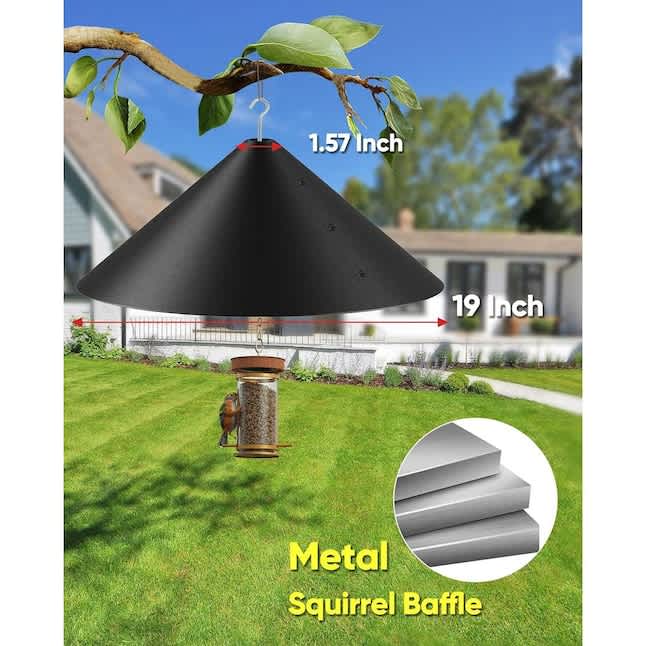
Eastern grey squirrels clear approximately 5 feet vertically and 8–10 feet horizontally from a standing launch. [1] Those numbers silently break most feeder setups. Six feet from the fence sounds safe. It isn’t — it’s inside jump range. “Roughly ten feet” from the tree isn’t good enough either, because the relevant distance is to the branch tip, not the trunk.
A condensed rule worth remembering:
All three simultaneously. And look up — overhead branches and roof overhangs are the most frequently missed launch points in any yard. A squirrel will climb to guttering level and drop straight down onto a feeder below without a moment’s hesitation if the geometry works.
Step 4 — Control What Ends Up on the Ground
A squirrel that can’t get into the feeder will often simply park beneath it and eat everything the birds kick out. If that works — and in many setups, it works quite comfortably — there’s no reason to leave. Remove the ground reward and you remove the reason to persist after the climbing route is blocked.
Placement: Where Most Setups Quietly Fail
This is where good intentions consistently come undone. The setup looks right — smooth pole, baffle installed, feeder appears to be in open space. The squirrel is still getting in every morning, and you cannot work out why.
I’ve stood at the feeder poles of frustrated birders many times. The answer is almost always visible within sixty seconds of standing at the pole and looking outward in all directions. It’s always a surface nobody had thought to measure from.
Stop Thinking in Distances. Start Thinking in Routes.
The squirrel follows a chain of surfaces in sequence from the ground to the feeder. The right question isn’t “how far is this from the tree?” — it’s “what is the squirrel’s actual route, and which one link haven’t I broken yet?”
Approach chains people miss most often:
>🌿 The low-branch bypass: the feeder is ten feet from the trunk — but a branch extends out and its tip is five feet away. The squirrel uses the branch tip, not the trunk. Trim it or move the feeder.
>🏠 The aerial drop: squirrels climb to roof edges and guttering and drop down. If the feeder is within five or six feet horizontally of a roofline, you have an active drop route operating above your baffle.
>The furniture launch: a garden chair, a terracotta pot, a retaining wall — any elevated surface within 8–10 feet becomes a launch point. Clear the zone or measure from it.
>❄️ The snow-loaded branch: a branch that cleared 12 feet in October can hang to within 7 feet in February after heavy snow loads it downward. A setup that worked all autumn starts failing in winter — and the cause isn’t obvious until you go outside and look up. Recheck overhead clearances after every significant snowfall.
A Layout That Works in Most Yards
>Find the most open area available — maximum clearance in all directions, nothing overhead within 9 feet.
>Set a smooth metal pole there with ground anchors at the base. A pole that rocks when pulled makes the entire assembly shift under squirrel pressure — including the baffle.
>Mount a baffle — minimum 16 inches in diameter — rigidly at 4–5 feet above ground. Push it. It should not move.
>Hang feeders at comfortable refilling height above the baffle — typically 5–6 feet from the ground.
>Place a catch tray beneath the feeder port. Empty it into the bin — not onto the ground — twice a week.
Hardware Worth Buying — And What to Skip
Once placement is right, hardware fills the remaining gaps. Here’s what’s worth the money and what isn’t — with the honest version of why.
Pole Baffles — Buy This Before Anything Else
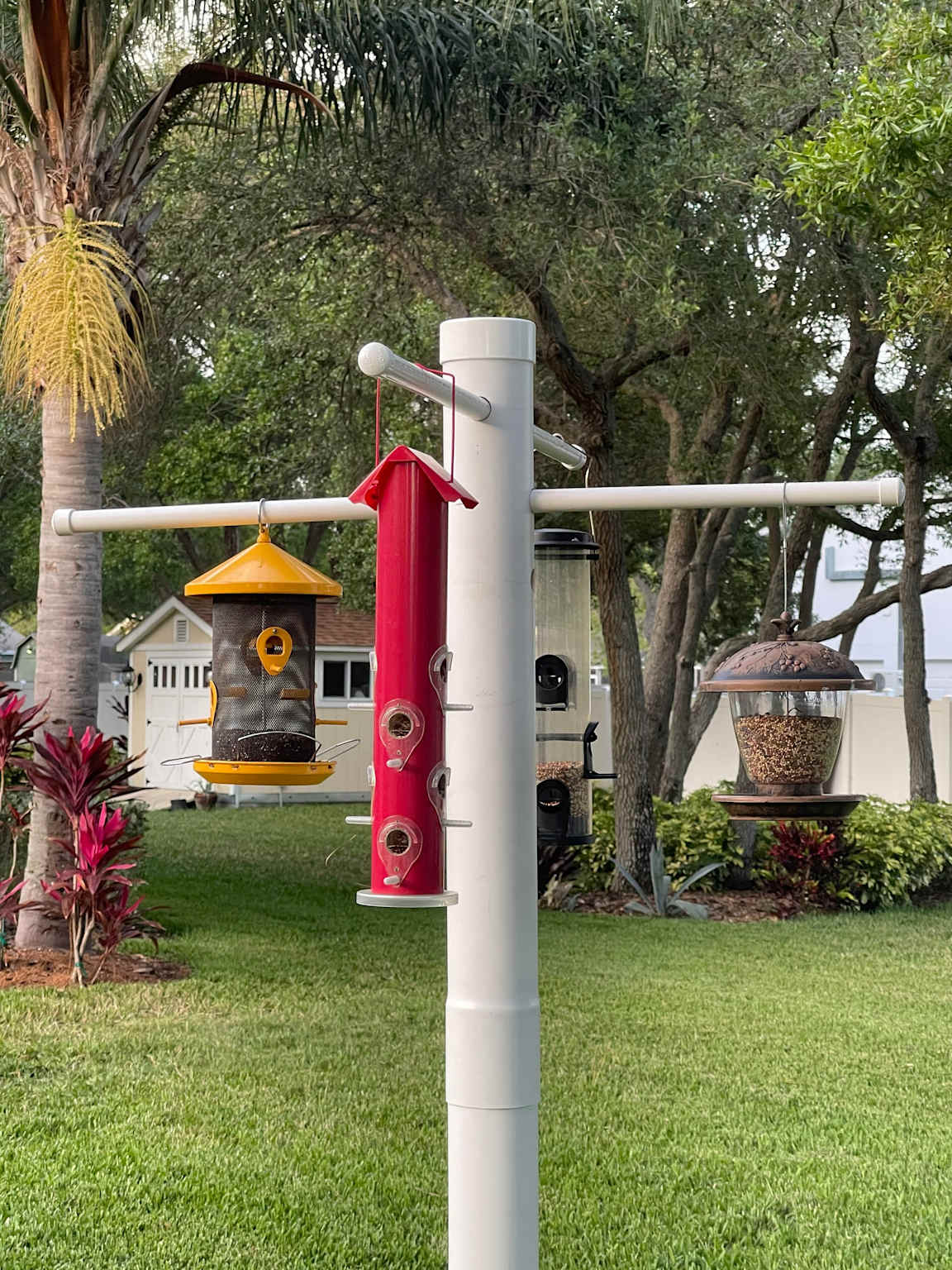
A quality pole baffle on a smooth metal pole, correctly positioned and rigidly mounted, is the single most effective piece of hardware available for this problem. Audubon puts it directly: “We lack the hubris to describe any feeding setup as squirrel-proof, but you can get pretty darn close by sticking a pole with a baffle into the ground.” [1]
It works because it’s mechanical — squirrels don’t habituate to a physical wall the way they habituate to anything that depends on their behaviour or discomfort. [2]
What to look for: smooth material, no grip texture, minimum 16-inch diameter (18–20 is better), solid tightenable mounting hardware. Torpedo-style baffles that hang below a feeder on a wire also work well — they swing freely under weight, making grip impossible once momentum is applied.
Feeder Designs — Useful as a Second Layer, Not a First Line
| Method | Best for | Reliability | How it gets defeated | What makes it work |
|---|---|---|---|---|
| Smooth pole + wide baffle | Almost any yard | Very high | Feeder within jump range; baffle too narrow; baffle shifts laterally | 8–10 ft clearance all directions; 16 in+ baffle; rigid mount |
| Weight-activated feeder | Extra protection layer | High (with baffle) | Squirrel drops onto the top from above, bypassing side ports | Combine with baffle; confirm no aerial drop route first |
| Caged feeder | Small birds only | High for target species | Excludes cardinals, woodpeckers, jays | Use as dedicated small-bird station alongside open feeder |
| Standard tube or hopper alone | Near-perfect placement only | Low–medium | No mechanical barrier of any kind | Never as a standalone — only as part of the full system |
The Soda-Bottle Wire Method — For Awkward Yards
If a freestanding pole in adequate open space isn’t feasible, this low-cost technique is worth knowing: string a smooth wire between two poles (not trees), thread large plastic bottles or PVC pipe sections onto the wire on both sides, hang the feeder in the centre. When a squirrel walks the wire, the bottles spin freely under its weight and it rolls off before reaching the feeder. Requirements: wire at least 5 feet off the ground, poles as anchor points, feeder far enough from each end to prevent reaching past the bottles.
On Pole Surface: The Detail That Silently Undoes Everything
Smooth means smooth — not powder-coated with visible texture, not wood with paint, not plastic with moulded seams. Squirrels climb using minute surface irregularities. A single rough section below the baffle is enough to get the squirrel to baffle height, turning the baffle from the last obstacle into the only obstacle. Check the entire pole from ground level to the baffle mount.
Seed Choices That Turn Down a Squirrel’s Motivation
Seed selection alone won’t solve a squirrel problem. But it does one specific useful thing: it adjusts the reward level. A feeder packed with premium black oil sunflower seed is worth considerably more effort to defeat than one stocked with something less compelling. Think of it as dialling down motivation — not as a primary deterrent.
Safflower — The Easiest First Experiment
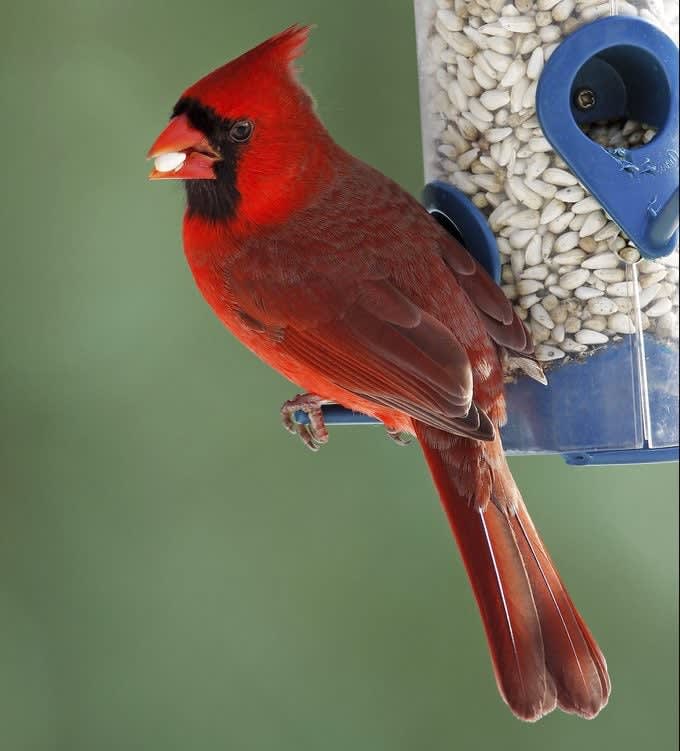
Safflower is consistently the first recommendation for reducing squirrel interest. Many squirrels find it far less compelling than sunflower seed, while cardinals actively prefer it. Doves, chickadees, and House Finches eat it readily. Many House Sparrows and European Starlings dislike it too — which makes a safflower-stocked feeder a noticeably more peaceful place in general. [1]
The honest caveat: results vary by yard. In some gardens it works all season. In others, squirrels adapt within a week. Try it — it costs nothing extra. If it makes a difference in your yard specifically, great. If not, you’ve lost nothing.
Cayenne Pepper — More Effective Than People Expect
Birds completely lack the receptor that detects capsaicin — so they’re indifferent to it at any concentration. Squirrels are not. Mixing cayenne powder generously into seed, or using a capsaicin-treated product, is one of the more consistently reported successes among birders who’ve tried multiple approaches. [3] [4]
Practical notes: wear gloves when mixing. Don’t use loose powder in windy conditions — capsaicin dust near your face or a child’s face is a genuine hazard. For windy yards, a liquid spray product applied directly to seed in the feeder works better than loose powder. This supplements physical barriers; it doesn’t replace them.
No-Mess Blends — Often Overlooked, Genuinely Useful
Budget seed mixes contain large proportions of red milo, millet, and filler seeds that most backyard birds actively discard — physically pushing them out of the feeder port and onto the ground. That’s not accidental spillage. It’s birds rejecting food they don’t want, and every rejected seed feeds the ground-level problem. Switching to a no-mess or shell-free blend reduces ground accumulation more directly than any cleanup schedule. Less falls in the first place.
Spillage and Hygiene — The Part People Skip
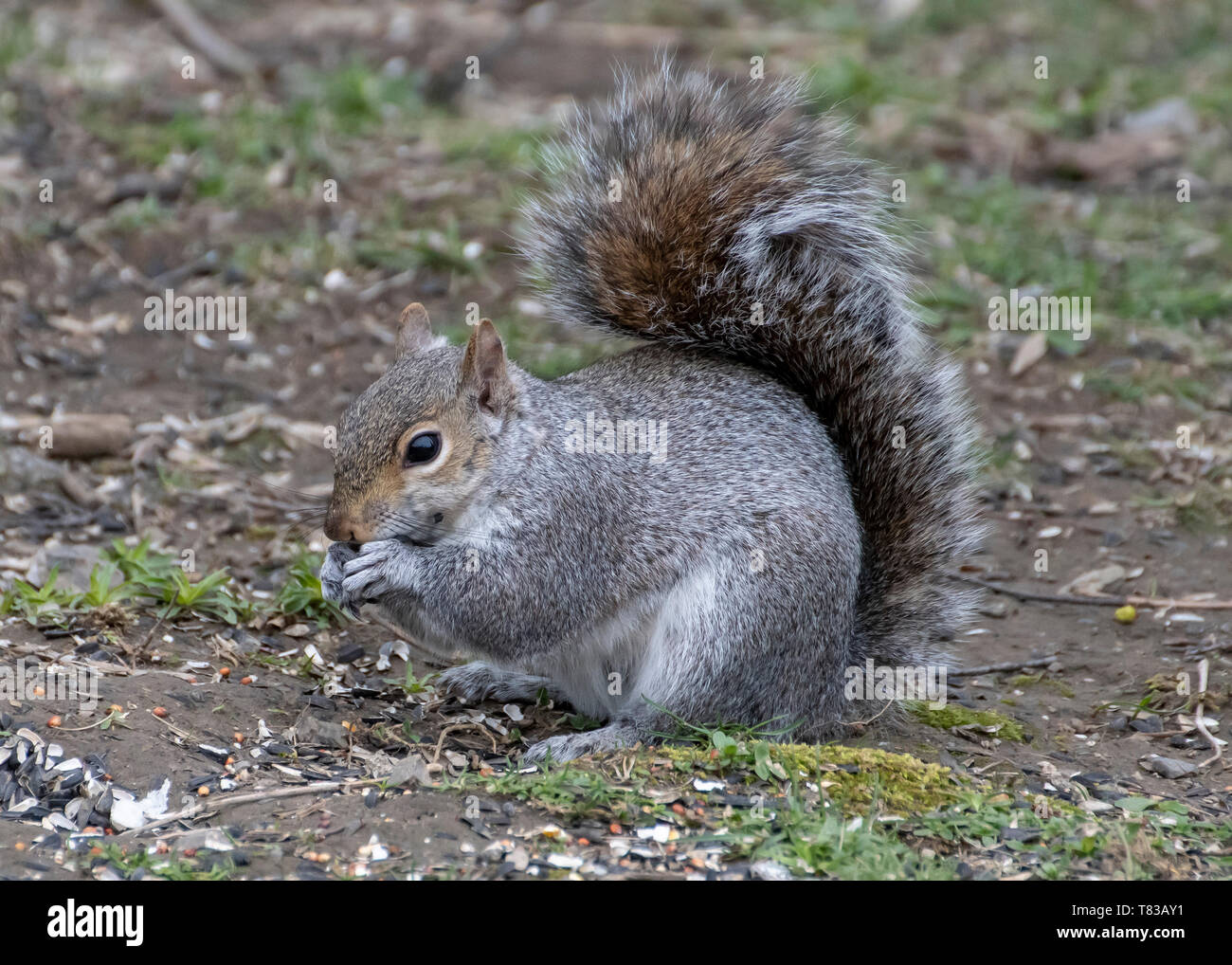
Picture this: you’ve done everything right. Smooth metal pole. Baffle rigidly mounted. Distances checked with an actual tape measure. You walk outside on day four and there’s a squirrel sitting contentedly in a pile of seed shells directly beneath the feeder, eating at a leisurely pace, completely untroubled.
The baffle is working perfectly. What’s failed is the ground. You’ve created a second feeding station that requires no climbing, no jumping, and zero effort — and you’re stocking it automatically every time you fill the feeder above.
Three Things That Actually Reduce Ground Accumulation
>Add a catch tray and empty it into the bin. The tray intercepts falling seed before it hits the ground. The crucial detail is bin — not back onto the ground, not into a pile next to the pole. A tray you top up instead of clear is just a slightly elevated ground feeder with extra steps. Clear it twice a week minimum.
>Fill less, more often. A feeder loaded to the brim encourages birds to dig through it and kick everything out. Two-thirds full, twice a week, produces substantially less waste than one full load per week. The birds get the same amount of food. The squirrel gets considerably less.
>Use seed birds actually eat. Most of what accumulates under a budget seed mix is food birds actively rejected, not food that fell accidentally. No-mess blends eliminate this at source. The slightly higher cost is usually offset within the first week by less waste and far less cleanup.
A Hygiene Schedule That People Actually Stick To
Feeder hygiene matters beyond squirrel management. A neglected feeder can become a disease transmission point — avian salmonellosis spreads readily at contaminated feeding stations. [5]
>🗑️ Twice a week: empty the catch tray into the bin; clear debris from the ground beneath the pole. About three minutes combined. This single step is the most impactful and most consistently skipped.
>🧼 Weekly: empty the feeder completely, brush out clumped or discoloured seed, wash with warm water, and dry fully before refilling. Mould grows fast in a damp feeder. Birds standing at ports without feeding are usually telling you seed is blocked or mouldy — not that a hawk is nearby.
>🌧️ After heavy rain: check the same day. Wet seed clumps in hours. Clumped seed at the bottom of a tube feeder that keeps being refilled on top of it is one of the most common feeder problems people spend months failing to diagnose.
>🚨 If sick birds appear: take the feeder down that day. One part bleach, nine parts water, full dry, minimum a week before refilling. Running a feeder through a local disease event accelerates transmission significantly. [5]
Common Mistakes Keeping the Squirrels Winning
❌ Mistake 1: Treating feeder design as the solution and ignoring placement
This is the most expensive version of the problem. Someone buys a well-made weight-activated feeder, hangs it from a branch six feet from the fence, and wonders why it doesn’t work. A squirrel that drops onto the top from a nearby branch bypasses every internal mechanism — the perches are weight-sensitive, the top is just a lid. Placement first. Always. [1]
❌ Mistake 2: Installing a baffle on a textured pole
A baffle on a rough wooden post or textured metal pole is dramatically less effective than the same baffle on smooth metal. If the pole itself can be climbed to baffle height, the baffle becomes the only obstacle rather than the last of several. A squirrel arriving at the underside with full climbing momentum has options that a squirrel stopped halfway up a smooth pole simply doesn’t. The pole is part of the barrier system — not just the thing the baffle is attached to. [2]
❌ Mistake 3: The “distraction station” that backfires every time
The theory: a corn cob station at the far end of the yard keeps squirrels away from the bird feeder. The reality: providing a reliable dedicated food source increases total squirrel activity in the yard. More individuals, covering more of the yard more thoroughly — including the bird feeder. People who try this approach report the same pattern: squirrels use both. Don’t do it.
❌ Mistake 4: Greasing the pole
Petroleum jelly and cooking oil reappear as tips in gardening forums every few months. They don’t work reliably — motivated squirrels quickly learn to work through the mess. The real problem is what happens when the substance transfers to a bird’s feathers. Oiled feathers lose insulating and waterproofing properties. In cold weather, that is potentially fatal. University extension wildlife guides specifically advise against this. [2] It harms the birds you’re trying to help.
❌ Mistake 5: Fixing only part of the access chain
Moving the feeder away from the fence but leaving it under tree canopy. Installing a baffle but forgetting the hanging basket hook two feet above it. Moving the feeder away from the house but missing the shed corner eight feet away. After making changes, walk the entire perimeter and ask: “If I were the squirrel, what would I try?” Whatever you think of will occur to the squirrel within a few days. It has considerably more time available for this exercise than you do.
❌ Mistake 6: Abandoning a working setup during the persistence period
A squirrel that’s been feeding at a location for months doesn’t give up after three failed visits. It persists — testing alternatives, retrying the main route — typically for two to three weeks before redirecting elsewhere. This normal behaviour gets misread as “the system isn’t working” by people who check back after three days and see the squirrel still trying. Still trying is not the same as still succeeding. Give it three weeks before deciding there’s a problem.
Pro Tips From People Who’ve Actually Solved This
>👀 Watch the squirrel for ten minutes before moving anything. It follows the same route with remarkable consistency — same launch point, same landing, same sequence every time. Watch it two or three mornings and the access chain becomes completely visible. You’ll see exactly which one surface the route depends on. Remove that surface and the rest collapses with it. This single step saves more people more money and effort than any hardware purchase.
>📏 Wider baffles close the gap that defeats narrow ones. When a baffle fails despite correct pole and positioning, it’s almost always because the squirrel reached across the rim rather than climbed over the top. An 18–20 inch diameter closes this reliably. If your current baffle is being defeated and you can’t find a placement issue, measure the diameter before assuming the height is wrong.
>⏳ Three full weeks before judging the outcome. If attempts are genuinely decreasing week by week — fewer per day, shorter duration each time — the system is working and you need to wait. If they’re not decreasing after three full weeks, something still provides a workable route. Almost always placement. Almost never hardware.
>❄️ Recheck overhead clearances after the first heavy snowfall. Snow loads branches downward — sometimes two feet or more. A branch that cleared 12 feet in October can be inside jump range in February. Build a brief clearance check into your routine after first snow every year.
>🔩 Anchor the pole base. A pole that rocks when you pull the feeder during refilling is a pole whose baffle shifts under squirrel pressure. Two ground anchors take five minutes and make the whole assembly substantially more resistant. The baffle should be the immovable object here. Make it one.
>🔧 Think in systems, not parts. The most persistent failure pattern is people who have most of the setup right but are missing one element and keep adding hardware to compensate. More hardware on an incomplete system rarely closes the gap. Identify the missing piece, fix it, then reassess whether additional hardware is still needed. Usually it isn’t.
Troubleshooting by Symptom
✅ Quick Reference — Stick This Near the Feeder
-
- >☐ Feeder on a smooth metal pole — not a tree, fence, deck, or shed
>☐ Pole baffle: minimum 16 inches in diameter, rigidly mounted at 4–5 feet
>☐ 8–10 feet of horizontal clearance in every direction from any launch surface
>☐ Nothing overhead within 9 feet of the feeder
>☐ Catch tray in place, emptied into the bin twice a week
>☐ Ground beneath the pole cleared on the same schedule
>☐ Seed blend chosen to minimise waste and ground accumulation
>☐ Feeder washed, dried, and refilled weekly
Frequently Asked Questions
What’s the most effective way to keep squirrels off bird feeders?
Smooth metal pole in open space, wide pole baffle (minimum 16 inches diameter) rigidly mounted at 4–5 feet above ground, feeder at least 8–10 feet from any launch surface in every direction including overhead, plus spillage control beneath the pole. This works because it’s mechanical rather than deterrent-based — squirrels don’t habituate to a physical wall. [1]
Do “squirrel-proof” feeders actually work?
Weight-activated and caged designs work well as part of a complete setup. The consistent failure is treating feeder design as the primary solution without fixing placement first. A squirrel that drops onto the top of a weight-activated feeder from a nearby branch bypasses every internal mechanism — the weight-sensitive ports are on the sides. Placement and baffle first. Feeder design as an additional layer. [1]
Should I set up a separate squirrel feeding station to distract them?
No. A dedicated squirrel food source increases total squirrel activity in the yard, adding pressure to the bird feeder rather than relieving it. People who try this almost universally report that squirrels use both. The better approach is making the entire yard zone less rewarding for squirrels — not adding to it.
Is trapping and relocating squirrels worth trying?
Rarely, and only as a genuine last resort. Regulations vary significantly — in many US states and Canadian provinces, relocating wildlife without a permit is illegal even on private property. The practical success rate is poor: a removed squirrel’s territory is typically occupied by a new individual within weeks. Contact your local wildlife authority before taking any action. [4]
Why do squirrels keep trying even after I’ve made changes?
Because persistence is the behaviour that got them fed in the first place. Expect two to three weeks of continued testing after any significant change. If attempts are decreasing week by week — fewer per day, shorter in duration — the system is working. Wait it out. If they’re not decreasing after three full weeks, something still provides a workable route. Almost always placement rather than hardware.
The Bottom Line
There’s no product clever enough to permanently outwit an animal with nothing else to do all day. But the problem is genuinely solvable — because squirrels aren’t clever, they’re persistent, and persistence is stoppable. You stop it not by outsmarting the squirrel but by removing every physical path it has available.
Smooth pole. Wide baffle. Correct distances in every direction. Clean ground. Those four things applied consistently, with clearances rechecked when seasons change, resolve the problem in most yards within three weeks. The goal was never a garden with no squirrels. It was a feeder that squirrels have tried, failed at enough times, and quietly moved on from.
That outcome is genuinely achievable. And once it holds, it tends to keep holding.
Sources
>National Audubon Society — How to stop squirrels from raiding your bird feeders>University of Nebraska–Lincoln (PDF) — Squirrel-proof bird feeders: baffles, placement, and common mistakes
>Clemson Cooperative Extension — Squirrels: deterrents and practical control considerations
>Wisconsin DNR — Nuisance and urban wildlife: permits, regulations, and management options
>USGS (PDF) — Avian salmonellosis: bird feeder hygiene and disease risk
Note: Wildlife trapping and relocation rules vary by location. This guide covers humane prevention only — barriers, placement, and cleanup.