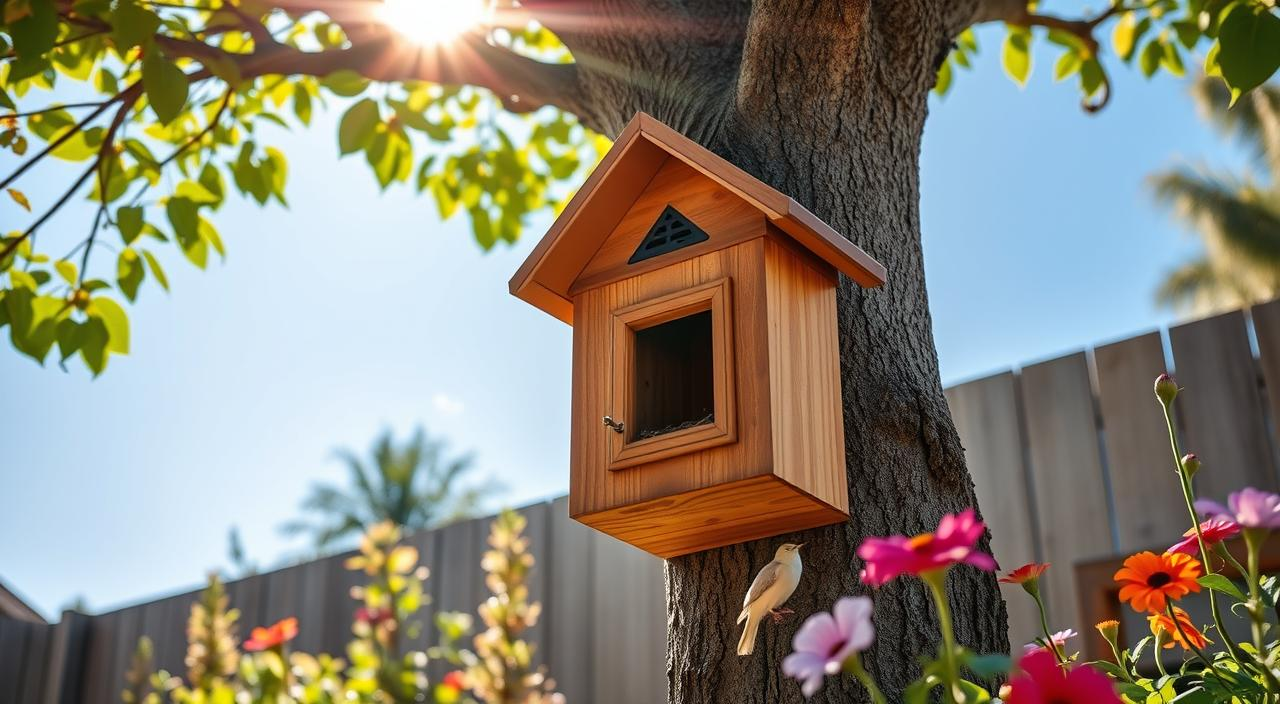
A nest box can be a real help to cavity-nesting birds—if it’s placed in the right habitat, mounted securely,
protected from common predators, and designed for the bird you’re trying to attract.
This guide covers nest box placement in a practical, species-aware way (with references you can trust).[1]
- Pick a target bird first (bluebirds vs chickadees vs wrens want different habitat).[1]
- Mount on a smooth pole when possible and add a predator guard (it’s the easiest setup to protect and maintain).[1][2]
- Don’t obsess over compass direction—prioritize habitat + safety; then face the entrance away from prevailing wind and harsh afternoon sun.[1]
- Use a “good birdhouse” design (drainage, ventilation, no perch, easy cleaning).[3]
Why nest box placement matters
Birds choose nest sites based on habitat, security, and microclimate.
A well-built box in the wrong spot can sit empty—or become a predator trap. NestWatch’s core idea is simple:
match the right box with the right place for the species you want to help.[1]
When to put up nest boxes
Put boxes up before the breeding season so birds can find and evaluate them early.
NestWatch’s general timing guidance is:
- Southern regions: around February
- Northern regions: mid to late March
Don’t panic if a box stays empty at first—habitat match, box specs, and predator pressure are usually the real drivers.
Adjust one variable at a time so you can learn what works in your yard.[1]
Step 1: Match the box to the habitat
Habitat is the #1 filter. Many “birdhouse” articles skip this and jump straight to height and direction.
NestWatch emphasizes that different birds use boxes in different habitat types—so your first decision is:
who are you trying to attract?[1]
A simple habitat checklist
- Open-country birds (e.g., many bluebirds, some swallows): place boxes in open lawn/meadow/field edges, not deep woods.[1]
- Woodland/edge birds (e.g., chickadees, nuthatches, titmice): place boxes near mature trees and woodland edges.[1]
- Near-water species (species-dependent): follow species guidance and keep boxes in the correct habitat type.[1]
- Avoid heavy pesticide zones when possible; insect-rich habitat supports healthier nesting.
Fix habitat match first, then fine-tune placement.
Step 2: Choose a safe mounting method
Pole mounting (often the easiest to protect)
NestWatch notes that mounting boxes on a free-standing metal pole or PVC pipe is often ideal because it’s easier
to add predator guards and some predators struggle to climb smooth poles compared with trees or fence posts.[1]
Tree mounting (works, but increases access routes)
Tree mounting can work—especially for woodland species—but branches can create easy predator “highways.”
If you mount on a tree, prioritize entrance clearance and consider species-appropriate predator protection.[2]
Building mounting (stable, but manage heat)
Building mounts can be convenient for monitoring and cleaning, but sun exposure can overheat boxes.
Avoid intense afternoon sun in hot climates and make sure the box has ventilation/drainage.[3]
Height, direction, and spacing (practical ranges)
Exact specs vary by species. Use the table below as a practical starting point, then confirm with species guidance.
These example ranges are aligned with NestWatch placement and “right birdhouse features” guidance.[1][3]
| Target bird (example) | Habitat cue | Typical box height | Direction / entrance notes | Spacing notes |
|---|---|---|---|---|
| Eastern Bluebird | Open field/lawn, scattered trees | Often ~3–6 ft | Face away from prevailing wind; avoid harsh afternoon sun in hot climates | Territorial spacing varies; follow local guidance and results |
| Chickadees / Titmice | Woodlots, yards with mature trees | Often ~5–15 ft | Entrance away from prevailing wind; partial shade can help temperature | More than one box may work if space + habitat support it |
| House Wren | Edges, gardens, parks | Often ~5–10 ft | Near shrubs/edges (while managing predator access) | Wrens can be very active around boxes—observe and adjust |
| Tree Swallow | Open areas, often near water | Often ~5–6 ft | Open approach; away from strong prevailing wind when possible | Can nest in loose colonies where habitat supports it |
avoid harsh, direct afternoon sun (especially in hotter climates). Then improve safety (pole + guard) and habitat match first.[1][3]
“Pairing” boxes (useful in some open habitats)
NestWatch describes pairing two boxes about 15–25 feet apart (or back-to-back) to reduce conflict between certain species in open areas—when you have the space and the right habitat.[1]
Predator protection that actually helps
Predator guards can meaningfully improve nesting success. NestWatch summarizes research showing boxes with predator guards can have
higher nesting success than unguarded boxes, and it highlights several time-tested guard types (cone baffles, stovepipe baffles, and entrance-hole extenders such as Noel guards).[2][3]
Practical predator-safe setup
- Smooth pole + baffle: makes climbing much harder for raccoons, snakes, and other climbers.[2]
- Keep “launch points” away: avoid nearby branches, fences, rails, and roofs that predators (or cats) can jump from.[3]
- Skip perches: perches aren’t needed and can help predators gain access.[3]
- Mount solidly: wobbling boxes can stress adults and fail in storms.
Box design essentials (often overlooked)
Placement can’t fix a poorly designed box. NestWatch’s “good birdhouse” checklist emphasizes basics that protect nestlings:
untreated wood, drainage, ventilation, thick walls, no perch, sturdy construction, easy cleaning access, and (when appropriate) a predator guard.[3]
Common placement mistakes (and fixes)
- Wrong habitat: putting an “open-country” box deep in woods. Fix: move it into appropriate habitat first.[1]
- Predator access routes: mounted on a fence post or near a branch “highway.” Fix: switch to a pole + guard, and clear launch points.[2]
- Heat exposure: baking in harsh afternoon sun. Fix: adjust placement/orientation and ensure ventilation.[3]
- Too late in the season: birds may already be settled elsewhere. Fix: install earlier next year and keep notes.[1]
- Design issues: no drainage, added perch, flimsy build. Fix: upgrade the box before changing everything else.[3]
Monitoring & cleaning safely
Nest boxes need maintenance, but avoid disturbing active nests. A simple, low-stress approach:
- Off-season check: repair leaks, tighten mounts, remove old nests if appropriate, and clear wasp nests.
- Monitor responsibly: keep checks brief and consistent; stop if adults show distress.
- Record what happens: occupancy, timing, predator issues, and weather exposure—then improve one variable next season.
If you’re unsure what’s legal or appropriate in your area during an active nest, consult local wildlife guidance.
FAQ
What is the best nest box placement height?
It depends on the species. Many small cavity nesters commonly use boxes in the ~5–15 ft range,
while some birds prefer lower or higher. Use species guidance when possible, then prioritize safe mounting and predator protection.[1]
Which direction should a nest box face?
Can I put multiple boxes close together?
Sometimes. NestWatch describes “pairing” boxes (often about 15–25 feet apart) to reduce competition between certain species in open habitats.
Territorial behavior varies, so observe results and adjust spacing if harassment occurs.[1]
Should I place nest boxes near bird feeders?
Keep nesting areas relatively calm. Feeders increase traffic (and sometimes predators).
If you notice stress, mobbing, or predator activity, increase distance and improve escape cover nearby (without creating predator launch routes).
References (sources)
- Cornell Lab of Ornithology (NestWatch) — Nest Box Placement.
View source - Cornell Lab of Ornithology (NestWatch) — Dealing with Predators (predator guards and effectiveness).
View source - Cornell Lab of Ornithology (NestWatch) — Features of a Good Birdhouse (design checklist, ventilation/drainage/no perch, guards).
View source