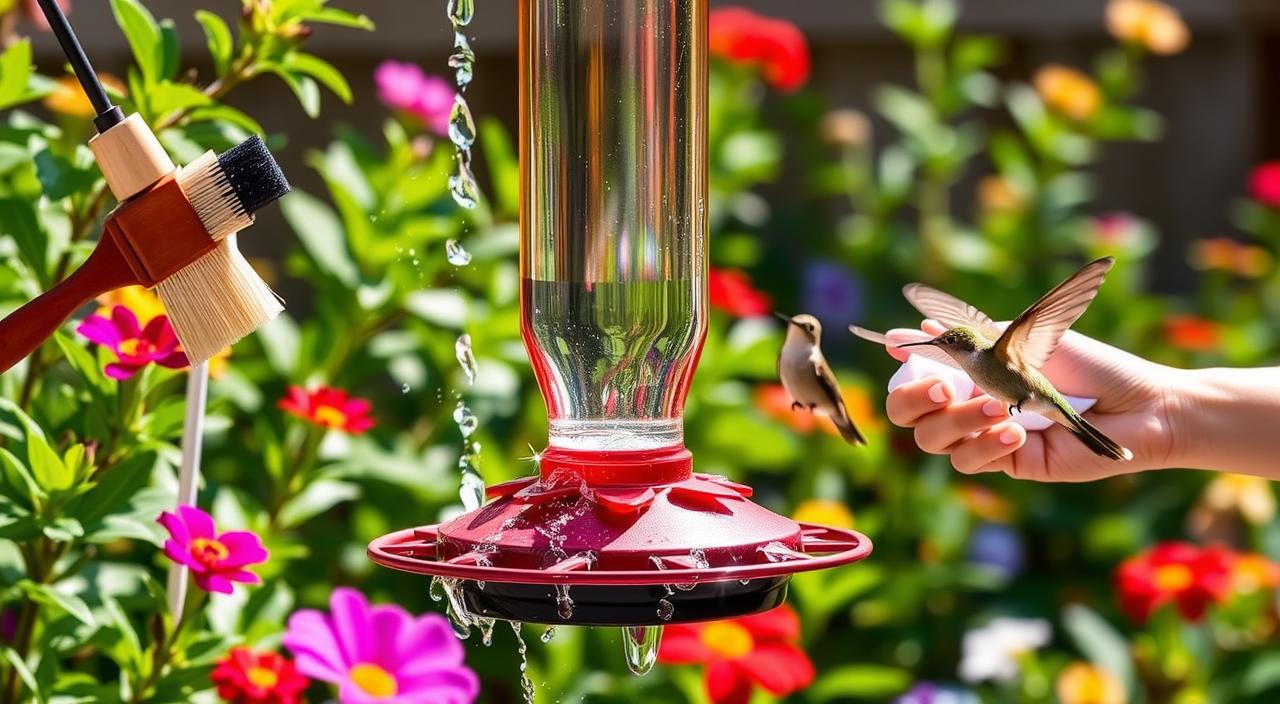
A clean feeder is one of the simplest ways to protect hummingbirds. Warm weather can spoil nectar quickly,
and residue inside ports and seams can encourage mold or microbial growth. This guide gives you a practical,
bird-safe cleaning schedule and a step-by-step method you can follow all season.
Quick answer (fast, safe baseline)
- Change nectar more often in heat. Warm conditions increase spoilage risk—refresh frequently.[1]
- Clean the feeder every refill. Scrub ports, rinse extremely well, and let parts air-dry fully.[2]
- Skip dyes and sweeteners. Use plain white sugar + water only; avoid red dye in nectar.[1]
- Vinegar for routine cleaning. Use diluted, unscented bleach only for periodic disinfecting (with thorough rinsing + complete air-dry).[2]
Wildlife note: This guide covers feeder hygiene and prevention, not veterinary care.
Why cleaning matters
Hummingbirds visit feeders frequently. When nectar sits too long—especially in warmth—microbes grow faster and
sugar residue builds up in feeding ports. That’s why the safest approach is a repeatable routine:
refresh nectar often, clean thoroughly, and keep ports clear.[2]
Stick to a simple nectar recipe (white sugar + water) and avoid additives like red dye. The red parts of many
feeders already attract hummingbirds without coloring the nectar.[1]
How often should you clean your hummingbird feeder?
A “set it and forget it” schedule doesn’t work because temperature drives spoilage.
Use this as a practical starting point, then tighten the schedule if you notice cloudiness, sediment,
stringy residue, or odor.[1]
| Conditions | Change nectar | Clean feeder |
|---|---|---|
| Hot weather / heat waves (fast spoilage risk) | Daily to every 2 days | Every refill (minimum) |
| Warm, typical summer days | Every 3–5 days | Every refill |
| Cooler periods (lower spoilage risk) | Every 4–5 days (watch closely) | Every refill |
Clean immediately if nectar looks cloudy, has floating debris, has black specks, feels slimy/stringy,
or smells “off.” Dump it and scrub the feeder before refilling.[2]
Essential supplies for hummingbird feeder cleaning
- Dedicated bottle brush (long enough to reach the reservoir)
- Small port brush or pipe cleaners (for feeding holes and grooves)
- Clean basin or bowl for soaking
- White vinegar (routine cleaning option)
- Unscented household bleach (optional, periodic disinfecting only)[2]
- Clean drying rack or towels for air-drying parts
Tip: Keep a small “feeder cleaning kit” so you’re not tempted to skip port scrubbing when life gets busy.
Hummingbird feeder cleaning: step-by-step
Step 1: Empty and rinse
- Pour out leftover nectar (don’t “top off” old nectar).[1]
- Rinse the reservoir, base, and ports with hot water.
Step 2: Disassemble completely
Take the feeder apart so you can reach seams, gaskets, and the underside of the base—common hiding places for buildup.
If your feeder has removable flowers/ports, remove them.
Step 3: Soak (routine cleaning)
For routine cleaning, soak parts in hot water + vinegar solution (details below), then scrub.
Step 4: Scrub the “problem zones”
- Feeding ports: scrub inside each port with a small brush/pipe cleaner.
- Seams and threads: scrub where the base screws on.
- Gaskets: wipe and inspect for cracks (replace if damaged).
Step 5: Rinse thoroughly and air-dry
- Rinse until you no longer smell vinegar/cleaner.
- Air-dry fully before refilling (moist crevices = faster growth).[2]
Step 6: Refill with fresh nectar
Use a simple nectar recipe: 1 part white sugar to 4 parts water. Always cool fully before filling,
and store extra nectar in the refrigerator.[1]
Vinegar vs diluted bleach: what to use (and when)
Option A (routine): White vinegar solution
For routine cleaning, a practical mix is 1 part white vinegar + 2 parts water.
Soak components ~20–30 minutes, scrub, then rinse very well and air-dry fully before refilling.
Option B (periodic disinfecting): Diluted, unscented bleach
Safety rules (important)
- Use unscented household bleach only.
- Never mix bleach with vinegar or any other acids.
- Rinse repeatedly and air-dry completely before refilling.[2]
For deeper disinfecting (for example, after visible mold), you can soak feeder parts in a
10% bleach solution (about 1 part bleach to 9 parts water) for around 10 minutes,
then rinse thoroughly and allow parts to air-dry completely before adding nectar.[2]
If you prefer to avoid bleach, use more frequent cleaning + shorter nectar-change intervals during warm spells.
Cleaning different types of hummingbird feeders
Glass bottle feeders
- Use a bottle brush for the reservoir.
- Use a port brush for the base and each feeding hole.
- Inspect rubber seals—replace if stiff or cracked.
Plastic feeders
- Use soft brushes to avoid scratches (scratches can trap residue).
- Avoid harsh scouring pads.
- Replace heavily scratched reservoirs or bases.
Saucer/dish feeders
- Pay extra attention to the underside and port channels.
- Soak briefly to loosen dried sugar film, then brush ports.
Troubleshooting: mold, ants, cloudy nectar, clogs
“I keep getting mold.”
- Move the feeder into shade (heat speeds spoilage).
- Shorten nectar change intervals during hot spells.[1]
- Brush ports every refill (not just the reservoir).
- If mold persists, do a periodic disinfecting soak (diluted bleach option), then rinse and air-dry fully.[2]
“Ants and insects keep showing up.”
- Use an ant moat above the feeder (if compatible with your hanger setup).
- Wipe drips off the outside daily.
- Don’t place feeders where branches touch the hanger (ant bridges).
“Nectar is cloudy or has floating bits.”
Dump immediately. Disassemble, soak, scrub ports, rinse thoroughly, air-dry completely, then refill with fresh nectar.
[2]
“Feeder leaks or clogs.”
- Check gasket alignment and cracks.
- Clear ports with a small brush (avoid enlarging holes with sharp objects).
- Don’t over-tighten parts (warping can cause leaks).
Best practices to keep feeders cleaner longer
- Rotate two feeders: hang one while the other dries fully after cleaning.
- Make smaller batches: less waste, always fresher nectar.
- Skip honey, brown sugar, and artificial sweeteners: stick with plain white sugar + water.[1]
- Avoid red dye: it’s unnecessary—use a red feeder instead.[1]
- Shade helps: cooler nectar generally spoils more slowly than nectar in full sun.
FAQ: Hummingbird feeder cleaning
How often should I clean my hummingbird feeder?
What’s the safest cleaner to use?
For routine cleaning, vinegar + hot water plus thorough rinsing is a common approach. For periodic disinfecting,
a diluted, unscented bleach soak can be used with strict rinsing and complete air-drying.[2]
Do I need to boil nectar?
Many guides recommend a simple 1:4 sugar-to-water mix. Boiling can help dissolve sugar; if you boil,
cool fully before filling and keep everything clean to reduce contamination risk.[1]
Should I add red food coloring to attract hummingbirds?
No—use a red feeder or red accents instead. The nectar itself does not need dye.[1]
Sources
- Cornell Lab of Ornithology (All About Birds) — hummingbird feeding guidance (nectar recipe, dye warnings, refresh frequency).
View source - Project FeederWatch (Cornell Lab) — feeder cleaning and disinfecting guidance (including diluted bleach and complete drying).
View source - Mississippi State University Extension — practical hummingbird feeder tips (nectar recipe and routine cleaning guidance).
View source